
SYLLABUS
GS-3: Important Geophysical phenomena such as earthquakes, Tsunami, Volcanic activity, cyclone etc., geographical features and their location-changes in critical geographical features (including water-bodies and ice-caps) and in flora and fauna and the effects of such changes.
Context: United Nations University Institute for Water, Environment and Health released a report titled as “Global Water Bankruptcy: Living Beyond Our Hydrological Means in the Post-Crisis Era”, highlighting irreversible water “bankruptcy” due to decades of overuse, pollution, and declining freshwater sources.
Key highlights of the Report
- This report declares that the world has already entered the era of Global Water Bankruptcy. The condition is not a distant threat but a present reality.
- Nearly 75% of the global population lives in water-insecure or critically water-insecure countries.
- Around 4 billion people face severe water scarcity for at least one month annually.
- Water bankruptcy is a permanent “post-crisis” state where a region’s long-term water use persistently exceeds its renewable supply, leading to irreversible damage to natural water systems.
- Decades of unsustainable extraction have depleted aquifers, glaciers, wetlands, soils, and river systems.
- Water systems are described as being in a “post-crisis state of failure.”
- Over 170 million hectares of irrigated cropland face high to very high water stress.
- Annual global economic losses exceed $300 billion due to land degradation, groundwater depletion, and climate change.
- Three billion people and over half of global food production are located in regions with declining water storage.
- Salinisation has degraded more than 100 million hectares of cropland.
- Researchers call for a new global water agenda, focusing on damage minimisation rather than restoring past norms.
- Major hotspots of Water Bankruptcy:
- Middle East and North Africa region: These regions face the convergence of low agricultural productivity, energy-intensive desalination, sand and dust storms within complex political economies.
- South Asia: Groundwater-dependent agriculture and urbanization have produced chronic declines in water tables and local subsidence.
- American Southwest Region: The Colorado River and its reservoirs have become symbols of over-promised water.
Key Causes of Water Bankruptcy
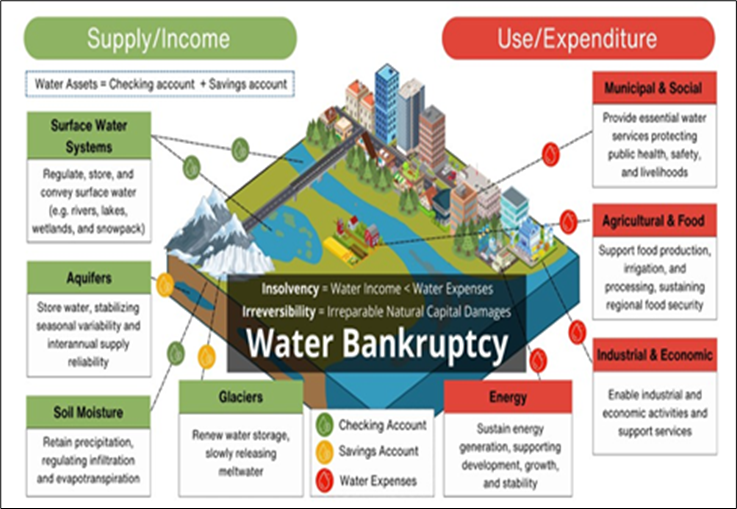
- Unsustainable Water Extraction: Excessive withdrawal of surface water and groundwater beyond natural recharge rates, leading to depletion of rivers, aquifers, wetlands, and long-term water reserves.
- Agricultural Overdependence on Water: Nearly 70% of global freshwater withdrawals are used for irrigation, often inefficiently, placing severe stress on water systems amid rising food demand.
- Climate Change Impacts: Melting glaciers, altered rainfall patterns, and extreme weather events intensify droughts and floods, disrupting natural water storage and availability.
- Population Growth and Urbanisation: Rapid uneven population growth, expanding cities, and economic growth have sharply raised water demand for domestic, industrial, and energy uses.
- Water Pollution and Degradation: Contamination from industrial waste, agricultural runoff, and salinisation reduces usable freshwater, effectively shrinking available supplies.
- Weak Governance and Mismanagement: Fragmented policies, poor regulation, and short-term crisis management have failed to address long-term water sustainability and ecosystem protection.
Significance of the Report
- Conceptual Shift in Water Discourse: Formally introduces “global water bankruptcy”, moving beyond reversible notions of water stress or crisis to highlight irreversible depletion of natural water capital.
- Policy and Governance Reset: Calls for a fundamental reset of the global water agenda, prioritising science-based adaptation, long-term sustainability, and damage minimisation over short-term crisis management.
- Global Risk and Interconnectedness: Establishes water scarcity as a systemic global risk, linked through trade, migration, climate feedbacks, food security, and geopolitics, affecting all regions, not just hotspots.
- Catalyst for Global Cooperation: Positions water as a unifying strategic issue capable of advancing climate action, biodiversity conservation, and international cooperation ahead of the 2026 UN Water Conference.