
SYLLABUS
GS-2: Bilateral, Regional and Global Groupings and Agreements involving India and/or affecting India’s interests.
Context: On January 1, 2026, Bulgaria adopted the euro as its national currency, becoming the 21st member of the eurozone, nearly 20 years after it joined the European Union (EU).
More on the News
- Bulgaria is phasing out the lev, its national currency since 1881, which has been pegged to the Deutschmark and later the euro since 1997.
- From January 1, 2026 both the lev and the euro may be used for payments, though the euro will become the only legal tender on February 1, and the prices will be displayed in both euros and lev until August 8, 2026.
Benefits of adopting Euro for Bulgaria
- Greater opportunities for citizens and businesses: It will boost competitiveness, as the euro, being the common currency, allows consumers in member nations to compare prices with other members.
- Financial stability: Eurozone members enjoy price stability, as ECB (European Central Bank) targets 2% inflation, and Bulgaria will also get a seat on the ECB’s Governing Council, which sets rates for the eurozone.
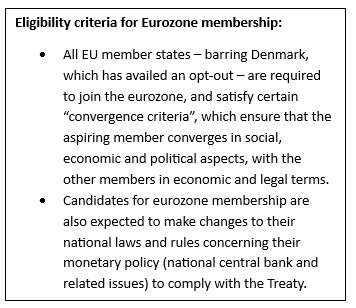
- Eurozone refers to the geographic and economic region comprising those members of the EU (established under Maastricht Treaty of 1992) that have fully adopted the euro as their official currency.
- Enhanced Mobility: Adoption of euro would boost Bulgaria’s tourism by allowing travellers to move freely across the eurozone without needing to exchange currency.
- Protection of Euro umbrella: Eurozone Members are shielded from external shocks due to large size of its economy as euro is the second largest reserve currency, after the US Dollar.
- Enhance Economic activities: Bulgaria will enjoy the benefits of a free trade area, which allows the free flow of labour, goods and services, and capital within the eurozone, eliminating currency exchange costs.
Concern regarding Adoption of Euro for Bulgaria:
- According to the latest Eurobarometer survey, 49% of Bulgarians oppose the adoption, fearing that prices will increase while wages stay unchanged.
- ATMs and cash transactions may face temporary issues during the transition.
- Business owners and shopkeepers have reported difficulty in adoption of new currency.
- Bulgaria’s cultural and political ties with Russia add further complexity, beacuse Russia sees the move as a threat to its sovereignty, given the two countries’ shared Orthodox Christian heritage and Black Sea connection.
What is Euro?
- The euro is the official currency of European Union countries, which comprise the Eurozone.
- It was first rolled out in 12 countries on January 1, 2002.
- EU Countries using Euro as official Currency: Austria, Belgium, Croatia, Cyprus, Estonia, Finland, France, Germany, Greece, Ireland, Italy, Latvia, Lithuania, Luxembourg, Malta, Netherlands, Portugal, Slovakia, Slovenia, Spain.
- Croatia is the latest to join, in 2023.
- Bulgaria’s accession will bring the number of Europeans using the euro to more than 350 million.
- Six of the EU’s 27 member countries Sweden, Poland, the Czech Republic, Hungary, Romania, and Denmark have not yet adopted the euro.
- Four microstates, Andorra, Monaco, the Vatican City and San Marino, although not a part of EU but also use the euro through agreements with the EU,
- While Kosovo and Montenegro use the euro as their sole currency without an agreement. However, none of these countries are not regarded as members of the eurozone.