

Pinaka Long Range Guided Rocket
Context: Recently, DRDO successfully conducted the maiden flight test of Pinaka Long Range Guided Rocket (LRGR 120) from Chandipur, Odisha.
More on the News
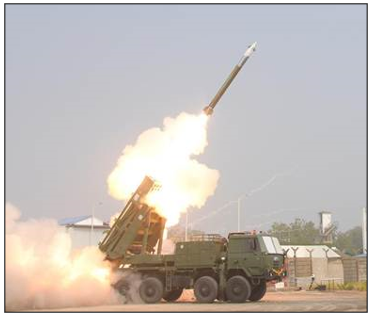
- The Pinaka Long Range Guided Rocket (LRGR-120) is an indigenous multi-barrel rocket system with a range of 120 km that uses an integrated navigation, guidance, and control kit for high-precision strike.
- This rocket is designed by Armament Research and Development Establishment in association with High Energy Materials Research Laboratory and supported by Defence Research and Development Laboratory and Research Centre Imarat.
- The LRGR was launched from the in-service Pinaka launcher, demonstrating its versatility and providing launch capability of Pinaka variants of different ranges from the same launcher.
Key Highlights of the Test
- Strike Range: The rocket was tested for its maximum range of 120 km, significantly extending the reach of previous Pinaka variants which targeted 40 km to 75+ km.
- Precision and Performance: The LRGR-120 followed its planned trajectory and hit the designated target with “textbook precision” after performing all intended in-flight maneuvers.
- Platform Versatility: The rocket was launched from an in-service Pinaka launcher, proving the system’s ability to fire multiple rocket variants with different ranges from a single platform.
- Strategic Approval: The test coincided with the Defence Acquisition Council (DAC) clearing procurement proposals worth ₹79,000 crore, which included the long-range guided rockets for the Indian Army.
INS Vagsheer
Context: Recently, President Droupadi Murmu, the Supreme Commander of the Indian Armed Forces, carried out a sea sortie aboard INS Vagsheer (S26), the sixth and final submarine of the Kalvari class.
Key Highlights of the Sortie
- President Murmu is only the second Indian President to undertake a submarine sortie, following Dr. APJ Abdul Kalam, who did so in 2006. She is also the first head of state to sail in a Kalvari-class (Scorpene-class) submarine.
About INS Vagsheer
- Class: It is the sixth and final submarine of the Project-75 Scorpene-class, entirely built by Mazagon Dock Shipbuilders Limited (MDL).
- Commissioning: The submarine was commissioned into the Indian Navy in January 2025.
- Capabilities: It is an indigenous combatant designed with advanced stealth features and high automation, serving as a pillar of the Aatmanirbhar Bharat initiative in defence.
Project 75
- The conventional diesel-electric submarines such as the Scorpene, under Project 75, come with improved stealth features.
- The six submarines under Project-75 are INS Kalvari, INS Khanderi, INS Karanj, INS Vela, INS Vagir and INS Vagsheer.
- Project-75 (India), also known as P-75(I), succeeds the P75 under which six diesel-electric attack submarines of the Kalvari class, based on the Scorpene class, were being built at MDL.
- Of the total 24 submarines to be built in India, six will be nuclear-powered.
National Technology Readiness Assessment Framework (NTRAF)
Context: Recently, the Principal Scientific Adviser (PSA) to the Government of India, unveiled the “National Technology Readiness Assessment Framework (NTRAF)” to Standardise Innovation Assessment in India.
More on the News
- The framework has been developed by the Office of the Principal Scientific Adviser in collaboration with the Confederation of Indian Industry.
- It establishes a unified national methodology to assess the maturity of technology projects from laboratory research to commercial deployment.
- The framework has been opened for public consultation until January 31, 2026 to incorporate stakeholder feedback before wider adoption.
- The framework assesses technologies across nine Technology Readiness Levels, ranging from early proof of concept to full operational deployment.
- It categorises development stages into proof of concept levels one to three, prototype development levels four to six, and operational deployment levels seven to nine.
Key features of the Framework include
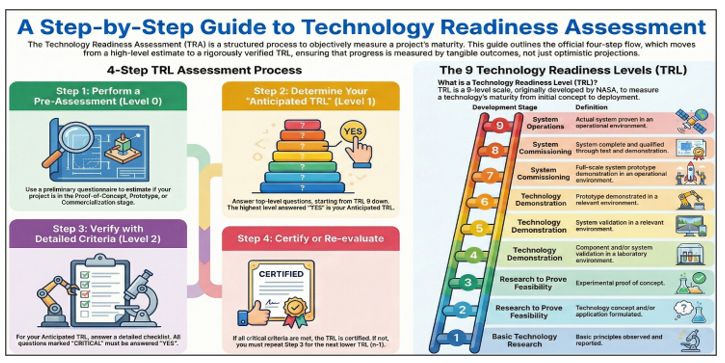
- Global Best Practices, Indian Context: Adapted from global standards (such as NASA) but tailored to the specific needs of the Indian R&D ecosystem.
- Objectivity over Subjectivity: Replaces qualitative estimation with a structured, evidence-based checklist for every stage of development.
- Sector-Specific Nuances: Includes specialised annexures for distinct sectors like Healthcare & Pharmaceuticals and Software, acknowledging that development pathways differ across domains.
- Self-Assessment Tool: Empowers Project Investigators to realistically gauge their standing and identify technical gaps before seeking funding.
Guidelines for Shipbuilding Assistance and Development Schemes
Context: The Ministry of Ports, Shipping and Waterways notified guidelines for the Shipbuilding Financial Assistance Scheme and the Shipbuilding Development Scheme.
More on the News
- Guidelines aim to boost domestic shipbuilding capacity and global competitiveness, the Centre has notified operational guidelines for two major shipbuilding schemes with a total outlay of ₹44,700 crore.
- The schemes seek to strengthen forward and backward linkages in the maritime manufacturing ecosystem.
- Both schemes will remain valid till March 31, 2036 with an in-principle extension envisaged up to 2047.
Shipbuilding Financial Assistance Scheme (SBFAS)
- The scheme has a total corpus of ₹24,736 crore to support domestic shipbuilding activities.
- It provides financial assistance ranging from 15 percent to 25 percent per vessel depending on vessel category.
- Aims to increase India’s commercial shipbuilding capacity to 4.5 million gross tonnage (GT) per annum by 2047.
Shipbuilding Development Scheme (SbDS)
- The scheme has a budgetary outlay of ₹19,989 crore and focuses on long-term capacity creation.
- It supports the development of greenfield shipbuilding clusters with full capital support for common infrastructure.
- The core component of the scheme is to develop new facilities with 100% capital support for common infrastructure via a 50:50 Centre–State SPV model.
- Upgrading existing shipyards with 25% capital assistance for critical infrastructure.
- Disbursements will be milestone-based and monitored by independent evaluation agencies.