
SYLLABUS
GS-2: Important International institutions, agencies and fora- their structure, mandate.
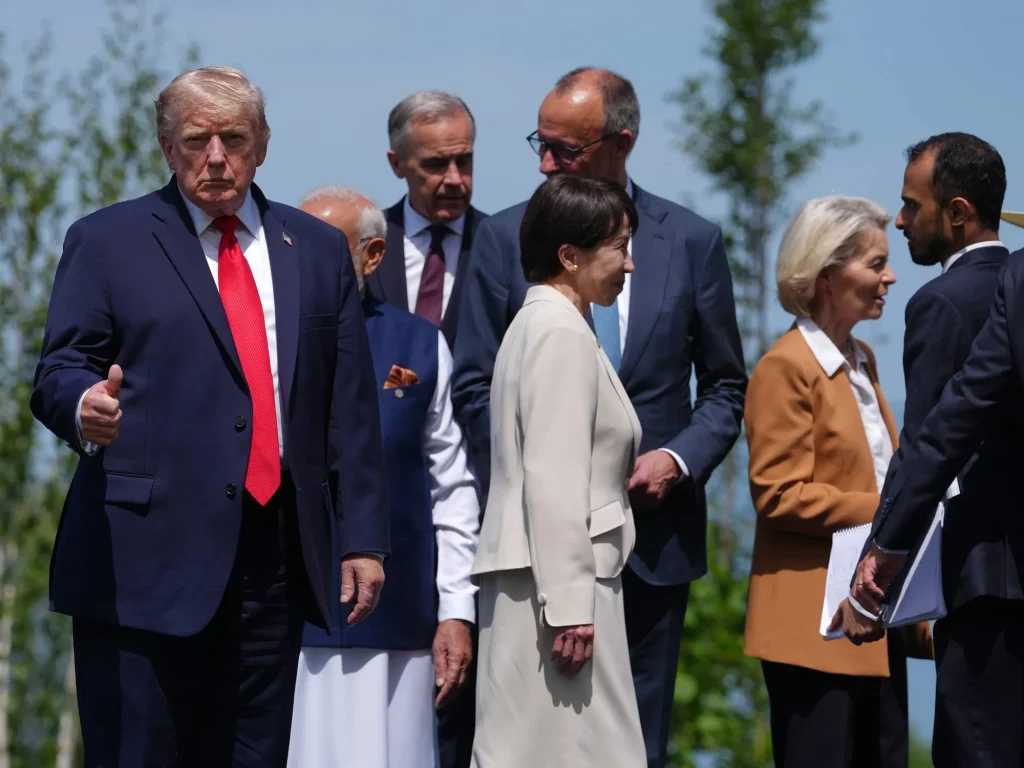
Context: Recently,Prime Minister Narendra Modi attended the 52nd G7 Summit held at Évian-les-Bains, France, from 15–17 June 2026, as an invited partner country.
More on the News
- France hosted the 52nd G7 Summit under the presidency of President Emmanuel Macron at Évian-les-Bains on Lake Geneva.
- The theme of the opening working dinner was “Working Together to Address Major International Challenges.”
- Besides G7 members, leaders from India, Brazil, South Korea, Kenya, Ukraine, UAE, Qatar, and Egypt participated in discussions on global economic and security issues.
- This marked India’s 13th participation in the G7 Summit and Prime Minister Modi’s seventh consecutive attendance.
- During the Outreach Session on “Reviving a Balanced, Shared and Sustainable Economic Growth for All,” Prime Minister Modi emphasized inclusive growth, the concerns of the Global South, and the need for stronger support mechanisms for developing countries.
- He highlighted the India–Middle East–Europe Economic Corridor (IMEC) and proposed the International Mobilization Partnership for Accelerating Connectivity and Trade (IMPACT) to strengthen connectivity, trade, investment, and economic resilience.
Key Outcomes of the G7 Summit 2026
Geopolitical and Security Issues:
- Ukraine: G7 leaders reaffirmed their commitment to Ukraine’s freedom, sovereignty, and territorial integrity.
- They agreed to increase military assistance, including air defence systems, interceptors, long-range capabilities, support Ukraine’s energy resilience, and to intensify sanctions on Russian oil and gas.
- Middle East: Leaders welcomed the U.S.–Iran framework agreement and stressed the need for the immediate and unconditional reopening of the Strait of Hormuz.
- They also supported efforts to address Iran’s nuclear and ballistic threats and its regional destabilizing activities.
- Lebanon: The G7 called for a strong and immediate ceasefire and backed efforts by Lebanese authorities to ensure the state’s monopoly on weapons.
- Leaders also supported measures aimed at Hezbollah’s disarmament while reaffirming Lebanon’s sovereignty and territorial integrity.
- Indo-Pacific: The summit adopted a joint declaration on the Indo-Pacific, reflecting the region’s growing strategic importance and the need for cooperation in maintaining stability and prosperity.
Global Economic and Development Cooperation:
- Global Economic Imbalances: A key theme of the summit was addressing global macroeconomic imbalances.
- Leaders agreed that coordinated economic policies, IMF monitoring, and stronger international cooperation are necessary to prevent future trade wars, financial crises, and protectionist tendencies.
- International Partnerships: Leaders reaffirmed support for international solidarity, human development, and protection of vulnerable populations.
- They also emphasized the need to mobilize private finance for sustainable development.
Digital Governance and Artificial Intelligence:
- Artificial Intelligence (AI): AI featured prominently in summit discussions involving governments and leading technology companies.
- Leaders emphasized the safe and beneficial deployment of AI, particularly the protection of children from risks associated with AI chatbots and harmful online content.
- Online Safety for Children: The G7 adopted a declaration focusing on child online safety.
- Members called on technology companies to prioritize child protection in the design of digital services and address risks arising from conversational chatbots and synthetic child sexual abuse material.
Supply Chain Resilience:
- Critical Minerals: Leaders agreed to strengthen cooperation to reduce strategic dependencies in critical mineral supply chains.
- The objective is to build resilient and secure supply chains necessary for future economic and technological growth.
Global Health Initiatives:
- Cancer: The summit promoted a coordinated international approach towards poor-prognosis cancers, pediatric cancers, and universal healthcare access through enhanced information sharing and cooperation.
- Ebola: In response to a potential health crisis, G7 countries committed over US$1 billion to support international efforts against Ebola, in coordination with the United Nations.
Combating Transnational Crime:
- Drug Trafficking: Leaders agreed to strengthen cooperation against drug trafficking, particularly through enhanced collaboration among international seaports.
- Migrant Smuggling: The G7 renewed its commitment to prevent and dismantle criminal networks involved in migrant smuggling, human trafficking, and related transnational crimes.
About G7 Summit
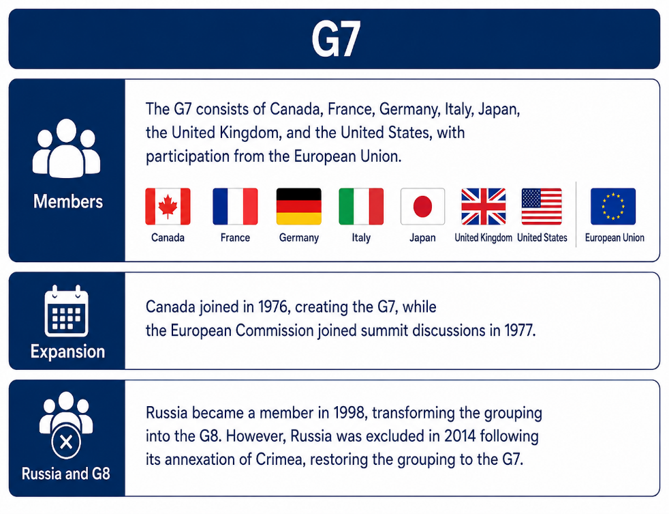
- The G7 was established in 1975 on the initiative of Francefollowing the first oil crisis.
- The first summit was held at Rambouillet, France, with six members, making it the G6.
- Nature of the Group: The G7 is an informal forum with no legal status, permanent secretariat, or binding authority.
- Its effectiveness stems from direct dialogue among major democratic economies sharing common values.
- Key Features: Annual summit with a rotating presidency among member countries.
- Provides a platform for discussions on:
- Global economy and trade
- International security and regional conflicts
- Climate change and energy security
- Development and global governance
- Leaders issue joint outcome documents and coordinate policy responses to global challenges.
- Based on shared values of freedom, democracy, human rights, and the rule of law.
- Provides a platform for discussions on:
- Major Achievements of the G7: The G7 has contributed to the creation of the Financial Action Task Force (FATF), the European Bank for Reconstruction and Development (EBRD), Global Fund to Fight AIDS, Tuberculosis and Malaria, and has supported the implementation of the Paris Climate Agreement.