
SYLLABUS
GS-2: Issues relating to the development and management of Social Sector/Services relating to Health, Education, Human Resources.
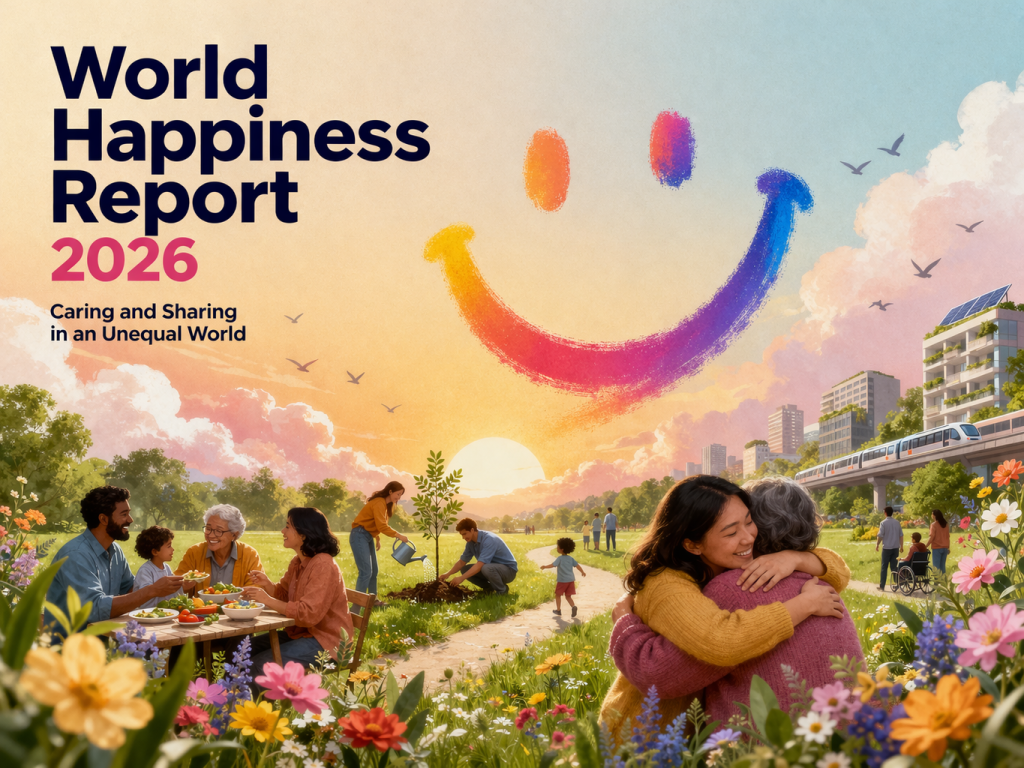
Context: The World Happiness Report 2026, released on the occasion of the International Day of Happiness (20 March), highlights global well-being trends with a special focus on the impact of the digital age.
About the World Happiness Report
- It is a globally recognised annual publication on wellbeing, first released in 2012 following a United Nations initiative inspired by Bhutan’s emphasis on happiness as a measure of development.
- It is prepared by the University of Oxford’s Wellbeing Research Centre in partnership with Gallup and the UN Sustainable Development Solutions Network, with contributions from leading researchers across disciplines.
- The report aims to provide a comprehensive understanding of global happiness and the factors that influence it, while making insights from wellbeing science accessible for policymakers and the public alike. Its release coincides every year with the International Day of Happiness, observed on 20 March.
- Methodologically, the report is based on data from the Gallup World Poll covering over 140 countries.
- It uses the Cantril Self-Anchoring Scale, where respondents rate their lives on a ladder from 0 (worst possible life) to 10 (best possible life).
- The rankings are derived from a three-year average of life evaluations (2023–2025) to ensure stability and reliability.
- The report evaluates happiness based on key determinants such as GDP per capita, healthy life expectancy, social support, freedom to make life choices, generosity, and perceptions of corruption.
- The 2026 edition specifically focuses on wellbeing in the digital age, examining how patterns of internet and social media use are reshaping global happiness.
Key Findings of the Report
- Global Rankings and Trends:Finland remains the world’s happiest country for the 9th consecutive year (score: 7.764).
- Iceland (2nd), Denmark (3rd), Sweden (5th), Norway (6th).
- Costa Rica emerged as a major climber, reaching 4th rank, the highest-ever for a Latin American country.
- Switzerland re-entered the top 10 (10th).
- Absence of English-Speaking Countries: No English-speaking country is in the top 10 for the second consecutive year
- Only a few in the top 20: New Zealand (11th), Ireland (13th), Australia (15th)
- Others rank lower: USA (23rd), Canada (25th), UK (29th)
- India’s Performance:India ranks 116th (score: 4.536)
- Shows gradual improvement; 126th (2024) → 118th (2025) → 116th (2026)
- Least Happy Countries: Countries affected by conflict and instability dominate the bottom rankings
- Afghanistan remains the unhappiest country (147th)
- Followed by Sierra Leone, Malawi, Zimbabwe, Botswana, Lebanon, DR Congo, Egypt, Tanzania
- Global Improvement in Happiness: The report highlights that 79 countries have recorded significant improvements in happiness levels compared to the 2006–2010 baseline period, indicating overall global progress.
- Social media and Youth Wellbeing: A key highlight of the report is the declining wellbeing among youth, particularly in developed countries like the United States, Canada, Australia, and New Zealand.
- Excessive social media usage is identified as a major contributing factor to this decline.
- Usage Patterns and Behavioural Impact: Moderate social media use (less than one hour per day) is associated with the highest wellbeing levels, whereas excessive use (around 2.5 hours daily) leads to lower life satisfaction.
- Activities such as communication and learning improve wellbeing, while passive scrolling and gaming reduce it.
- Gender Dimension: The negative impact of social media is particularly pronounced among teenage girls, who report significantly lower life satisfaction at higher levels of usage.
- Platform Design Matters: Platforms that promote genuine social interaction tend to enhance happiness, whereas algorithm-driven content platforms show negative effects when usage becomes excessive.
- Policy Implications: The findings are influencing policymaking globally, with countries like Australia increasing the minimum age for social media use, while others such as Denmark, France, and Spain are considering similar regulations.
- Drivers of High Happiness: Top-ranking countries share common features such as strong welfare systems, equitable income distribution, high social trust, and effective governance, which collectively support higher levels of wellbeing.