SYLLABUS
GS-2: Bilateral, regional and global groupings and agreements involving India and/or affecting India’s interests
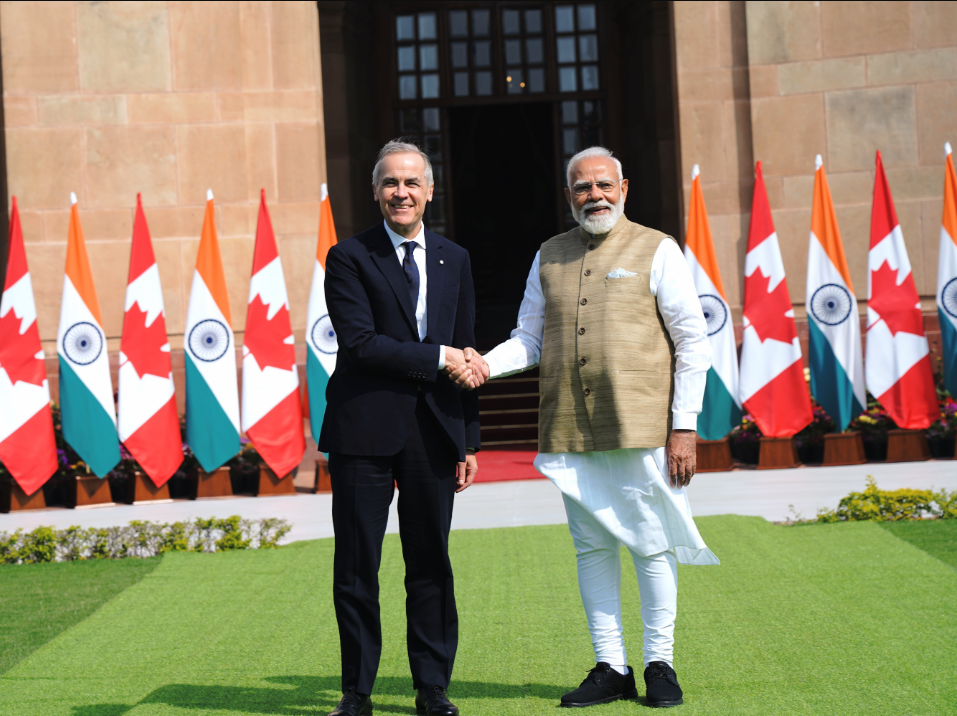
Context: At the invitation of Indian Prime Minister Narendra Modi, Canadian Prime Minister Mark Carney paid an official visit to India to revive bilateral relations and strengthen the strategic partnership between the two countries.
More on the News
- This was Prime Minister Carney’s first visit to India after assuming office and the first bilateral visit by a Canadian Prime Minister since 2018, marking a key step in the normalization of India–Canada relations after recent diplomatic tensions.
- The leaders reviewed progress in the India–Canada Strategic Partnership and discussed cooperation in trade, energy, critical minerals, agriculture, education, innovation, and people-to-people ties.
- The visit also followed their earlier meetings during the G7 Summit 2025 in Kananaskis and the G20 Summit 2025 in Johannesburg, reinforcing efforts to rebuild strategic trust and expand economic collaboration.
Key Highlights of Visit
- Strategic Vision for Partnership: Both leaders reaffirmed commitment to rebuilding bilateral relations guided by the principle “Vasudhaiva Kutumbakam – One Earth, One Family, One Future.”
- Emphasis on cooperation between two major democracies to support economic resilience, climate action, innovation, and Indo-Pacific stability.
- Trade and Economic Cooperation: Signing of Terms of Reference for negotiations on a Comprehensive Economic Partnership Agreement (CEPA).
- Target to expand bilateral trade to about USD 50 billion by 2030.
- Reconstitution of the India–Canada CEO Forum to strengthen private-sector engagement.
- Launch of a Finance Ministers’ Economic and Financial Dialogue focusing on fintech, payments modernisation, and financial cooperation.
- Energy and Critical Minerals Partnership: Long-term uranium supply agreement between India’s Department of Atomic Energy and Cameco.
- MoU on Critical Minerals Cooperation to build secure supply chains.
- Expansion of collaboration in nuclear energy, renewable energy, hydrogen, biofuels, battery storage and electricity systems.
- Canada announced its intention to join the International Solar Alliance and upgrade its participation in the Global Biofuel Alliance.
- Science, Technology and Space Cooperation: Trilateral MoU under the Australia–Canada–India Technology and Innovation (ACITI) Partnership.
- Relaunch of the Joint Science and Technology Cooperation Committee.
- Collaboration in AI, semiconductors, cybersecurity, digital technologies and high-performance computing.
- Enhanced space cooperation between the Indian Space Research Organisation and the Canadian Space Agency.
- Education, Talent and Research: MoU between All India Council for Technical Education and Mitacs for Globalink Research Internships enabling about 300 Indian students annually to work in Canada.
- Launch of a Joint Talent and Innovation Strategy to promote skills, mobility and research collaboration.
- 24 MoUs signed between universities and institutions in areas such as AI, healthcare, agriculture and innovation.
- Agriculture and Food Security: Agreement to strengthen cooperation in agri-technology, food processing and nutrition-sensitive food systems.
- Proposal to establish a Canada–India Pulse Protein Centre of Excellence at the National Institute of Food Technology Entrepreneurship and Management (NIFTEM), Kundli.
- Cultural and People-to-People Ties: Signing of an MoU on Cultural Cooperation to expand collaboration in arts, heritage and creative industries.
- Canada to participate in the Bharat Tribes Festival 2026 in New Delhi (17-30th March).
- Security and Defence Cooperation: Institutionalisation of an India–Canada Defence Dialogue.
- Cooperation in counter-terrorism, organised crime, cybercrime and immigration enforcement.
- Indo-Pacific and Multilateral Cooperation: Commitment to a free, open and inclusive Indo-Pacific.
- India supported Canada’s interest in joining the Indian Ocean Rim Association as a dialogue partner.
- Agreement to coordinate in global institutions on climate change, supply chain resilience and sustainable development.
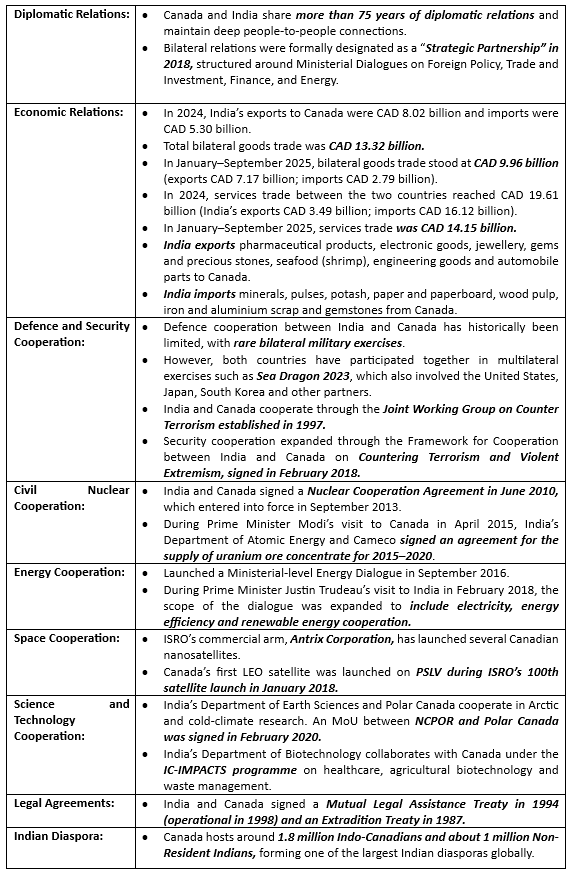
India–Canada Bilateral Relations