
SYLLABUS
GS-2: Government Policies and Interventions for Development in various sectors and Issues arising out of their Design and Implementation.
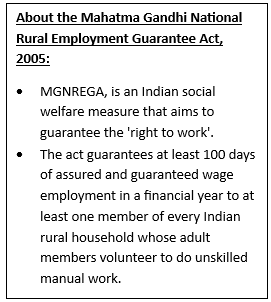
Context: Recently, the Government introduced the Viksit Bharat – Guarantee for Rozgar and Ajeevika Mission (Gramin) (VB—G RAM G) Bill 2025 in the Lok Sabha to replace the Mahatma Gandhi National Rural Employment Guarantee Act, 2005 (MGNREGA).
Key Features of the Bill
- Aim: It will establish a future-ready, convergence-driven, saturation-oriented rural development architecture.
- Employment guarantee: It enhances the statutory wage employment guarantee from 100 to 125 days per rural household in every financial year, for adults who volunteer to undertake unskilled manual work.
- Unified National framework for rural public works: All works undertaken under this bill shall be originated from the Viksit Gram Panchayat Plans prepared under sub-section (3), and consolidated at the Block, District and State levels and further aggregated into the Viksit Bharat National Rural Infrastructure Stack, which shall comprise a comprehensive listing of works aligned with National development priorities
• Thematic priority: Viksit Bharat National Rural Infrastructure Stack shall focus on four thematic domains:
- water security
- rural infrastructure
- livelihood-related infrastructure
- mitigation of extreme weather events.
- These plans will be integrated with the PM Gati Shakti National Master Plan and also aggregated at the national level.
• Comprehensive Governance ecosystem: It will be built on digital public infrastructure, including biometric authentication, spatial-technology-enabled planning and monitoring, mobile-based reporting with real-time dashboards, AI-enabled analytics and strengthened social audit mechanisms, ensuring transparent, efficient and high-integrity implementation.
• Implementation and monitoring: It constitutes the National Level Steering Committee , which will provide high-level oversight, and recommend normative allocations.
• It also constitutes a Steering Committee for each state. Key functions of the State Committee include:
(i) overseeing convergence with other programmes
(ii) aggregation of district plans into state plans
(iii) coordinating with the National Committee.
• Unified, Whole-of-Government rural development framework: All the works will be identified through the Viksit Gram Panchayat Plans (VGPPs), which are bottom-up, convergence-based and saturation-oriented.
- These plans will be aggregated at the Block, District and State levels to ensure alignment with broader sectoral priorities.
- The VGPPs will be prepared using spatial technology and integrated with PM Gati Shakti to enable coordinated and efficient planning.
• Weekly Disclosure meetings: Convened by Gram panchayat shall in the Gram Panchayat Bhavans to present the status of works, payments, grievances, progress of the works, muster rolls etc., in automatically generated, and displayed in a publicly accessible physical and digital formats.
• Empowering States:
- States will be empowered to notify in advance, periods aggregating to 60 days in a financial year during which works under the Bill shall not be undertaken, in order to facilitate the availability of farm labour during peak sowing and harvesting seasons.
- Every State Government is required to prepare a Scheme for giving effect to the guarantee proposed under this bill, within six months of the commencement of the Act.
• Funding Pattern: It will operate as a Centrally Sponsored Scheme (CSS), with a fund sharing pattern of 90:10 for North-Eastern and Himalayan States/UT and 60:40 for all other States.
• Unemployment allowance: To be paid by the State Governments, if employment is not provided within 15 days, at prescribed rates.
Significance of the Bill:
- Rural development framework: Transition from fragmented provisioning to a coherent and future-oriented approach in rural infrastructure creation to reduce disparities and promote inclusive growth.
- Recalibrated approach: The bill responds to evolving rural aspirations, leverages technology and ensures convergence across Central, State and Local schemes.
- Support the vision of Viksit Bharat: It engages the rural workforce more effectively to achieve the objectives of Viksit Bharat @2047, while empowering them through enhanced livelihood guarantee.