
SYLLABUS
GS-2: Government policies and interventions for development in various sectors and issues arising out of their design and implementation.
GS-3: Security challenges and their management in border areas.
Context: The Government is expanding the Vibrant Villages Programme (VVP) to strengthen development and security across India’s international land borders. VVP-I and VVP-II together have an outlay of ₹11,639 crore and aim to cover more than 2,616 villages.
More on the News
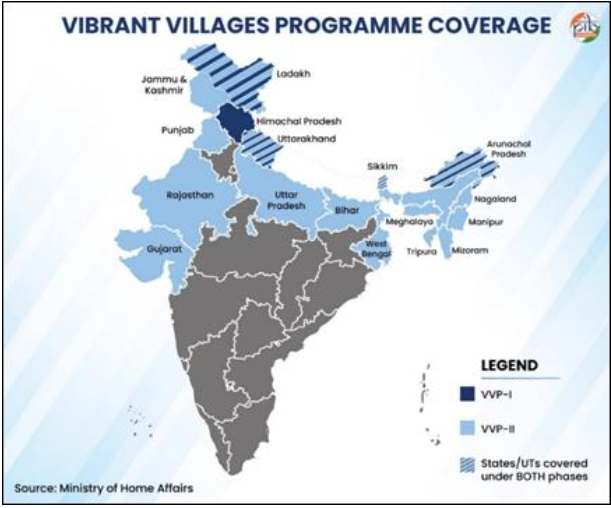
• Two-Phase Expansion: VVP-I covers villages along the northern border, while VVP-II extends the programme to other international land borders, taking the development-security approach across India’s land frontier.
• VVP-II Coverage: It covers 1,954 villages in 334 blocks across 15 States and 2 Union Territories, with an outlay of ₹6,839 crore up to FY 2028–29.
• Implementation Progress: As of July 2026, MHA has sanctioned 1,248 projects worth ₹3,020.32 crore, while another 1,655 projects had been sanctioned by Central Ministries/Departments through convergence; ₹953.47 crore had been released, and 283 projects were reported completed.
• Key Outcomes under VVP-I: 111 road projects worth ₹2,481.93 crore have been sanctioned to connect 134 previously unconnected villages, alongside 327 tourism projects worth ₹145 crore and more than 8,800 outreach/service-delivery activities up to July 2026.
Understanding the Vibrant Villages Programme
• Nodal Ministry: The Ministry of Home Affairs (MHA) is the nodal ministry, working with State Governments, district administrations, Central Ministries/Departments and border guarding forces.
• Core Approach: The programme seeks to transform selected border settlements from the nation’s “last villages” into “first villages” and vibrant centres of growth.
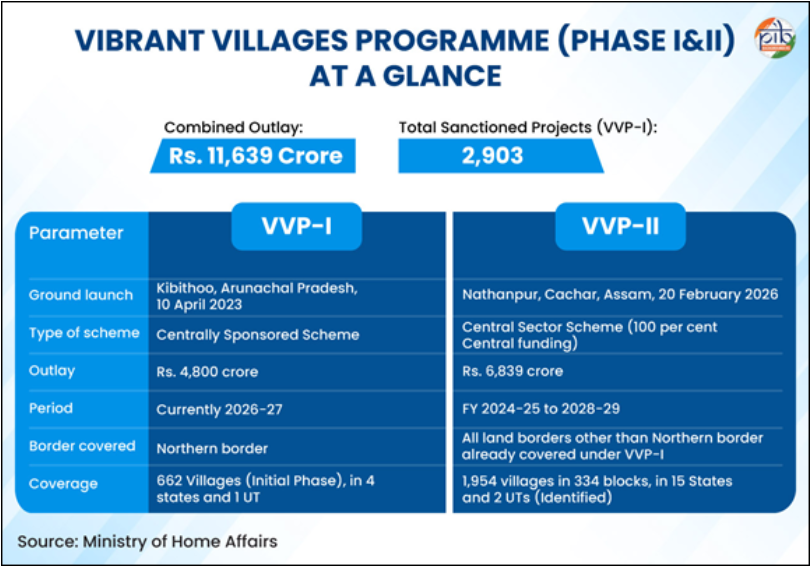
• VVP-I: Announced in the Union Budget 2022–23 and approved on 15 February 2023 as a Centrally Sponsored Scheme for comprehensive development of 662 strategic villages in 46 blocks across Arunachal Pradesh, Himachal Pradesh, Sikkim, Uttarakhand and Ladakh, covering 19 districts and about 1.42 lakh people.
• VVP-II: Approved on 2 April 2025 as a Central Sector Scheme, fully funded by the Centre, and formally launched on 20 February 2026 at Nathanpur village in Assam’s Cachar district. It covers selected villages along international land borders other than the northern border covered under VVP-I.
• Key Objectives: Improve living conditions, generate sustainable livelihoods, ensure saturation of applicable government schemes, encourage people to remain in border villages and strengthen border security through community participation.
Key Interventions under VVP
• Infrastructure & Connectivity: All-weather roads, drinking water, reliable electricity, mobile/internet connectivity, healthcare, education and essential village infrastructure.
• Livelihood & Local Economy: Tourism, local culture, agriculture/horticulture, social entrepreneurship, youth and women empowerment, cooperatives, SHGs/FPOs and One Block-One Product enterprises.
• VVP-II Interventions: Value chains through cooperatives and SHGs, SMART classrooms, tourism circuits, financial inclusion, healthcare, skill development and sustainable livelihoods.
• Scheme Saturation: Convergence with existing government schemes to ensure eligible households receive available welfare and development benefits.
• Community-Based Border Management: Empowering residents as the “eyes and ears” of border guarding forces and strengthening community awareness to prevent and control trans-border crime.
• Localised Planning & Convergence: Implementation through Village Action Plans and border-, State- and village-specific interventions; a High-Powered Committee chaired by the Cabinet Secretary may recommend relaxations in scheme guidelines to address the special needs of border villages.
Significance of the Vibrant Villages Programme
• Strengthens Border Security: A populated and confident frontier enhances civilian presence and facilitates local inputs against infiltration, smuggling and trans-border crime.
• Promotes Demographic Resilience: Better connectivity and livelihood opportunities can reduce out-migration and encourage people to remain in, or return to, border villages.
• Creates Local Growth Centres: Tourism, agriculture, cooperatives, SHGs and FPOs can generate local employment and connect remote border economies with wider markets.
• Bridges Development Gaps: Extends essential infrastructure, public services and welfare delivery to geographically difficult and historically underserved frontier regions.
• Integrates Development with Security: Establishes an integrated frontier-management approach in which development, livelihoods, demographic stability and security reinforce one another.
VVP and India’s Broader Border-Development Strategy
• Builds on BADP: The Border Area Development Programme (BADP), implemented since 1986–87, covers areas within 0–10 km of the first habitation along international borders across 16 States and 2 UTs and is now in its sunset phase.
• Significant Development Footprint: Since FY 2004–05, BADP has approved 39,248 works/projects, including roads, bridges, health and education infrastructure, while 3,273 projects have focused on livelihoods through tourism, market facilities and skill development.
• From Broad Areas to Strategic Villages: VVP builds on BADP but adopts a more targeted, village-centric and security-linked approach, covering 662 strategic villages under VVP-I and 1,954 villages under VVP-II across India’s international land borders.
• Integrated Frontier Governance: VVP advances from conventional border-area development towards an integrated model combining infrastructure, livelihoods, welfare saturation, demographic resilience and community participation in border management.