
SYLLABUS
GS-2: Government policies and interventions for development in various sectors and issues arising out of their design and implementation.
Context: Recently, Union Home Minister and Minister of Cooperation launched the Vibrant Villages Programme–II (VVP–II) at Nathanpur village in Assam’s Cachar district along the Indo-Bangladesh border.
More on the News
- The launch marks the expansion of the Vibrant Villages initiative beyond the northern border areas, with the second phase targeting strategic villages along multiple international borders.
- The programme builds on Vibrant Villages Programme–I, which focused on villages along the China border.
About the Vibrant Villages Programme–II (VVP-II)
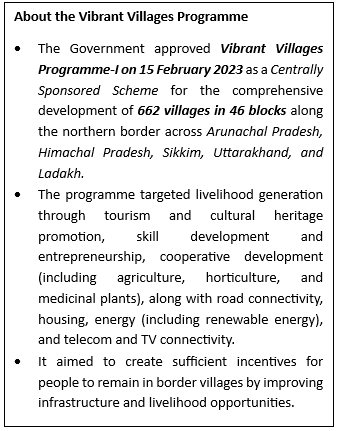
- To further the vision of Viksit Bharat@2047 for safe and vibrant land borders, the Government approved Vibrant Villages Programme-II on 2 April 2025 as a Central Sector Scheme with an outlay of ₹6,839 crore up to FY 2028–29.
- VVP-II seeks saturation of villages across four thematic areas, all-weather roads, telecom connectivity, television connectivity, and electrification, through convergence with existing schemes.
- The main goal of VVP–II is to develop border villages as vibrant growth centres and ensure they are not left behind in India’s development journey.
- Key objectives include:
- Improving quality of life in border villages through infrastructure and services.
- Livelihood generation and economic opportunities.
- Saturation of welfare schemes for eligible households.
- Strengthening border security through local engagement.
- Promoting national integration and preventing migration from border areas.
- Coverage: 1,954 villages across 334 blocks.
- Geographic spread: 15 States and 2 Union Territories.
- Borders covered: Pakistan, Nepal, Bangladesh, Bhutan, and Myanmar.
- States include: Arunachal Pradesh, Assam, Bihar, Gujarat, Jammu & Kashmir, Ladakh, Manipur, Meghalaya, Mizoram, Nagaland, Punjab, Rajasthan, Sikkim, Tripura, Uttarakhand, Uttar Pradesh and West Bengal.
- Assam share: 140 villages across 26 blocks and 9 districts.
Strategy and Components
- Infrastructure Development: The programme focuses on improving roads, telecommunications, and basic amenities to enhance connectivity and social infrastructure in border areas.
- Scheme Saturation: It aims to ensure full coverage of existing government welfare schemes through targeted delivery to individual beneficiaries.
- Livelihood Promotion: The initiative promotes economic opportunities in border regions through enabling infrastructure and capacity-building measures.
- Security Integration: It integrates residents into border management by encouraging them to act as the “eyes and ears” of security forces to curb illegal activities and trans-border crimes.
- Community Outreach: The programme emphasises culturally sensitive engagement with border communities to build trust, enhance awareness of border security, and promote understanding of immigration laws.
Significance
- Strategic Security Importance: The programme strengthens border management through community participation, helping counter infiltration, smuggling, and trans-border crimes while enhancing civilian presence in sensitive regions.
- Development of Border Regions: It reduces regional disparities by improving infrastructure, connectivity, and access to welfare schemes while preventing out-migration from border areas.
- National Integration: The initiative promotes socio-cultural integration of border populations, builds trust between citizens and security agencies, and reinforces national unity in peripheral regions.
- Economic and Livelihood Impact: It generates local employment opportunities, promotes rural growth centres along borders, and integrates border economies with national markets.
- Governance Significance: The programme reflects a convergence model combining development, welfare, and security, marking an expansion from the China-focused VVP-I to a multi-border VVP-II with a long-term border stabilisation strategy.
Sources :
PIB
Indian Express
VVP