
SYLLABUS
GS-3: Indian Economy and issues relating to planning, mobilization of resources, growth, development and employment; Inclusive growth and issues arising from it.
Context: The Unified Payments Interface (UPI) completes 10 years of operations on 25 August 2026, marking a decade of transformation in India’s digital payments ecosystem and its emergence as a globally recognised real-time payments platform.
About the Unified Payments Interface (UPI)
- The Unified Payments Interface (UPI) was developed by the National Payments Corporation of India (NPCI) under the regulatory oversight of the Reserve Bank of India (RBI) and went live in August 2016.
- It is an interoperable, real-time payment system that enables 24×7 instant person-to-person (P2P) and person-to-merchant (P2M) transactions through a single interface.
- UPI allows multiple bank accounts to be accessed through a common platform, enabling users to transact across different banks and payment applications.
- It has emerged as a key pillar of India’s Digital Public Infrastructure (DPI) and has simplified digital payments through speed, accessibility and interoperability.
UPI: A Decade of Growth
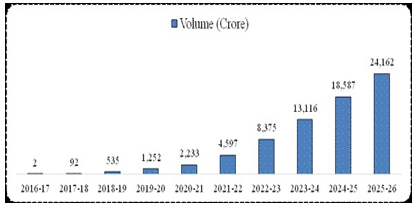
- Annual transaction volume increased from 1.78 crore in FY 2016-17 to over 24,162 crore in FY 2025-26, an almost 13,000-fold increase.
- Transaction value rose from ₹0.07 lakh crore to around ₹314 lakh crore during the same period, marking a more than 4,000-fold increase.
- UPI processed an average of around 66 crore transactions daily in 2026.
- Monthly transactions crossed 2,300 crore for the first time in May 2026, reaching 2,320 crore.
- In July 2026, UPI recorded a record 2,366 crore transactions, valued at ₹29.88 lakh crore.
- The number of banks live on UPI increased from 44 in FY 2016-17 to 703 in FY 2025-26, reaching 741 by July 2026.
- UPI accounted for around 84% of India’s digital payment transactions in FY 2025-26.
Significance
- Financial Inclusion: UPI has expanded access to digital financial services by enabling individuals, businesses and merchants to participate in the formal digital economy, thereby strengthening financial inclusion.
- Interoperable Digital Payments: Its interoperability allows users to make instant payments across participating banks and platforms through a common infrastructure, making digital transactions simpler, faster and more accessible.
- Everyday Retail Payments: UPI has become deeply integrated into everyday commerce. P2M transactions constitute 63% of transaction volume, while 86% of P2M transactions were below ₹500 in FY 2025-26, highlighting its importance for small-value retail payments.
- Digital Foundation for Mass Adoption: UPI’s rapid expansion has been supported by India’s wider digital ecosystem, particularly Pradhan Mantri Jan Dhan Yojana (PMJDY) for expanding access to bank accounts, Aadhaar for digital identity and authentication, and affordable connectivity for wider access to digital services.
- Establishing Global Leadership: UPI accounted for nearly 49% of global real-time payment transaction volume in 2025, with the IMF recognising it as the world’s largest real-time payment system by transaction volume.
- Expanding India’s Digital Infrastructure Globally: UPI is operational in 11 countries, including the UAE, Singapore, France, Bhutan, Nepal, Sri Lanka, Mauritius, Qatar, Cambodia, Greece and the Maldives, expanding India’s digital public infrastructure into cross-border payments.