
SYLLABUS
GS-3: Conservation, environmental pollution and degradation, environmental impact assessment.
Context: Ahead of World Wetlands Day on February 2, two wetlands have been included as wetlands of international importance in the Ramsar sites list, under the global Ramsar Convention.
More on the News
- The Indian government officially announced that Patna Bird Sanctuary in Etah (Uttar Pradesh) and Chhari-Dhand in Kutch (Gujarat) have been designated as Ramsar sites.
- The designation of these two sites under the Ramsar Convention takes the total number of such wetlands in India to 98.
- The recognition adds to India’s expanding list of Ramsar wetlands, reaffirming the nation’s focus on sustainable development, habitat protection, and fostering environmental stewardship at both local and global levels.
Key Information on Recently Added Ramsar Sites
• Patna Bird Sanctuary
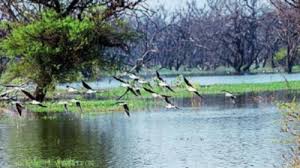
- It consists of freshwater marshes, woodlands and grasslands, and is surrounded by agricultural landscapes.
- Together, these different landscapes create a wide range of habitats and support a high level of biodiversity, reflected in the 178 bird species and 252 plant species recorded at the site.
- It is particularly important in supporting waterbird populations and has been designated an Important Bird and Biodiversity Area (IBA) by BirdLife International.
• Chhari-Dhand
- This is the first Conservation Reserve of Gujarat State.
- It is a seasonal saline wetland located between the famous Banni grasslands and salt flats of Kutch, as per the Ramsar Convention.
- It is an important wintering site for waterfowl, supporting species such as the critically endangered sociable lapwing, the vulnerable common pochard, and, notably, approximately 30,000 common cranes (Grus grus) annually
About the Ramsar Convention
- The Ramsar Convention is an international treaty established in 1971.
- Its aim is the conservation and sustainable use of wetlands to preserve biodiversity and maintain ecological balance.
- They are also known as wetlands of international importance.
- According to the Convention, Wetlands are defined as areas of marsh, fen, peatland or water, whether natural or artificial, permanent or temporary, with water that is static or flowing, fresh, brackish or salt, including areas of marine water the depth of which at low tide does not exceed six metres.
- World Wetlands Day is celebrated annually on 2nd February since 1997.
Ramsar Sites in India
- India acceded to the Ramsar Convention on Wetlands on February 1, 1982.
- India has the highest number of Ramsar sites in Asia (98, including recent ones) and the third highest in the world after the United Kingdom (176) and Mexico (144).
- Tamil Nadu has the highest number of Ramsar Sites in India, with 20 designated wetlands, followed by Uttar Pradesh with 11.
- The Sundarban Wetland in West Bengal, covering 4,230 square kilometres, is India’s largest Ramsar site, while Renuka Lake in Himachal Pradesh, with an area of 0.2 square kilometres, is the smallest.
- These wetlands are protected under various national laws, including the Indian Forest Act (1927), the Forest (Conservation) Act (1980), the Environment (Protection) Act, 1986, and the Indian Wildlife (Protection) Act (1972).
Sources:
The Hindu
DD News
Indian Express