
SYLLABUS
GS-2: Bilateral, Regional and Global Groupings and Agreements Involving India and/or Affecting India’s Interests.
Context: Türkiye, Qatar, Pakistan and Indonesia have signed the Badr Memorandum of Understanding (MoU) in Doha to deepen defence cooperation and strengthen their defence-industrial capabilities.
More on the News
- Named Badr, meaning “full moon” in Arabic, the MoU seeks to expand cooperation in military production, technical training, research and development (R&D), and the strengthening of defence capabilities.
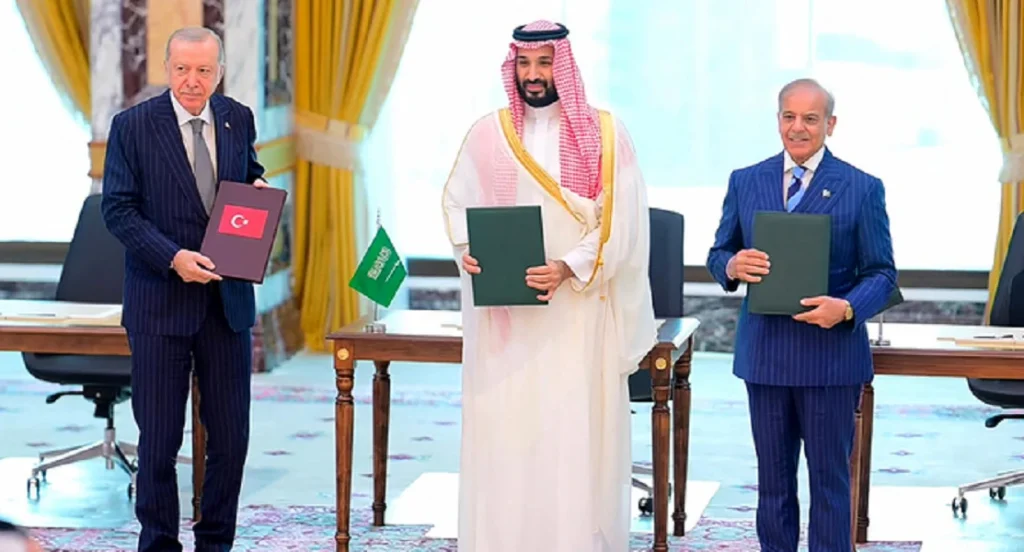
- The agreement comes about two months after Türkiye, Pakistan and Saudi Arabia signed the separate Makkah Joint Defence Agreement in August 2026, which provides for collective defence in the event of an armed attack against any one of its parties.
About the Badr Memorandum of Understanding
- Defence-industrial cooperation: The MoU seeks to strengthen ties between the participating countries’ defence industries and promote cooperation in military production.
- Technology and R&D: It aims to facilitate technology sharing, joint development and research to support the development of modern defence technologies.
- Training and military capabilities: The agreement provides a framework for cooperation in technical military training and strengthening the participating countries’ defence capabilities.
- Domestic production: According to Türkiye’s defence-industry chief, the initiative seeks to move beyond off-the-shelf procurement towards joint technological development and stronger domestic production capabilities.
- Economic dimension: By combining their respective defence-industrial strengths, the countries aim to improve industrial integration and meet the requirements of allied and friendly nations.
Strategic Significance
- Joint defence production: The MoU could facilitate joint development, technology transfer and collaborative manufacturing. The actual outcomes will depend on the projects subsequently agreed upon by the participants.
- Complementary capabilities: Türkiye brings an established defence industry, Pakistan has domestic defence-production capabilities, Indonesia has ongoing defence-industrial partnerships, and Qatar maintains defence partnerships and investment capacity. The MoU creates scope for cooperation among these capabilities.
- Diversification of defence partnerships: The agreement reflects efforts to expand defence-industrial collaboration, strengthen domestic production and reduce dependence on conventional equipment procurement.
- Regional security cooperation: The arrangement brings together countries with interests spanning West Asia, South Asia and Southeast Asia. However, its wider strategic impact will depend on the nature and scale of its implementation.
Implications for India
- Regional security: Closer defence-industrial cooperation involving Pakistan could have implications for India if it results in new military capabilities or technology transfers relevant to the regional security environment.
- Defence technology monitoring: India will need to monitor any concrete joint-production projects, technology-sharing arrangements and military capabilities emerging from the MoU.
- Indo-Pacific partnerships: Indonesia’s participation highlights the importance of monitoring defence developments alongside India’s own bilateral defence engagement with Southeast Asian countries.
- Distinguishing the two agreements: The Badr MoU focuses on defence-industrial and military cooperation. It should not be conflated with the Makkah Joint Defence Agreement between Türkiye, Pakistan and Saudi Arabia, which includes a collective-defence commitment.