
SYLLABUS
GS-3: Conservation, environmental pollution and degradation, environmental impact assessment.
Context: Recently, a well-preserved 37,000-year-old thorny bamboo fossil discovered in Manipur that provides the earliest Asian evidence of bamboo spinescence and offers insights into Ice Age ecology.
More on the News
- Scientists discovered a fossilised bamboo stem in the silt-rich deposits of the Chirang River in Manipur’s Imphal Valley.
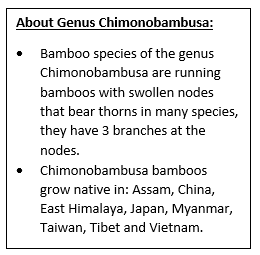
- Researchers identified the fossil as a new species belonging to the genus Chimonobambusa, based on detailed morphological analyses.
Key Findings from the Discovery
• The discovery demonstrates that thorny bamboo existed in Asia during the late Pleistocene and survived harsh Ice Age conditions.
• The study highlights Northeast India (Indo-Burma biodiversity hotspot) as an ecological refugium where bamboo persisted even as it disappeared from many other regions.
- An ecological refugium is a geographical area where a population, species, or community can survive during an adverse period like a glacial period or a period of climate change.
• This fossil preserves exceptional morphological features such as nodes, internodes, nodal buds and distinct thorn base scars that rarely fossilize and indicate early defensive traits in bamboo.
• This is the earliest fossil evidence of thorny bamboo in Asia and the first Quaternary record of bamboo from the region.
• This finding shows that spinescence (plant that has spines, thorns, or prickles) in bamboo evolved much earlier than previously understood and served as a defence against herbivores.
Scientific Significance of the Discovery
- This fossil bridges a major gap in the global bamboo fossil record, offering new insights into bamboo evolution and climate adaptation.
- This research shows that thorny bamboo species existed in Asia during the late Pleistocene, aligning with earlier evidence from Peru that points to Neogene origins of bamboo spinescence.
- This study enhances understanding of how bamboo responded to changing climatic conditions and herbivory pressures during the Quaternary.
About Bamboo
- Bamboo, belonging to the subfamily Bambusoideae of the grass family Poaceae, includes more than 115 genera and 1,400 species distributed mainly across tropical, subtropical and mild temperate regions.
- The greatest diversity of bamboo occurs in East and Southeast Asia and on islands across the Indian and Pacific Oceans, with a few Arundinaria species native to the southern United States.
- Bamboos are fast-growing perennial plants, with some species capable of growing up to 30 cm per day, producing woody, ringed, hollow stems (culms) that arise in clusters from thick underground rhizomes.
- Bamboo species vary greatly in size, with culm heights ranging from 10–15 cm in the smallest varieties to over 40 metres in the largest, and most species flower only once after 12–120 years, reproducing mainly vegetatively.
- In India, the scientific community and botanists have always classified bamboo as a grass (family Poaceae). However, for almost a century, bamboo was legally classified as a tree under the Indian Forest Act, 1927.
- The legal classification was changed by the Government of India in 2017 through an amendment to the Indian Forest Act, 1927.