

SYLLABUS
GS-3: Conservation, Environmental Pollution and Degradation, Environmental Impact Assessment.
Context: The Supreme Court expanded conservation zones for the Great Indian Bustard, banning new power lines and large solar plants, to protect the endangered species.
More on the News
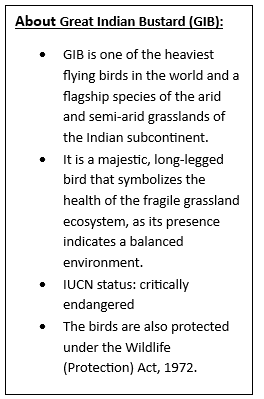
- The Supreme Court bench said, the GIB is soon approaching the fate of recently extinct animals like Golden Toad, Western Black Rhinoceros, Pinta Giant Tortoise, Poʻouli, Bridle WhiteEye, etc, which the universe has lost forever.
- The order came on recommendations from a nine-member expert committee the court formed in March 2024, comprising technical experts from the Union government and agencies including the Wildlife Institute of India.
Key highlights of the ruling
- Legal finality: It closes a four-year legal battle that repeatedly disrupted GEC planning and execution.
- In April 2021, the court ordered all overhead power lines across nearly 99,000 sq km of GIB habitat to be placed underground within a year.
- In March 2024, the court partially modified its earlier order, citing technical infeasibility, grid safety concerns and climate costs, and appointed an expert committee to recommend a more calibrated approach.
- The December 2025 verdict now gives legal finality to that framework—one that preserves core GEC infrastructure but redraws its permissible geography.
- Reiterated GIB protection as “non-negotiable”: finalised revised priority conservation areas—14,013 square kilometres in Rajasthan and 740 square kilometres in Gujarat.
- Within these zones, no new wind turbines, no solar parks above 2 megawatt (MW), and no expansion of existing renewable projects will be allowed, effectively capping future generation that GEC Phase II was intended to evacuate.
- Corridor-based approach: In Gujarat, where GEC infrastructure is critical to evacuating wind power from Kutch and coastal solar projects, the court-approved corridors linked to Bhachunda and coastal substations.
- Preventing complete derailment of GEC execution: The court rejected universal undergrounding and mandatory bird diverters with exemptions for 11 kV and below distribution lines near settlements to provide limited relief.
Significance
- Bustard habitat conservation: All future evacuation will be funnelled into a single dedicated power corridor up to 5 km wide south of the Desert National Park, preserving GIB habitat.
- Signals a decisive shift towards environmental governance: India’s flagship transmission backbone for renewables must now be planned not just around resource availability and demand centres, but around immutable conservation boundaries.
- Policy clarity: Provides guidelines for balancing conservation with energy needs.