
SYLLABUS
GS-2: Indian Constitution—significant provisions and basic structure; Structure, organization and functioning of the Executive and the Judiciary.
Context: The Supreme Court in the Jaskaran Jeet Singh Deol v. State of Punjab (2026) case has ruled that re-arrest following an unconstitutional arrest requires judicial oversight, thus strengthening safeguards against arbitrary deprivation of liberty.
Key Highlights of the Judgment
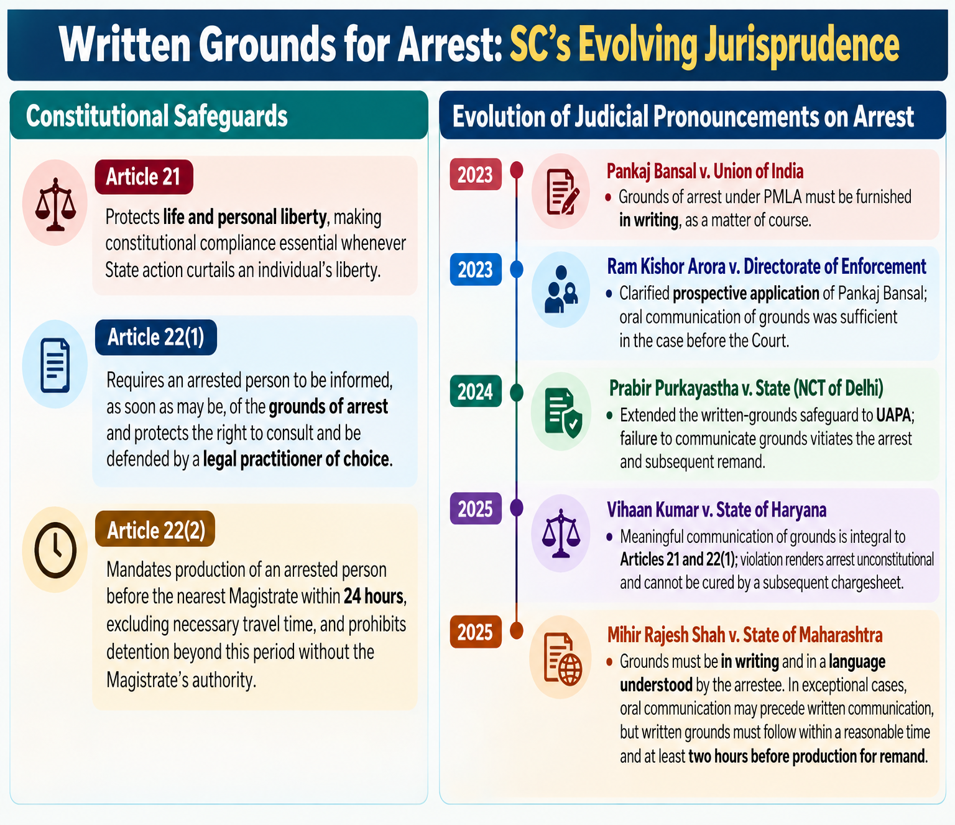
- Unconstitutional arrest will lead to immediate release: Violation of Article 22(1) or 22(2) vitiates the arrest; release in such a case is not bail, but release from illegal and unconstitutional detention. A subsequent chargesheet or cognisance order cannot cure the defect.
- Re-arrest requires judicial imprimatur: If custody remains necessary, the agency must first furnish the written grounds of arrest and approach the jurisdictional Magistrate, explaining the need for re-arrest and the reasons for the earlier violation.
- Superior-officer oversight: The application must be endorsed by the investigating officer’s immediate superior, who must also ensure that the investigation is transferred to another officer and that a departmental inquiry is initiated.
- Magistrate’s scrutiny: The Magistrate must examine the bona fides of the earlier non-compliance and the necessity for custody, following natural justice and deciding the application preferably within one week.
- Article 22(2) and compensation: The same safeguards apply where the 24-hour production requirement is violated. The High Court may also award suitable compensation as a public-law remedy, without affecting other private-law remedies.
- Gravity of offence no exception: The seriousness of the alleged offence cannot dilute Article 22 safeguards; constitutional protection against arbitrary deprivation of liberty applies irrespective of the gravity of the accusation.
Significance and Wider Implications
- Strengthens personal liberty: The judgment reinforces that Article 22 safeguards are substantive constitutional guarantees linked to Article 21, and not merely technical procedural requirements.
- Creates a judicial check on re-arrest: Judicial approval prevents the same authority responsible for an unconstitutional arrest from unilaterally deciding to take the person back into custody.
- Enhances institutional accountability: Superior-officer scrutiny, transfer of investigation, departmental inquiry and potential service-record consequences strengthen accountability for violations by investigating officials.
- Balances liberty with legitimate investigation: The judgment does not create an absolute bar on subsequent arrest. Instead, it requires any renewed deprivation of liberty to satisfy constitutional safeguards, demonstrate genuine investigative necessity and receive judicial scrutiny.