
SYLLABUS
GS 1: Salient features of Indian Society, Diversity of India; Social empowerment, communalism, regionalism & secularism.
GS 2: Indian Constitution- historical underpinnings, evolution, features, amendments, significant provisions and basic structure.
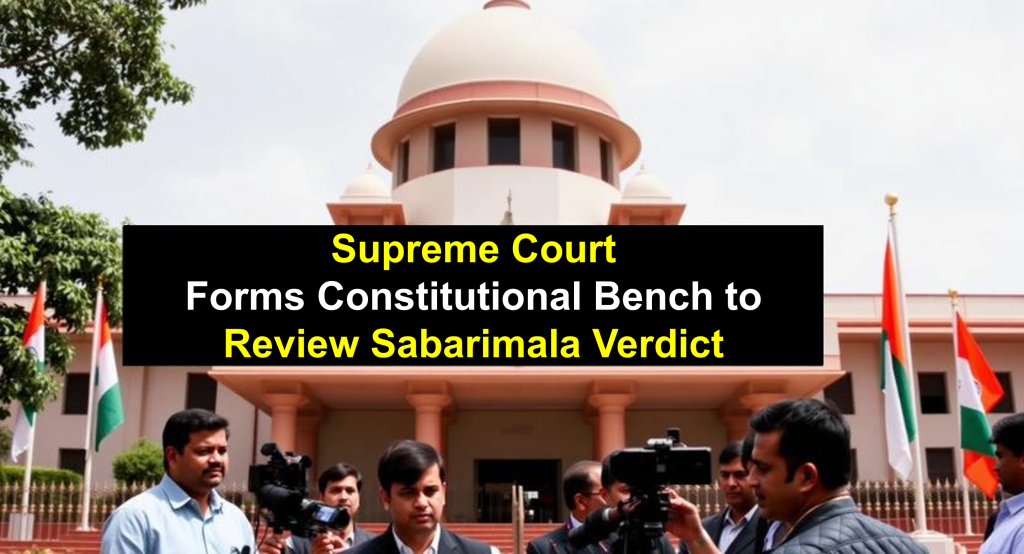
Context: Recently, the Supreme Court notified a Nine-Judge Bench headed by Chief Justice of India Surya Kant to hear the Sabarimala review case.
More on the News
• The nine-judge Bench is examining broad religious practice issues beyond the Sabarimala dispute and has implications for similar controversies involving religious practices across various faiths, including Muslim and Jain.
• Apart from the CJI, it comprises Justice BV Nagarathna, Justice MM Sundresh, Justice Ahsanuddin Amanullah, Justice Aravind Kumar, Justice Augustine George Masih, Justice Prasanna B Varale, Justice R Mahadevan and Justice Joymalya Bagchi.
• The reference concerns broader constitutional issues from the 2018 Sabarimala judgment, including the balance between religious freedom and rights to equality and dignity, and the extent of judicial review in essential religious practices.
About the Sabarimala Verdict
• On September 28, 2018, a five-judge Supreme Court bench, by a 4:1 majority, struck down Rule 3(b) of the Kerala Hindu Places of Public Worship Rules, 1965, and lifted the age-based restriction on women’s entry as unconstitutional.
• The issue reached the judiciary through a petition filed by the Indian Young Lawyers Association in 2006, challenging the ban as violative of women’s rights to equality and religious freedom under the Constitution.
• The Supreme Court held that Rule 3(b) is ultra vires the Constitution, as well as Section 3 and Section 4 of the Kerala Hindu Places of Public Worship (Authorisation of Entry) Act, 1965, which prohibit discrimination against any Hindu based on class or section.
• The Court described the exclusion of women as a form of “hegemonic patriarchy”, and said that exclusion on grounds of biological and physiological features like menstruation was unconstitutional, which violates the right to equality and dignity of women.
• Hegemonic Patriarchy refers to a system where patriarchal norms become so deeply embedded that discrimination appears natural, leading even women to internalise and perpetuate such biases.
• The Supreme Court held that the exclusion of women, based on notions of menstrual impurity and pollution, amounts to a form of untouchability and perpetuates the stigmatisation of women.
• It also ruled that devotees of Lord Ayyappa do not constitute a separate religious denomination, but are part of the broader Hindu community.
• SC emphasised that granting immunity to customs and personal laws would undermine the supremacy of the Constitution and its fundamental rights framework.
• Justice Indu Malhotra dissented from the majority opinion, asserting that courts should not apply rationality to religion and that essential practices must be determined by the faith itself, not judges.
• She emphasised that Article 25 protects the freedom of diverse sects to follow their customs, requiring fundamental rights to harmonise with religious beliefs.
Arguments Opposing Women’s Entry
• Customary Traditions: The Sabarimala temple follows long-standing religious customs, and the Travancore Devaswom Board argued that restricting women’s entry was an essential part of these traditions.
- Since Lord Ayyappa is worshipped as a celibate deity, the exclusion was claimed to be a reasonable and integral religious practice.
• Freedom of Religion: It was contended that Sabarimala constitutes a religious denomination protected under Article 26, which guarantees the right to manage internal religious affairs.
• Statutory Backing: Rule 3(b) of the Kerala Hindu Places of Public Worship (Authorisation of Entry) Rules, 1965 provided legal support by allowing exclusion based on custom, including restrictions on women during certain ages.
• Judicial Precedent: In Ritu Prasad Sharma v State of Assam, the court held that religious practices protected under Articles 25 and 26 are immune from challenge under other fundamental rights.
Arguments Supporting Women’s Entry in Religious Places
• Right to Equality (Article 14): The exclusion of women based on age and menstruation is arbitrary and discriminatory, violating Article 14 and Article 15(1) (non-discrimination on sex), as it reinforces gender stereotypes and systemic bias.
• Freedom of Religion for Women (Article 25): Women have an equal right to practice religion (Article 25); denying entry restricts this freedom unless justified by public order, morality, or health.
• Doctrine of Constitutional Morality: Constitutional morality mandates that customs align with equality, dignity, and liberty, and any violative practice must be reformed.
• Right to Dignity (Article 21): Exclusion based on menstruation treats women as impure, undermining their dignity and bodily autonomy.
• Not an Essential Religious Practice: The Court ruled that the ban is not an essential religious practice, and as Ayyappa devotees are not a separate denomination, it lacks protection under Article 26.
• Gender Justice and Social Progress: Allowing women’s entry promotes gender justice, inclusivity, and social reform, aligning religious practices with evolving democratic values and human rights standards.
Way Forward
• Balancing Fundamental Rights and Religious Freedom: Ensure a harmonious balance between equality (Arts. 14, 15, 21) and religious freedom (Arts. 25–26), upholding dignity without undue interference in faith.
• Promoting Constitutional Morality through Dialogue: Promote dialogue among the judiciary, religious bodies, and civil society to reform regressive practices while respecting faith.
• Effective Implementation with Sensitivity: Ensure uniform enforcement of court rulings with awareness campaigns to reduce resistance and promote gender inclusion.
Sources:
Live Law
The Hindu
Indian Express
The Hindu
Indian Express