
SYLLABUS
GS-3: Conservation, environmental pollution and degradation, environmental impact assessment.
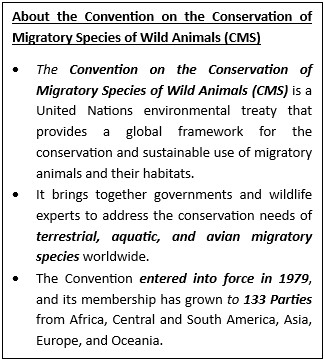
Context: A new interim update of the State of the World’s Migratory Species report has warned that 49% of migratory wildlife populations protected under the Convention on the Conservation of Migratory Species of Wild Animals (CMS) are declining, with 24% of species now facing extinction risk globally.
About the Report
- The interim report updates the landmark 2024 State of the World’s Migratory Species, the first comprehensive global assessment of migratory wildlife.
- It evaluates trends among 1,189 species listed under CMS, drawing primarily on data from the International Union for Conservation of Nature (IUCN) Red List of Threatened Species, scientific literature, and updated population assessments.
- The analysis reviewed 386 CMS-listed species that were reassessed since the previous evaluation, excluding species newly listed at CMS COP14.
- Findings will be presented at the 15th Conference of the Parties (COP15) to CMS, scheduled to be held in Campo Grande, Brazil (23–29 March).
Key Findings of the Report
- Large Share of Migratory Species in Decline: 49% of CMS-listed species (about 582–592 species) show declining population trends.
- This represents a 5% increase in population decline within two years, compared with 44% recorded in the 2024 report.
- Only 38% of species currently show stable or increasing population trends, down from 43% earlier.
- Rising Extinction Risk: 24% of CMS-listed species (284 species) are now classified as globally threatened under the IUCN Red List.
- This marks an increase from 22% in the earlier assessment.
- Among 386 reassessed species, 26 species shifted to a more threatened category and 7 species moved to a less threatened category.
- Migratory Shorebirds Facing Severe Declines: 18 of the 26 species that moved to a higher extinction risk category are migratory shorebirds.
- Many of these species have experienced long-term population declines since 1988.
- Significant reductions have been observed along major migratory flyways such as the East Asian–Australasian Flyway, East Atlantic Flyway, and Coastal sites in India.
- Emerging Disease Threat: Highly Pathogenic Avian Influenza (HPAI) H5N1 has emerged as a major threat to migratory wildlife worldwide.
- The virus has triggered mass mortality events across multiple continents, affecting both birds and marine mammals.
- Several migratory bird species such as African penguins, Humboldt penguins, Peruvian pelicans, Dalmatian pelicans, hooded cranes, and red-crowned cranes have been severely impacted, while marine mammals like the South American sea lion and South American fur seal have also been affected.
- Long-lived migratory species are particularly vulnerable, as even small increases in mortality can significantly reduce their already fragile populations.
- Key Drivers of Decline: The report identifies several major pressures affecting migratory wildlife:
- Overexploitation: Unsustainable hunting, fishing, and harvesting remain a major threat.
- Habitat Loss and Fragmentation: Conversion of wetlands, coastal zones, grasslands, and forests is reducing critical habitats.
- Infrastructure Expansion: Roads, railways, fences, and pipelines disrupt migration routes.
- Example: Mongolian Gazelle mobility declined significantly between 2002 and 2021 due to increasing infrastructure and traffic.
- Climate Change: Altered breeding conditions, changing migratory routes, and shifting habitats affect species survival.
- Fisheries Pressure on Marine Species: Overfishing and bycatch threaten migratory sharks and rays, particularly in the Northern Indian Ocean, Indo-West Pacific, Mediterranean, and tropical Atlantic.
- Habitat Degradation in Coastal Flyways: Loss of stopover and non-breeding habitats threatens migratory shorebirds globally.
- Significant Declines in Certain Species: Mara–Loita Blue Wildebeest populations have declined by about 75% since the late 1970s due to land-use changes.
- Raptors across Africa and Eurasia face threats from illegal hunting, poisoning, trapping, and collisions with energy infrastructure.
- Positive Conservation Success Stories: Despite widespread decline, some species show significant recovery due to conservation efforts:
- Saiga Antelope populations in Kazakhstan have rebounded, moving from Endangered to Near Threatened.
- Scimitar-horned Oryx has been reintroduced in Chad and reclassified from Extinct in the Wild to Endangered.
- Mediterranean Monk Seal populations have improved, shifting from Endangered to Vulnerable.
- Overall, seven CMS-listed species recorded improved conservation status.
- Ecological Importance of Migratory Species: Migratory species play a vital role in maintaining ecological balance and supporting ecosystem functioning.
- They contribute to pollination, transport nutrients across different ecosystems, help control pests, and regulate ecological processes.
- Many migratory animals also contribute to carbon storage and enhance ecosystem resilience.
- Their continued decline therefore threatens ecosystem stability, biodiversity, and the livelihoods and cultural traditions of communities that depend on them worldwide.
Sources :
Down to Earth
Indian Express