SYLLABUS
GS 2: Important International institutions, agencies and fora- their structure, mandate
GS 3: Conservation, environmental pollution and degradation and Issues related to direct and indirect farm subsidies.
Context: Recently, UNEP (United Nations Environment Programme) released the State of Finance for Nature 2026 report, which highlights that global investment in nature remains far off track for effectively addressing climate change, biodiversity loss, and ecosystem degradation.
More on the news
- The report marks its fourth edition and is titled Nature in the Red: Powering the Trillion-Dollar Nature Transition Economy.
- This edition used more robust methods to track Nature-based solutions (NbS) finance flows in 2023, NbS investment needs and opportunities to 2030 and 2050, and nature-negative finance.
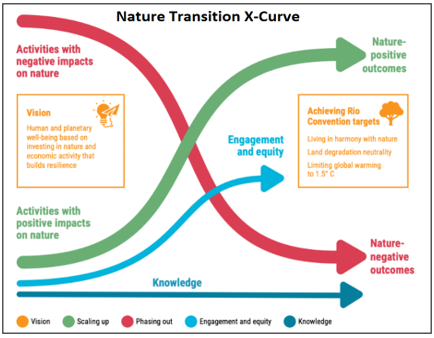
- This report also introduced the Nature Transition X-Curve, a practical framework for the transition to a nature-positive society.
Key highlights of the Report:
- Imbalance in Environmental finance: The report finds that for every $1 invested globally in protecting nature, around $30 is spent on activities that harm it, underscoring the urgent need to realign financial flows.
- Nature-negative Spending: In the year 2023, global finance directly harmful to nature reached $7.3 trillion, while investment in NbS amounted to only $220 billion.
- This 30:1 ratio in favour of nature-negative activities, is fuelling the ‘triple crisis’ of climate change, biodiversity loss and pollution
- Private Nature-negative finance: Of the $7.3 trillion spent on nature-negative activities in 2023, approximately $4.9 trillion came from private investment, largely concentrated in sectors such as utilities, industrials, energy, and basic materials.
- By 2024, private nature-negative finance had risen further, increasing 12% to $5.5 trillion.
- Public subsidies driving Nature-negative finance: Another $2.4 trillion flowed through environmentally harmful public subsidies, primarily supporting fossil fuels, agriculture, and water use.
- Decline in Private Oil and Gas Investment: Private investment in oil and gas activities harmful to nature dropped sharply, from nearly $1 trillion in 2020 to $519 billion in 2023.
- This 50% reduction over four years reflects increasing recognition of nature-related risks as significant to financial stability, as well as the falling costs of renewable energy production.
- Finance into Nature-based solutions: Finance for NbS reached $220 billion in 2023, with public domestic expenditure emerging as the largest contributor at $190 billion, marking a 4% increase from 2022.
- Spending on biodiversity and landscape protection rose 11%, reflecting government commitments to scale up conservation funding in line with Global Biodiversity Framework (GBF) targets.
- Public international finance for NbS, delivered through Official Development Finance (ODF), continued to grow, reaching $6.8 billion in 2023, a 21% increase from 2022.
- Private investment in NbS stood at $23.4 billion in 2023.
- Financing gap: According to UNEP, although finance for NbS has grown, it remains far below the levels needed to achieve the Rio Convention targets on biodiversity, climate action, and land restoration.
- Current annual NbS finance of $220 billion needs to rise more than 2.5 times to $571 billion by 2030, equivalent to just 0.5 % of global GDP.
- and more than triple to $771 billion by 2050 to stay aligned with Rio goals.
- Regional disparities: In 2023, government spending on NbS was highest in Asia at $93 billion, despite a 4% decline compared with 2022.
- North America followed with $59 billion, recording a 19% increase.
- Europe accounted for $34 billion, with 12% growth.
- In contrast, NbS spending fell sharply in Africa, the Middle East, and Oceania, declining by 76%, 11%, and 4% respectively.
UNEP’s recommendations to minimise the nature finance gap:
- Reform in subsidies: Environmentally damaging subsidies and direct public spending need to be reformed to support the Rio Convention targets.
- Enhanced Government investment: Government investment for nature-based solutions, especially in areas that provide critical public goods should be increased.
- Strengthened Oversight: Effective regulation and incentives are needed to align investment decisions with the value of nature and ecosystem services.
- Mandate disclosure of nature-related risks: Organizations should be required to report nature-related risks and impacts, helping to shift financial incentives toward sustainable practices.