
SYLLABUS
GS 2: Government policies and interventions for development in various sectors and issues arising out of their design and implementation.
GS 3: Conservation, environmental pollution and degradation, environmental impact assessment.
Context: Recently, the Ministry of Environment, Forest and Climate Change notified the Solid Waste Management (SWM) Rules, 2026, superseding the Solid Waste Management Rules, 2016.
More on the News
- The rules, notified under the Environment (Protection) Act, 1986, introduce an enhanced compliance framework effective from April 1, 2026.
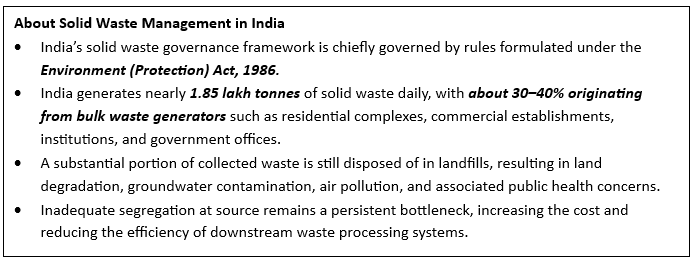
- They mandate source-level waste processing by bulk generators, who contribute approximately one-third of India’s total solid waste, thereby strengthening decentralised waste management.
- The revised rules integrate the principles of Circular Economy and Extended Producer Responsibility, with a specific focus on efficient waste segregation and management.
Key Provisions of the 2026 Rules
Waste Management Measures
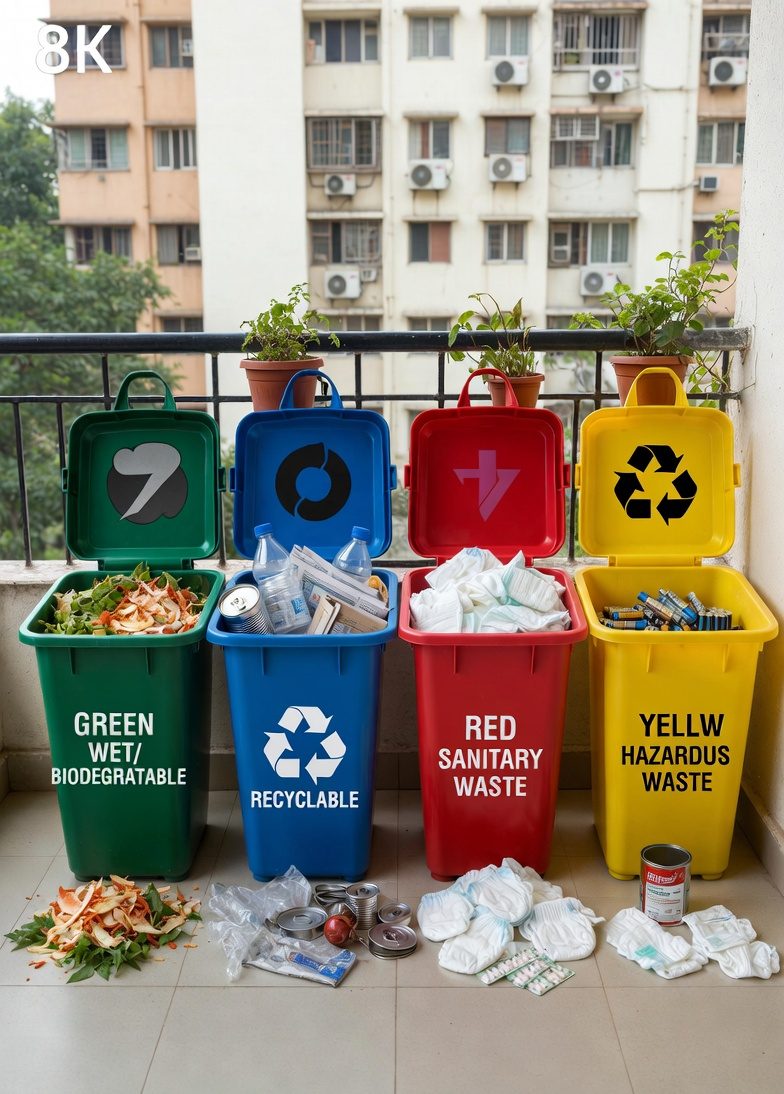
- Source Segregation Norms: Waste generators are required to segregate waste at the source into four categories—wet, dry, sanitary, and special care waste (domestic hazardous waste).
- Landfill Use Guideline: Sanitary landfills are permitted to accept only non-recyclable, non-energy-recoverable waste along with inert materials. Higher landfill charges are imposed on unsegregated waste than on the cost of processing segregated waste, to discourage indiscriminate dumping.
- EBWGR Compliance: Under the Extended Bulk Waste Generator Responsibility (EBWGR), bulk waste generators must process wet waste on-site or obtain certification for off-site processing.
- Criteria for Bulk Generators: Entities are classified as bulk waste generators if they exceed 20,000 sq. m of built-up area, consume over 40,000 litres of water daily, or generate more than 100 kg of waste per day.
- Role of Material Recovery Facilities: Material Recovery Facilities (MRFs) are formally designated as centres for segregation of recyclables and for handling special waste streams, including e-waste.
- Mandatory Use of Refuse-Derived Fuel (RDF): Industrial units relying on solid fuels, such as cement plants and waste-to-energy facilities, are required to substitute a portion of their fuel with RDF. The share of RDF in fuel usage is to be progressively increased from 5% to 15% over a six-year period.
- Obligations for the Hospitality Sector: Hotels and restaurants located in ecologically sensitive areas must adopt decentralised systems for processing their wet waste.
Regulatory Oversight Framework
- Polluter-Pays Enforcement: For the first time, Environmental Compensation (EC) is imposed for violations such as misreporting, operating without registration, and improper waste handling.
- Land-Use Planning Norms: The rules introduce graded land-use allocation criteria, along with buffer zones, based on the processing capacity of waste management facilities.
- Audit and Oversight: State Pollution Control Boards (SPCBs) are required to conduct annual landfill audits under the supervisory oversight of District Collectors.
- Buffer Zone Guidelines: The Central Pollution Control Board (CPCB) will prescribe buffer-zone norms for facilities handling more than 5 tonnes of waste per day.
- Digital Monitoring Mechanism: A centralised online portal has been established to track the entire waste lifecycle, facilitate facility registration, and manage mandatory audit reporting.
- Promotion of Carbon Credits: Urban local bodies are encouraged to generate carbon credits through efficient and sustainable waste management practices.
- Regulation in Tourist Areas: Local bodies in hilly regions and island territories are authorised to levy user fees on tourists and regulate visitor inflow.
Significance of Solid Waste Management (SWM) Rules, 2026
- Promotion of Decentralised Waste Management: Mandatory on-site processing by bulk generators reduces the burden on municipal infrastructure and improves efficiency at the source.
- Shift towards Circular Economy: Emphasis on segregation, recycling, and RDF usage enables resource recovery and reduces dependence on landfills.
- Reduction in Landfill Dependency: Strict landfill restrictions and disincentives for unsegregated waste help minimise environmental pollution and land use pressures.
- Enhanced Accountability through Polluter-Pays Principle: Environmental Compensation (EC) ensures that violators are held financially responsible, strengthening compliance and deterrence.
- Technology-Driven Monitoring and Governance: Digital tracking systems improve transparency, traceability, and enforcement of waste management practices.
Key Challenges Related to Solid Waste Management in India
- Weak Source Segregation Compliance: Despite mandates, segregation at source remains inconsistent due to low public awareness and behavioural gaps, undermining effective waste processing.
- Capacity Constraints of Urban Local Bodies (ULBs): Many ULBs lack adequate financial resources, technical expertise, and infrastructure to implement advanced waste management systems.
- Enforcement and Monitoring Gaps: Ensuring compliance with provisions like Environmental Compensation and digital tracking may be difficult due to institutional weaknesses and limited manpower.
- High Compliance Burden on Bulk Waste Generators: Mandatory on-site processing and certification requirements may increase operational costs and face resistance from residential and commercial entities.
- Limited Waste Processing Infrastructure: Insufficient number of Material Recovery Facilities (MRFs), waste-to-energy plants, and RDF utilisation units may hinder full implementation of the rules.
Way Forward
- Strengthening Source Segregation: Intensive awareness campaigns, behavioural nudges, and strict enforcement at the household and institutional level are needed to ensure effective segregation at source.
- Enhancing Capacity of Urban Local Bodies (ULBs): Adequate financial support, capacity building, and adoption of modern technologies are essential to improve the planning and execution of waste management systems.
- Expanding Waste Processing Infrastructure: Scaling up Material Recovery Facilities (MRFs), composting units, and waste-to-energy plants is crucial to bridge the gap between waste generation and processing capacity.
- Leveraging Technology: Effective utilisation of digital platforms for real-time tracking, data transparency, and compliance monitoring can strengthen enforcement and accountability.
- Promoting Public-Private Partnerships (PPP): Encouraging private sector participation and market linkages for recycled products and RDF can enhance efficiency and ensure long-term sustainability.