
SYLLABUS
GS-3: Conservation, environmental pollution and degradation, environmental impact assessment.
Context: The Union Ministry of Environment, Forest and Climate Change has notified the Solid Waste Management (SWM) Rules, 2026, superseding the Solid Waste Management Rules, 2016.
More on the News
• The rules have been notified under the Environment (Protection) Act, 1986 and will come into full effect from April 1, 2026.
• The rules introduce a more enforceable and compliance-driven framework for urban and rural waste management.
• The revised rules integrate the principles of Circular Economy and Extended Producer Responsibility, with a specific focus on efficient waste segregation and management.
Key reasons for the Introduction of the SWM Rules 2026.
• India generates over 620 lakh tonnes of solid waste annually, putting severe pressure on landfills.
• Implementation gaps under the 2016 Rules led to poor segregation and overburdened urban local bodies.
• The Centre aims to promote a circular economy by prioritising reduction, reuse and recycling.
• There was a need to shift responsibility from municipalities alone to all waste generators.
Key Changes Introduced Under SWM Rules, 2026
• Mandatory Four-Stream Segregation at Source
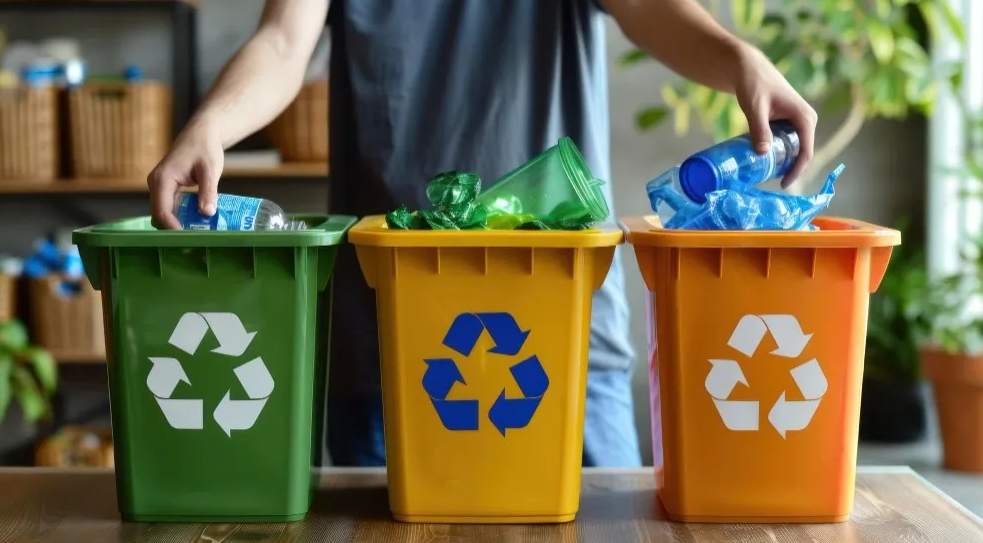
- Solid waste must be segregated into wet waste, dry waste, sanitary waste and special care waste at the source.
- Wet waste, such as kitchen and food waste must be composted or processed through bio-methanation.
- Dry waste like plastic paper metal and glass must be sent to Material Recovery Facilities for sorting and recycling.
- Sanitary waste must be securely wrapped and stored separately for safe handling.
- Special care waste including medicines bulbs and paint containers must be collected by authorised agencies or designated centres.
• Clear Definition and Expanded Responsibility of Bulk Waste Generators
- Bulk Waste Generators are defined based on floor area, water consumption or daily waste generation thresholds.
- Government bodies, institutions, commercial establishments and residential societies fall under this category.
• Introduction of Extended Bulk Waste Generator Responsibility (EBWGR)
- Bulk waste generators must process wet waste on-site as far as possible.
- Where on-site processing is not feasible, an EBWGR compliance certificate must be obtained.
- This framework targets improved accountability as bulk generators contribute nearly one-third of total waste generation.
• Digital Tracking: Development of a Centralised Online Portal to track all stages of solid waste management, including waste generation, collection, transportation, processing and disposal, as well as biomining and bioremediation of legacy waste dump sites.
• Faster Land Allocation for Waste Processing Facilities
- Graded criteria have been introduced to enable quicker land allocation for waste processing and disposal facilities.
- A buffer zone must be maintained within the total land allotted for facilities with a capacity above five tonnes per day.
- The Central Pollution Control Board will issue guidelines on buffer zones based on pollution load and capacity.
• User Fees & Polluter Pays Principle:
- Allow for the levy of user fees on waste generators as per the bye-laws of local bodies.
- Provide for the levy of environmental compensation based on the ‘Polluter Pays’ principle for non-compliance, including cases of operating without registration, false reporting, submission of forged documents or improper solid waste management practices.
• Strengthened Role of Local Bodies and Material Recovery Facilities
- Local bodies are responsible for coordinated collection, segregation and transportation of waste.
- Material Recovery Facilities are formally recognised as centres for sorting and deposition of multiple waste streams.
- MRFs may also serve as collection points for e-waste, sanitary waste and special care waste.
- Rural sanitation departments must give special focus to peri-urban areas.
- Local bodies are encouraged to generate carbon credits through improved waste management practices.
• Mandatory Use of Refuse-Derived Fuel by Industries
- Refuse Derived Fuel is defined as fuel derived from high calorific non-recyclable municipal waste.
- Industries using solid fuel must progressively replace it with RDF.
- The substitution target will increase from five percent to fifteen percent over six years.
• Stricter Restrictions on Landfilling and Legacy Waste Management
- Landfills are restricted to inert waste and waste that cannot be recycled or used for energy recovery.
- Higher landfill fees will be imposed for disposal of unsegregated waste.
- Annual landfill audits will be conducted by State Pollution Control Boards under district oversight.
- All legacy dumpsites must be mapped, assessed and remediated through biomining and bioremediation.
• Special Provisions for Hilly Areas and Islands
- User fees may be levied on tourists to manage waste in ecologically sensitive regions.
- Tourist inflow may be regulated based on available waste management capacity.
- Designated collection points will be created for non-biodegradable waste.
• Institutional Mechanism for Effective Implementation
- Central and State-level committees will be established to support implementation.
- State or Union Territory level committees chaired by Chief Secretaries will recommend measures to the CPCB.
How SWM Rules, 2026 Differ from SWM Rules, 2016
• The 2016 Rules focused mainly on municipal responsibility and advisory compliance.
• The 2026 Rules assign shared legal responsibility to households, institutions and bulk generators.
• Segregation norms are stricter with clearer enforcement mechanisms.
• Penalties and tracking systems are more explicit and technology-driven.
• Legacy waste remediation receives stronger regulatory emphasis.