
SYLLABUS
GS-3: Indian Economy and issues relating to planning, mobilisation of resources, growth, development and employment.
Context: Recently, the NITI Aayog launched a policy report titled “Revitalising Apprenticeship Ecosystem: Insights, Challenges, Recommendations and Best Practices.”
More on the News
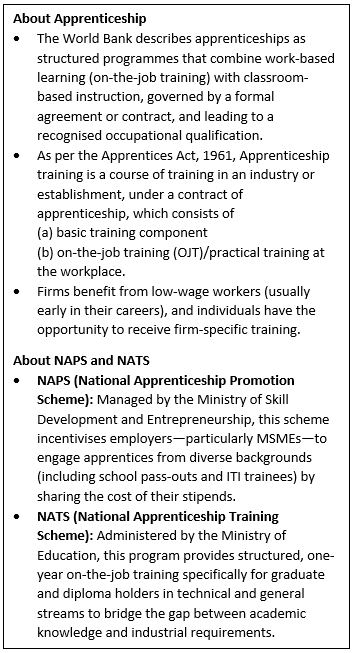
- The report outlines a comprehensive strategy to reposition apprenticeships as a powerful linkage between education and employment, with the objective of harnessing India’s demographic dividend to achieve the vision of Viksit Bharat @2047.
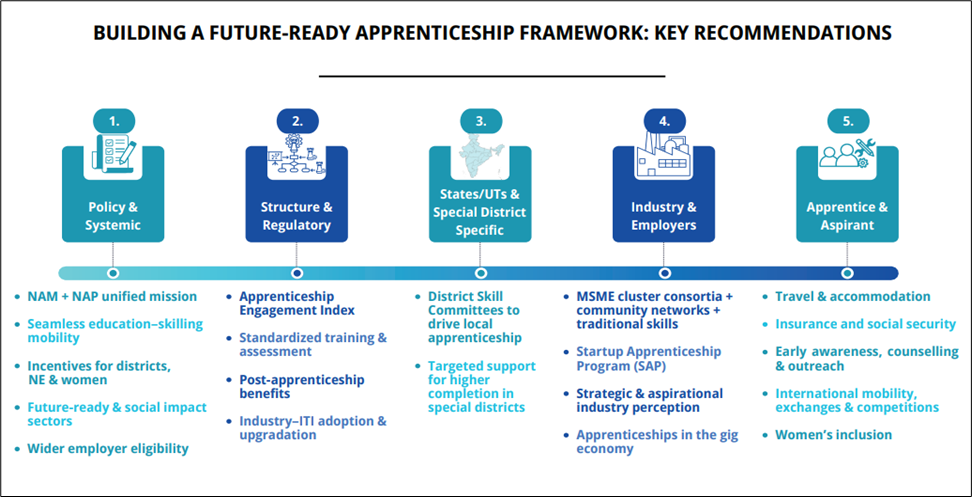
- The report presents 20 action-oriented recommendations along with an action plan, assigning implementation responsibilities and measurable performance metrics for each of the recommendations.
- It categorises recommendations into 5 interlinked pillars:
- policy and systemic reforms
- structural and regulatory strengthening
- state and district-specific interventions
- industry and employer engagement
- apprentice-and aspirant-level support mechanisms.
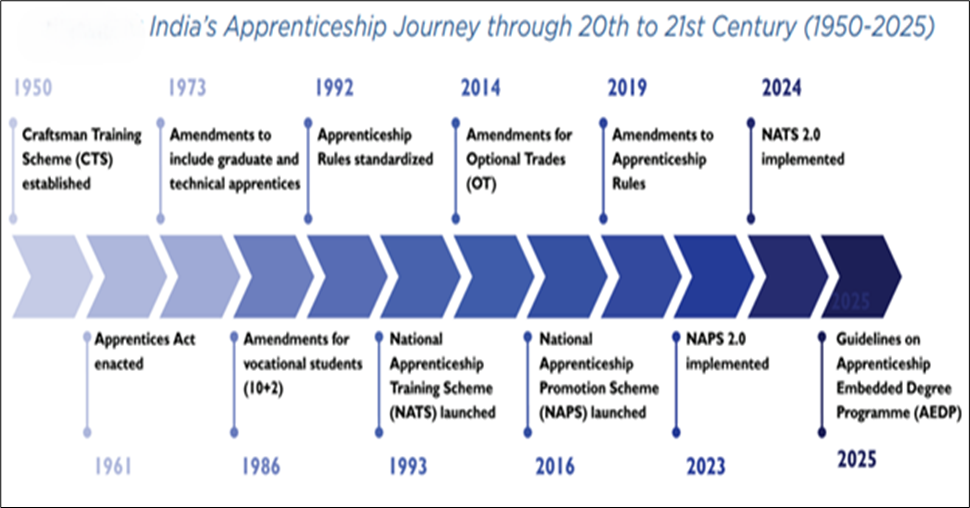
- The study was conceptualised and designed by the Skill Development and Employment Division of NITI Aayog, and it undertook a comprehensive review of the evolution of the Apprentices Act, 1961, including its subsequent amendments and regulatory refinements.
- It utilised secondary data from official public platforms, including the National Apprenticeship Promotion Scheme (NAPS) portal and the National Apprenticeship Training Scheme (NATS) dashboard.
Key Highlights of the Report
- National Trends in Apprenticeship:
- Analyses national performance indicators such as registered establishments, active contracts, completion rates, and dropout patterns to assess systemic growth and efficiency.
- Examines enterprise size, sectoral spread, and gender participation to understand inclusivity and industrial depth of apprenticeship adoption. Higher participation among large enterprises compared to MSMEs reflects uneven engagement.
- Trends and Insights: States and Special Regions:
- Provides State-wise and district-wise performance analysis from FY 2018–19 to FY 2024–25 to map regional progress and disparities.
- Categorises States into top and bottom performers to identify replicable models and lagging regions. High-performing States demonstrate strong industry convergence and institutional capacity.
- Stakeholder Consultations:
- Synthesises inputs from government bodies, industry associations, multilateral agencies, and domain experts to ground the analysis in field realities.
- Identifies operational bottlenecks and innovative practices emerging from State and sector-level experimentation.
- Unpacking the Roadblocks:
- Diagnoses structural and systemic constraints such as limited industry participation, regulatory complexity, and quality assurance gaps. Small firms often lack the administrative capacity to comply with apprenticeship norms.
Key Recommendation of the Report
- Policy and Systemic Reforms
- Proposes a unified apprenticeship mission, such as the National Apprenticeship Mission (NAM), accessible through a single digital platform, the National Apprenticeship Portal (NAP).
- Recommends structured pathways for seamless education–skilling mobility to enable vertical and lateral progression.
- Structure and Regulatory Recommendations
- Call for introduction of an Apprenticeship Engagement Index (AEI) for States and UTs to benchmark performance and promote competitive federalism.
- States/UTs and Special District-Specific Interventions
- Strengthens District Skill Committees to drive localised planning, coordination, and industry alignment.
- Recommends targeted institutional support for special and aspirational districts to improve completion outcomes.
- Expands eligibility criteria and engagement bands to widen establishment participation.
- Proposes an Apprenticeship-Linked Incentive framework for aspirational districts, North Eastern States, and women apprentices.
- Industry and Employers
- Promotes MSME cluster consortia, community-based networks, and integration of traditional skills to deepen outreach.
- Repositions apprenticeship as a strategic investment tool for productivity, competitiveness, and workforce planning.
- Apprentice and Aspirant Empowerment
- Enhances global competitiveness through international mobility pathways, exchange programmes, and skill competitions.
- Advances women’s inclusion through targeted outreach, enabling policies, and supportive institutional mechanisms.