
SYLLABUS
GS-3: Indian Economy and issues relating to Planning, Mobilization of Resources, Growth, Development and Employment.
Context: The Reserve Bank of India (RBI)’s special USD-INR forex swap facility has mobilised $72.85 billion in foreign-currency inflows as of August 21, 2026. The facility was introduced to augment forex liquidity, strengthen domestic liquidity and support orderly conditions in the foreign-exchange market.
More on the News
- The RBI introduced the special USD-INR forex swap facility on June 8, 2026, covering FCNR(B) deposits, External Commercial Borrowings (ECBs) and Overseas Foreign Currency Borrowings (OFCBs).
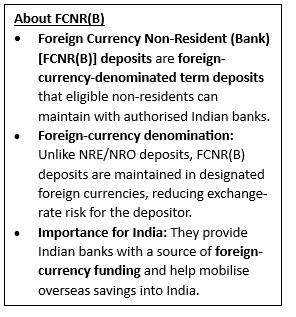
- As of August 21, 2026, authorised dealer banks had reported $72.85 billion in total inflows—$65.397 billion through FCNR(B), $4.860 billion through OFCBs and $2.591 billion through ECBs.
- FCNR(B) deposits accounted for nearly 90% of the mobilisation, making them the dominant channel under the facility.
- On August 14, 2026, the RBI advanced the closure of the FCNR(B) mobilisation window from September 30 to August 31, citing the encouraging response and resultant forex inflows.
Understanding RBI’s USD-INR Forex Swap Facility
- What is a Forex Swap?
- A forex swap involves the exchange of currencies for a specified period with an agreement to reverse the transaction at a predetermined future date and rate.
- Under the facility, the RBI receives foreign currency and provides rupee liquidity to banks, while assuming a corresponding forward obligation.
- How does the Facility Work?
- Banks mobilise eligible foreign-currency resources through FCNR(B) deposits, ECBs and OFCBs and enter them into the swap arrangement with the RBI.
- The concessional terms lower the effective cost of hedging these resources, incentivising banks to mobilise additional foreign currency.
- Policy Objective: The facility was introduced when the rupee and India’s forex reserves were under pressure, with the objective of augmenting forex liquidity, strengthening domestic liquidity and supporting the foreign-exchange market.
- Why FCNR(B) Dominated: The combination of concessional/zero-cost hedging arrangements and attractive deposit rates made FCNR(B) mobilisation particularly attractive, resulting in its overwhelming share of the total inflows.
Significance for India
- Strengthening Forex Liquidity: The facility has mobilised substantial foreign-currency resources, improving dollar availability in the domestic financial system and strengthening India’s external liquidity position.
- Supporting External Stability: Additional foreign-currency resources provide a buffer against external financing pressures and global financial volatility, complementing India’s existing forex reserves.
- Easing Pressure on the Rupee: Greater dollar availability can moderate excess demand for foreign currency and help reduce pressure on the rupee, although the facility does not by itself guarantee rupee appreciation.
- Supporting Banking-System Liquidity: The swap provides banks with rupee liquidity against eligible foreign-currency resources, supporting domestic liquidity while enabling the RBI to manage forex liquidity.
- Enhancing External Resilience: The mobilisation of foreign-currency resources, alongside India’s substantial reserves, strengthens its capacity to respond to external shocks and volatile capital flows.
Concerns and Limitations
- Not a Permanent Addition to Reserves: The $72.85-billion mobilisation should not be treated as an equivalent permanent addition to India’s forex reserves, since the swap creates corresponding forward obligations for the RBI.
- Liability Component: FCNR(B) deposits and foreign-currency borrowings represent liabilities of banks, so their maturity and repayment obligations must be considered while assessing the external-sector benefit.
- Cost of Concessional Hedging: The favourable swap terms entail a cost for the RBI. An SBI Research estimate cited by Indian Express put the potential hedging cost at around 15% of the amount raised, but this is an estimate and should not be presented as an official RBI cost.
- Limited Sustainability: The exceptional mobilisation partly reflects the attractiveness of a temporary concessional facility; similar inflows cannot be assumed to continue after the special window closes.
Way Forward
- Use as a Targeted Policy Instrument: Forex swaps should primarily remain a counter-cyclical liquidity-management tool during periods of external stress rather than substitute for structural sources of foreign exchange.
- Strengthen Structural Forex Sources: India should deepen durable sources of foreign exchange through exports, FDI, remittances and stable long-term capital flows to reduce reliance on temporary policy-driven mobilisation.
- Enhance Transparency and Risk Management: The RBI should maintain transparency regarding the cost, maturity profile and forward obligations associated with swap operations while carefully managing the associated balance-sheet risks.
- Maintain Policy Balance: Future interventions should balance rupee stability, forex liquidity, domestic liquidity and financial-system stability, while avoiding excessive dependence on temporary central-bank support.