
SYLLABUS
GS-3: Awareness in the fields of Space.
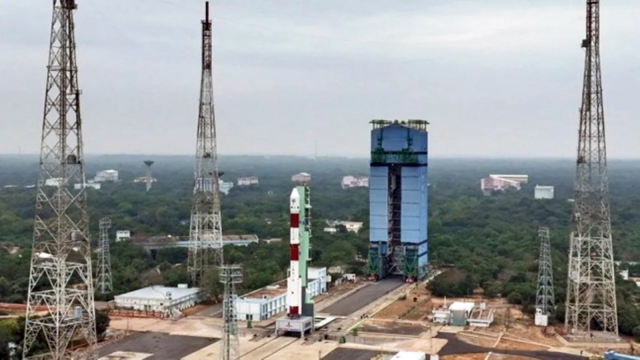
Context: India’s first industry-built Polar Satellite Launch Vehicle (PSLV-N1) is expected to undertake its maiden launch in the first quarter of 2027, marking a major milestone in private-sector participation in India’s space programme.
About PSLV-N1
- Developer: HAL–L&T consortium.
- Contracting agency: NewSpace India Limited (NSIL), the commercial arm of ISRO.
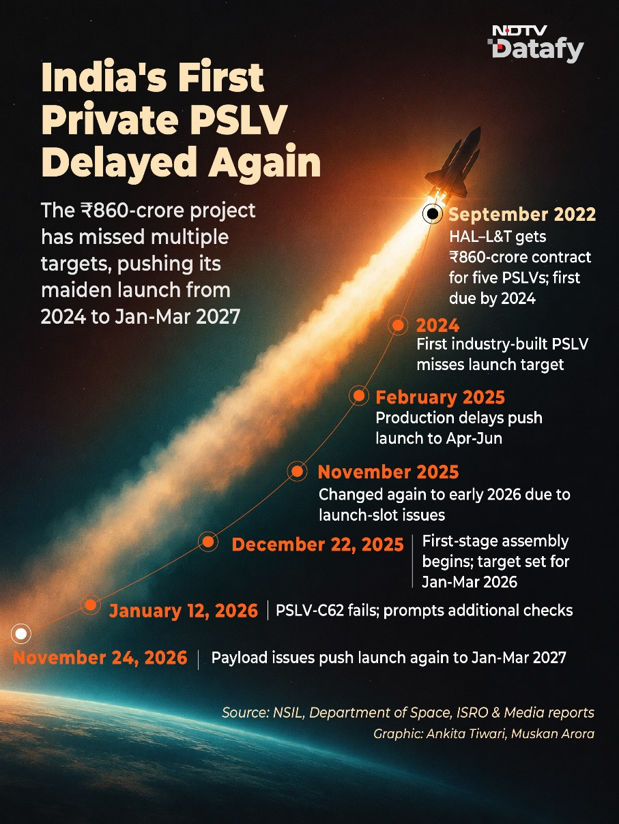
- Contract: Awarded in September 2022, worth approximately ₹860 crore, for manufacturing five PSLV-XL rockets.
- Original timeline: First vehicle within 24 months (2024), followed by one vehicle every six months, with all five to be delivered by 2026.
- Revised launch: First quarter of 2027, as announced by ISRO Chairman V. Narayanan on 24 November 2026.
- Intended payload: EOS-10, an Earth Observation Satellite.
- Key feature:
- Earlier, ISRO manufactured PSLV rockets with support from private industries supplying components and equipment.
- Under this initiative, the HAL–L&T consortium has been entrusted with the end-to-end realisation of the launch vehicle, rather than merely acting as a component supplier.
- This marks a transition towards industry-led manufacturing of operational launch vehicles in India.
Reasons Behind the Delay
- Payload Coordination and Launch Window: Coordination with the satellite payload and availability of a suitable launch window have delayed the launch, although the vehicle itself is ready.
- Consecutive PSLV Failures: ISRO has adopted a cautious approach following the failures of PSLV-C61 (18 May 2025) and PSLV-C62 (12 January 2026), both of which experienced third-stage anomalies.
- Changes in Component Suppliers: Following recommendations of the Failure Assessment Committee, suppliers of certain components were changed to address reliability concerns.
Need and Significance of PSLV-N1
- Greater Private-Sector Participation: Transfers end-to-end manufacturing responsibility to Indian industries, reducing ISRO’s manufacturing burden while encouraging private investment and innovation.
- Strengthening Atmanirbhar Bharat: Promotes indigenous launch vehicle manufacturing and domestic supply chains, reducing dependence on foreign suppliers for critical space technologies.
- Expanding India’s Space Economy: Strengthens the growing space ecosystem of around 440 start-ups through greater industrial participation and institutional support from ISRO and IN-SPACe.
- Strengthening Strategic and Operational Capabilities: Greater satellite deployment will strengthen India’s communication, navigation, Earth observation, national security and disaster management capabilities, particularly as India currently has only 56 space assets in orbit.
- Promoting Indigenous Space Components: The proposed Space Components Mission aims to develop indigenous space-grade electronics, radiation-hardened semiconductors, sensors, propulsion systems, advanced materials and mechanisms.
- Supporting Viksit Bharat 2047: Greater participation of private industries, start-ups and academia will accelerate India’s space capabilities and strengthen its position in the global commercial and strategic space sectors.
About the Polar Satellite Launch Vehicle (PSLV)
- Developed by: Indian Space Research Organisation (ISRO).
- First launch: 1993.
- Type: Expendable medium-lift launch vehicle.
- Weight: Approximately 320 tonnes.
- Payload capacity: Around 1,750 kg to a 600-km Sun-Synchronous Polar Orbit.
- Nickname: Workhorse of ISRO.
- Key Features:
- Primarily used to launch satellites into Sun-Synchronous Polar Orbit (SSPO).
- Also capable of placing satellites into higher orbits.
- Has supported India’s domestic space programme and launched satellites for international customers.
- According to the supplied report, PSLV has powered 65 of ISRO’s 107 launches, with four failures reported in that account.