
SYLLABUS
GS-3: Conservation, environmental pollution and degradation, environmental impact assessment.
Context: Recently, Union Minister for Environment, Forest and Climate Change announced that Project Great Indian Bustard (GIB) has entered its fourth year of captive breeding with the hatching of two new chicks, raising the total number of birds in captivity to 70.
More on the News
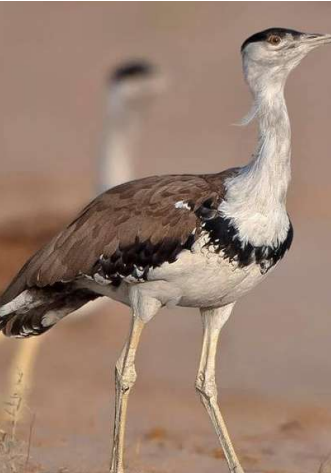
• The two chicks were hatched at the Conservation Breeding Centre in Rajasthan, a key facility for the species’ recovery.
• Of the two chicks one was born through natural mating and the other through artificial insemination, indicating success in assisted breeding techniques.
• The development represents a significant milestone under Project GIB, which aims to revive the critically endangered species.
About the Project Great Indian Bustard (GIB)
• It is an ambitious conservation programme launched on 5 June 2013 by the Government of Rajasthan to conserve the critically endangered Great Indian Bustard (Ardeotis nigriceps), locally known as Godawan.
• The project marks a significant step towards conservation of neglected species and is especially important as the Great Indian Bustard is the State Bird of Rajasthan.
• The project was initially implemented in the Desert National Park (DNP), Jaisalmer.
• Objectives of Project GIB:
- Protection and recovery of the Great Indian Bustard population
- Conservation and restoration of its natural habitat
- Reduction of threats such as poaching and habitat degradation
- Community participation and awareness generation
• Population Decline Trend: The population declined sharply from over 1,000 individuals a few decades ago to 745 (1978), 600 (2001), 300 (2008), and about 125 (2013).
About the Great Indian Bustard
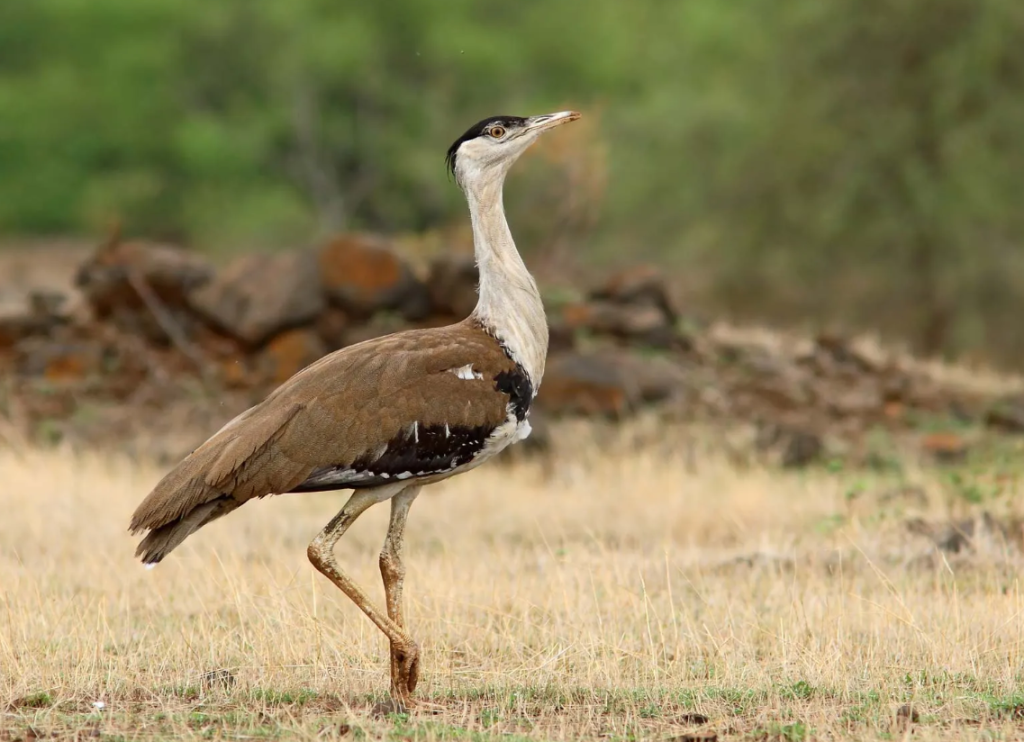
• Scientific Name: Ardeotis nigriceps.
• Also known as the Godawan, the state bird of Rajasthan.
• One of the largest flying birds endemic to India.
• Among the heaviest Flying birds in the world.
• GIBs are the largest among the 4 bustard species found in India
- (The other three MacQueen’s bustard, lesser florican, and the Bengal florican).
• Habitat: Open grasslands and semi-arid regions.
- Being terrestrial birds, they spend most of their time on the ground, taking flight only occasionally to move between different parts of their habitat.
• Omnivorous Diet: Insects, lizards, grass seeds, etc.
• Status:
- Current estimated population is below 150.
- Mainly found in Rajasthan (85% of the total population in India) and Gujarat, with small populations in Maharashtra, Karnataka, and Andhra Pradesh.
• Threats:
- Injury and death due to collisions with power lines due to poor vision.
- Hunting, poaching for eggs, predation, and habitat loss.
• Conservation Status:
- IUCN Red List status of Great Indian Bustard: Critically Endangered
- Wildlife Protection Act, 1972: Schedule I
- Convention on the Conservation of Migratory Species of Wild Animals (CMS): Appendix I
- Convention on International Trade in Endangered Species of Wild Fauna and Flora (CITES): Appendix 1.
Major Conservation Initiatives for the GIB
• National Bustard Recovery Programme (2013–16; Phase II: 2024–33): A long-term MoEFCC–WII initiative focused on habitat restoration and conservation breeding to create a viable founder population of the critically endangered Great Indian Bustard, with a ₹56 crore outlay for 2024–33.
• CAMPA-Funded Conservation Action Plan (2024): CAMPA has approved ₹77.05 crore for a five-year Conservation Action Plan for the Great Indian Bustard and Lesser Florican, focusing on integrated conservation measures.
• Integrated GIB Conservation Programme (2016): A ₹33.85 crore CAMPA-supported programme titled “Habitat Improvement and Conservation Breeding of GIB” that established breeding centres (Sam & Ramdeora), initiated captive breeding, and advanced ecological research and habitat management.
• Conservation Action Plan for GIB & Lesser Florican: A comprehensive strategy combining in-situ and ex-situ conservation, including surveys, artificial insemination, telemetry tracking, habitat improvement, predator control, and community participation.
• India–UAE Collaboration on GIB Conservation: An MoU between the Wildlife Institute of India and the International Fund for Houbara Conservation (UAE) to promote collaborative research and conservation of the Great Indian Bustard.
• Project Godawan (2013, Rajasthan Government): A state-led conservation programme in Desert National Park, Jaisalmer, focusing on habitat management, predator control, and captive breeding to protect the remaining GIB population.