
SYLLABUS
GS-3: Achievements of Indians in science & technology; indigenization of technology and developing new technology.
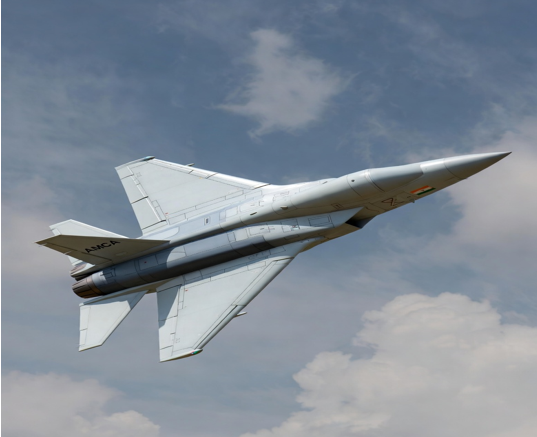
Context: Recently, the Defence Research and Development Organisation (DRDO) shortlisted three industry contenders to design and build prototypes of the Advanced Medium Combat Aircraft (AMCA).
More on the News
- The selected bidders include Tata Advanced Systems Ltd as a standalone applicant, a consortium of Larsen & Toubro and Bharat Electronics Limited, and another consortium comprising Bharat Forge, BEML Limited and Data Patterns.
- It is expected to produce over 125 fighter jets that could be ready for induction into the Air Force by 2035.
- India would then join a small list of countries with fifth-generation fighters like the US (F-22 and F-35), China (J-20), and Russia (Su-57).
- The shortlisted bidders are expected to receive funding support from the government to build models of the AMCA before manufacturing rights are given.
- The Aeronautical Development Agency (ADA), under the Ministry of Defence, will spearhead the AMCA project.
About Advanced Medium Combat Aircraft (AMCA)
- The Advanced Medium Combat Aircraft (AMCA) is India’s ambitious indigenous programme to develop a fifth-generation stealth multirole fighter jet.
- A fifth-generation fighter aircraft (FGFA) integrates advanced stealth, supercruise (achieving supersonic speeds without afterburners), super-manoeuvrability, data fusion, and multi-sensor integration into a single fighter aircraft.
- The development of AMCA will build upon the expertise gained in developing Light Combat Aircraft (LCA) Tejas.
- LCA Tejas is a 4.5-generation single-engine multi-role aircraft.
- Key Features of AMCA:
- Stealth: The 25-tonne twin-engine aircraft will have advanced stealth features to avoid detection by enemy radar.
- Fuel & Weapons: The aircraft will have a large, concealed internal fuel tank of 6.5-tonne capacity and an internal weapons bay for a range of weapons to be carried in its belly.
- Engine: The AMCA Mk1 variant will have the US-built GE414 engine of the 90kN (kilonewton) class.
- The AMCA Mk2 will be more advanced and powered by a stronger engine of 110kN, which will be developed indigenously by the Gas Turbine Research Establishment (GTRE)in collaboration with French defence major Safran.
Recent Developments Related to FGFA in India
- GE Engines: The initial MK1 squadrons will be powered by American GE-F414 engines. Negotiations for 80% transfer of technology (ToT) for co-production in India were finalised.
- F414 is a more powerful, larger derivative of the F404, offering significantly higher thrust (98 kN for F414 vs. 84 kN for the F404). This engine is earmarked for the LCA Mk-2 programme and Advanced Medium Combat Aircraft (AMCA) prototypes.
- Safran Partnership: A significant deal was confirmed with France’s Safran to co-develop a new, more powerful 110-120 kN thrust engine for the advanced AMCA MK2 variant.
Significance of AMCA for India
- Strategic importance: It is critical for addressing the growing “China-Pakistan fighter axis”. China has already deployed the J-20, and Pakistan is expected to procure the J-35 fifth-generation fighters from China.
- Aatmanirbhar Bharat (Self-Reliance): The project reduces long-term dependence on expensive foreign imports and allows India to control its own technological upgrades and maintenance.
- Private Sector Integration: For the first time in a major fighter project, India has opened the program to private sector participation through a collaborative execution model.
- Filling the Capability Gap: It will help the Indian Air Force move closer to its sanctioned squadron strength of 42 and address the existing shortfall in operational squadrons.