
SYLLABUS
GS-1: Urbanization, their problems and their remedies.
Context: The Ministry of Housing and Urban Affairs (MoHUA) has launched the operational guidelines for the Urban Challenge Fund (UCF) along with the Credit Repayment Guarantee Credit Sub-Scheme (CRGSS), marking a major step towards market-linked urban infrastructure financing.
More on the News
- The UCF aims to mobilise a total of ₹4 lakh crore (including ₹1 lakh crore central assistance) for urban development between FY 2025–26 and FY 2030–31.
- It focuses on Tier-II and Tier-III cities, including hilly and North-Eastern regions, to strengthen urban development.
- Key sectors include redevelopment of old city areas, urban mobility, last-mile connectivity, non-motorised transport, water & sanitation, and climate-resilient infrastructure.
- Of the total outlay, ₹90,000 crore has been earmarked for projects, while ₹5,000 crore each will support project preparation, capacity building and ₹5,000 crore for the Credit Repayment Guarantee Sub-Scheme.
- The initiative aims to make cities financially viable, strengthen ULBs, and support the vision of Viksit Bharat @2047.
About Urban Challenge Fund (UCF)
- The Fund gives effect to the Government’s vision announced in Budget 2025–26 to implement proposals relating to Cities as Growth Hubs, Creative Redevelopment of Cities, and Water and Sanitation.
- Aim:
- UCF aims to leverage market finance, private participation, and citizen-centric reforms to deliver high-quality urban infrastructure.
- It seeks to build resilient, productive, inclusive, and climate-responsive cities, positioning them as key engines of India’s next phase of economic growth while improving the financial discipline of Urban Local Bodies.
- Organisation involved:
- It is a Centrally Sponsored Scheme under the Ministry of Housing and Urban Affairs (MoHUA).
- Key Features:
- Financing Structure and Investment Scale: The Fund provides ₹1 lakh crore of Central Assistance for projects worth ₹4 lakh crore in total.
- The Centre will finance 25% of the project cost, while at least 50% must be raised from market sources, including municipal bonds, bank loans, and public–private partnerships (PPPs).
- The remaining funding will come from States, Union Territories, and Urban Local Bodies or their own sources.
- Implementation Period: The scheme will be operational from FY 2025–26 to FY 2030–31, with an extendable implementation period up to FY 2033–34.
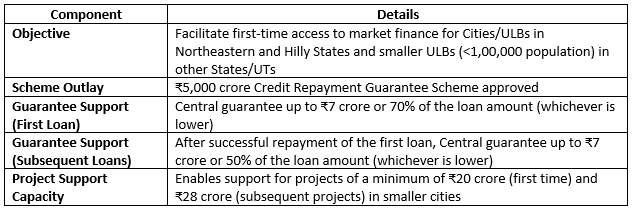
- A dedicated ₹5,000 crore corpus will enhance the creditworthiness of 4223 cities, including Tier- II and Tier-III cities, particularly for first-time access to market finance.
- Financing Structure and Investment Scale: The Fund provides ₹1 lakh crore of Central Assistance for projects worth ₹4 lakh crore in total.
- Challenge-Based Selection Framework: Projects under the Fund will be selected through a challenge-based framework, including transformative impact, sustainability & reform orientation.
- Funding will be linked to reforms, milestones and clearly defined outcomes. Continuation of reforms will be a prerequisite for further fund release.
- Focus Areas / Project Verticals: The Fund will support three major categories of projects:
- Cities as Growth Hubs: Identification of city regions and important economic nodes, integrated spatial economic and transit planning, development of greenfield and semi-greenfield areas, development along transit and economic corridors, urban mobility, and critical infrastructure projects to enhance economic competitiveness.
- Creative Redevelopment of Cities: Renewal of central business districts and heritage cores, brownfield regeneration, Transit Oriented Development, retrofitting of legacy infrastructure, climate resilience, disaster mitigation, and countermagnets to decongest existing cities in Northeastern and Hilly States.
- Water and Sanitation: Upgradation of water supply, sewerage and stormwater systems, rurban infrastructure, water grids, integrated solid waste management, and legacy waste remediation, focusing on Swachhata.
- Coverage: The Fund will cover:
- All cities with a population of 10 lakh or more (2025 estimates);
- All State and Union Territory capitals not covered above; and
- Major industrial cities with a population of 1 lakh or more.
- Additionally, all ULBs in hilly States, North-Eastern States, and smaller ULBs with a population below 1 lakh will be eligible for support under the Credit Repayment Guarantee Scheme. In principle, all cities will be covered under UCF.
- Credit Repayment Guarantee for Smaller Cities
Significance of the Fund
- Catalyses Market-Based Urban Financing: The Fund shifts urban infrastructure financing from grant-based dependency to market-linked mechanisms, thereby crowding in private investment and reducing fiscal burden on governments.
- Strengthens Municipal Financial Ecosystem: By improving creditworthiness and linking funds with reforms, it promotes better financial discipline, transparency, and governance in Urban Local Bodies (ULBs), making them viable borrowers.
- Drives Inclusive & Balanced Urbanisation: Focus on Tier-II, Tier-III, and special category regions ensures decentralised growth, reducing pressure on metros and enabling smaller cities to emerge as economic growth hubs.
- Promotes Sustainable & Resilient Urban Development: Emphasis on climate-resilient infrastructure, water management, and mobility enhances urban sustainability, service delivery efficiency, and long-term livability.