
SYLLABUS
GS-3: Issues related to direct and indirect farm subsidies and minimum support prices.
Context: Recently, the Union Cabinet has approved the Nutrient-Based Subsidy (NBS) rates for the Kharif Season 2026 (1 April 2026 – 30 September 2026) on Phosphatic and Potassic (P&K) fertilizers.
More on the News
- The government has increased subsidy rates by around 12% for Kharif 2026 to offset rising international fertilizer prices driven by geopolitical disruptions such as the West Asia crisis.
- Revised per kg subsidy rates are ₹47.32 for Nitrogen (N), ₹52.76 for Phosphorus (P), ₹2.38 for Potash (K) (unchanged), and ₹3.16 for Sulphur (S), applicable to P&K fertilizers including DAP, MOP, and NPKS complexes.
Rationale for Revision of NBS Rates
- Global Price Volatility: Rising international prices of key inputs such as DAP, MOP, urea, and sulphur, coupled with supply disruptions due to geopolitical tensions, necessitated subsidy revision.
- Farmer Protection: The government acts as a price shock absorber to shield farmers from fluctuations in global fertilizer markets.
- Balanced Fertilization Imperative: The revision aims to address declining crop productivity and correct soil nutrient imbalance caused by excessive urea usage.
- Food Security Concerns: Ensuring adequate and stable fertilizer availability is essential to sustain agricultural output and national food security.
- Subsidy Rationalisation: The adjustment aligns subsidy levels with global trends while maintaining fiscal prudence.
Key Benefits of NBS Revision
- Affordable Access: Ensures fertilizers are available to farmers at subsidized and reasonable prices.
- Balanced Nutrient Use: Promotes the application of Nitrogen (N), Phosphorus (P), Potash (K), and Sulphur (S) in appropriate proportions.
- Soil Health Improvement: Encourages the use of secondary and micronutrient-enriched fertilizers to restore soil fertility.
- Farmer Empowerment: Enables farmers to make informed choices based on crop needs and soil conditions.
- Market Efficiency: Fosters competition among fertilizer companies while promoting innovation and product diversification.
- Supply Stability: Ensures the timely availability of fertilizers during the critical Kharif season.
About the Nutrient-Based Subsidy (NBS) Scheme
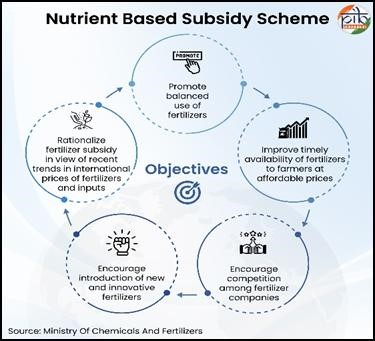
- The Government of India introduced the Nutrient-Based Subsidy (NBS) Scheme on 1 April 2010 for phosphatic and potassic (P&K) fertilizers.
- Under NBS, a fixed subsidy is provided based on nutrient content (per kg of Nitrogen (N), Phosphorus (P), Potassium (K), and Sulphur (S)), covering fertilizers like DAP and NPKS grades.
- Subsidy rates are revised annually or biannually.
- Coverage and Scope: The scheme covers 28 grades of P&K fertilizers, including DAP, MAP, MOP, TSP, SSP, complex fertilizers, and micronutrient-fortified variants.
- Pricing and Market Structure: It operates under a decontrolled regime where companies fix MRP (market-linked pricing) while the government monitors prices to prevent excessive increases.
- Subsidy Mechanism: Subsidy is paid to manufacturers and importers, which is then passed on to farmers through reduced retail prices.
- Institutional Mechanism: Subsidy rates are determined by the Department of Fertilizers based on recommendations of the Inter-Ministerial Committee (IMC).
- Distribution and Regulation: Fertilizer movement is tracked through the Fertilizer Monitoring System, with partial control under the Essential Commodities Act, 1955, and imports allowed under the Open General License.
About the Fertilizers
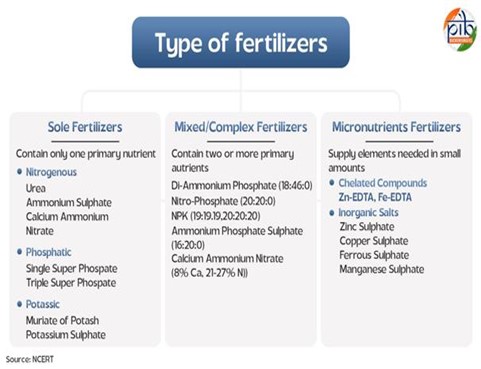
- Fertilizers are concentrated plant nutrients made from inorganic chemicals, used to supply essential elements required for proper plant growth.
- They contain nutrients in higher concentrations than organic manure, are applied in smaller quantities, and are readily available for plant uptake, though some may be lost through leaching or runoff.
- Based on composition, fertilizers are classified as sole fertilizers, mixed fertilizers, and micronutrient fertilizers.
- Current Fertilizer Scenario in India:
- India is the second-largest producer and consumer of fertilizers globally, after China.
- It is one of the country’s eight core industries.
- India produces key fertilizers such as Urea, DAP (Diammonium Phosphate), NP and NPK Complex Fertilizers, Ammonium Sulphate, Potash, and Single Super Phosphate (SSP).
- Around 87% of urea consumption is domestically met.
- 90% of NPK Fertilizers are also produced within the country.
- However, for DAP, only about 40% comes from local production.
- In the case of Muriate of Potash (MOP), 100% is still imported.
About the Balanced Fertilization
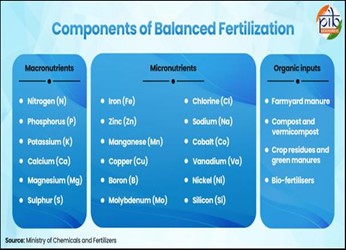
- Balanced fertilization refers to the application of all essential plant nutrients, macronutrients and micronutrients, in appropriate proportions, quantities, timing, and methods based on crop needs, soil fertility, and climatic conditions.
- It aims to enhance fertilizer use efficiency, improve crop productivity, sustain soil health, and reduce environmental impacts such as nutrient losses and emissions.
- The concept is guided by Justus von Liebig’s Law of the Minimum and goes beyond the traditional NPK-focused approach to a holistic nutrient management system.