
SYLLABUS
GS-2: Government Policies and Interventions for Development in various sectors and Issues arising out of their Design and Implementation.
GS-3: Indigenization of Technology and Developing New Technology.
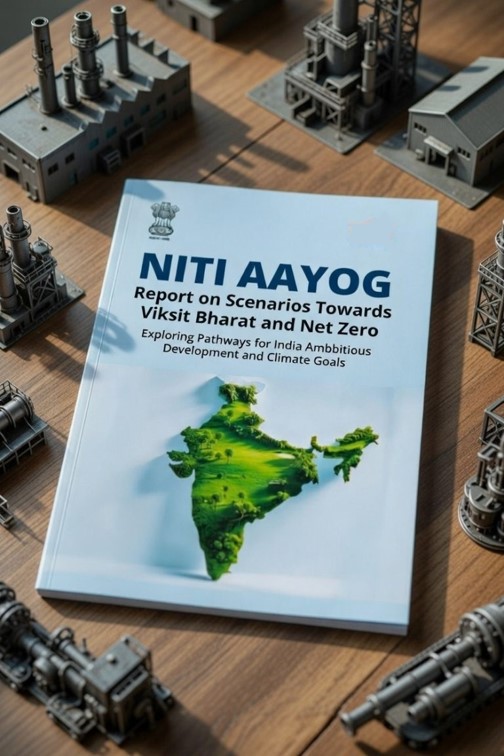
Context: NITI Aayog has released a set of study reports outlining India’s development pathways towards achieving the goal of Viksit Bharat by 2047 while progressing towards Net Zero greenhouse gas emissions by 2070.
More on the News
- India seeks to achieve a dual objective of developed-economy status (Viksit Bharat) by 2047 alongside net-zero greenhouse-gas emissions by 2070, representing a simultaneous growth-and-decarbonisation transition of unprecedented scale.
- In this context, NITI Aayog has presented a roadmap, which highlights that reconciling rapid GDP expansion, energy security, and climate responsibility is central to India’s long-term policy planning.
- The study uses a model-based framework with two core scenarios: a Current Policy Scenario (CPS) that extends existing policies and trends, and a more ambitious Net Zero Scenario (NZS) aligned with India’s 2070 Net Zero pledge.
- The transition is anchored in United Nations Framework Convention on Climate Change (UNFCCC) principles of equity, climate justice, and common but differentiated responsibilities, and builds on India’s Long-term Low Emission Development Strategy (LT-LEDS) submitted by India to the UNFCCC in 2022.
Key Findings of the Report
- Growth and Development Trajectory:
- GDP is projected to rise from USD 4.18 trillion in 2025 to about USD 30 trillion by 2047 across scenarios, indicating resilience of long-term growth.
- Urbanisation is expected to increase from 37% (2023) to 51% by 2047 and 65% by 2070, driving major expansion in transport, buildings, and infrastructure.
- Net-zero transition has limited long-term impact on GDP, with variations around 0.5% by 2050 depending on financing structure.
- Energy Transition Pathway:
- Under the Net Zero Scenario, India’s energy demand grows modestly (only 2.1–2.6 times between 2025 and 2070) despite an eleven-fold expansion of GDP, driven by efficiency gains, electrification and circularity.
- Electricity becomes the backbone of the economy, with renewables and nuclear power dominating generation by mid-century, while fossil fuels shrink to a residual role by 2070.
- Electricity’s share of final energy rises from 21% (2025) to 40% in CPS and 60% in NZS by 2070, driven by EVs, electric heat, and clean cooking.
- Coal demand may rise until mid-century under current policies before declining sharply in a net-zero scenario, where residual use is confined to hard-to-abate sectors with carbon capture.
- The primary energy mix shifts from 87% fossil fuels in 2025 to 54% under CPS and just 14% under NZS by 2070.
- Finance and Investment Structure:
- Achieving Net Zero requires cumulative investments of about USD 22.7 trillion by 2070, roughly USD 500 billion per year, with the power sector taking over half.
- Expected domestic and external flows could mobilise about USD 16.2 trillion, leaving a financing gap of around USD 6.5 trillion that must be met largely from international capital.
- Critical Minerals and Social Impacts:
- Demand for critical energy transition minerals (CETMs) exceeds 110 Mt during 2050–70 under NZS, about 51% higher than CPS, with EV batteries and solar dominating usage.
- Copper and graphite account for nearly two-thirds of cumulative CETM demand by 2070, while India remains heavily import-dependent for lithium, nickel, cobalt and rare earths.
- Net Zero paths generate more jobs overall (about 7 million additional energy-sector jobs by 2050 versus today), but around 17 million workers in fossil-linked manufacturing and 150+ coal-dependent districts face structural disruption.
- Demand for critical energy transition minerals (CETMs) exceeds 110 Mt during 2050–70 under NZS, about 51% higher than CPS, with EV batteries and solar dominating usage.
Challenges & Constraints
- Technological and Infrastructure Constraints: Many key Net Zero technologies, such as Carbon Capture, Utilisation, and Storage (CCUS), long-duration storage, small modular reactors, and green hydrogen at scale, are still nascent or unproven commercially.
- Financial and Macroeconomic Risks: The USD 6.5 trillion financing gap and need to front-load about USD 8 trillion by 2050 pose significant capital mobilisation and cost-of-capital challenges.
- Additionally, overreliance on domestic financing could crowd out private investment and consumption, while excessive foreign financing raises concerns over external vulnerability and current account deficits.
- Resource and Supply-Chain Pressures:
- Large-scale renewable deployment competes for land and water with agriculture, urban growth and ecosystems, especially in already water-stressed states where nearly 75% of RE capacity is concentrated.
- High import dependence for critical minerals exposes India to concentrated and geopolitically sensitive global supply chains.
- Social and Governance Challenges: Regional job losses in coal and fossil-fuel belts demand extensive reskilling, social protection and economic diversification to avoid inequitable outcomes.
Recommendations of the Report
- Adopt an economy-wide “Avoid–Shift–Improve” approach: avoid unnecessary demand, shift to low‑carbon modes, and improve efficiency across transport, buildings and industry.
- Use District Mineral Foundations, Skill India and the Skill Council for Green Jobs to fund retraining, relocation and diversification in fossil-dependent regions, with special focus on women and marginalised groups.
- Establish a National Green Finance Institution, deepen bond markets, create a unified climate finance taxonomy, and scale blended finance to crowd in foreign and private capital.
- Build a resilient CETM ecosystem via domestic exploration, refining and advanced recycling, diversified international sourcing, and production-linked incentives for clean-tech manufacturing.
SOURCES
Down to Earth
PIB
DD News