
SYLLABUS
GS-3: Indian Economy and issues relating to planning, mobilization of resources, growth, development and employment.
GS-2: Government policies and interventions for development in various sectors and issues arising out of their design and implementation
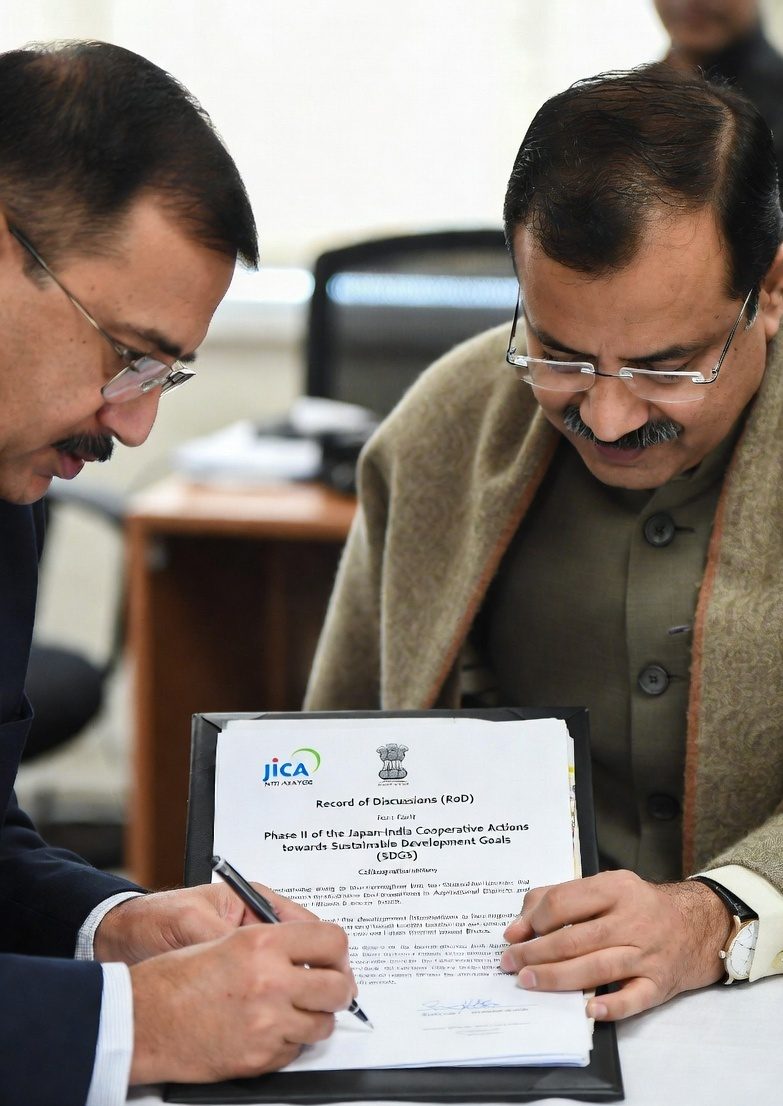
Context: Recently, the NITI Aayog and the Japan International Cooperation Agency (JICA) signed the Record of Discussions (RoD) for Phase II of the Japan–India Cooperative Actions towards Sustainable Development Goals (SDGs) to strengthen development interventions in Aspirational Districts and Aspirational Blocks.
More on the News
- The initiative reflects the deepening India–Japan development partnership and aims to accelerate progress toward the Sustainable Development Goals (SDGs) by 2030.
- The collaboration focuses particularly on underserved regions covered under the Aspirational Districts Programme (ADP) and Aspirational Blocks Programme (ABP).
- Officials highlighted that the project will strengthen institutional capacity and governance systems at the district and block levels.
About the Project
- The project is titled “Project for Promotion of the Program for Japan–India Cooperative Actions Towards Sustainable Development Goals – Phase II.”
- It aims to strengthen policy frameworks, implementation systems, and evidence-based governance under ADP and ABP.
- Key thematic focus areas (6):
- Global Partnership
- Health & Nutrition
- Education
- Agriculture & Water Resources
- Financial Inclusion & Skill Development
- Basic Infrastructure
- Major components of the project include:
- Institutional capacity-building initiatives.
- People-to-people and capacity-building exchanges between India and Japan.
- Japan–India knowledge forums for policy learning and cooperation.
- Identification and dissemination of best practices from successful districts and blocks.
- Improved monitoring and evaluation mechanisms.
- Targeted support to Aspirational Districts and Aspirational Blocks.
- Promotion of localisation of SDGs through data-driven planning and implementation.
Significance of the Project
- Strengthens India–Japan Development Partnership: Reinforces bilateral cooperation in sustainable development and governance reforms.
- Accelerates SDG Achievement: Supports India’s efforts to meet SDG targets by 2030, especially in lagging regions.
- Improves Governance at Grassroots Level: Enhances district and block-level policy implementation and monitoring systems.
- Promotes Evidence-Based Policymaking: Encourages data-driven planning, monitoring, and evaluation.
- Supports Inclusive Development: Focuses on underserved regions covered under ADP and ABP, reducing regional disparities.
- Knowledge and Best-Practice Exchange: Facilitates institutional learning between India and Japan through forums and exchanges.
About the Aspirational Districts Programme (ADP)
- The Aspirational Districts Programme was launched in January 2018 by the Government of India to accelerate development in 112 underdeveloped districts across 27 states, identified by NITI Aayog.
- The programme focuses on five sectors—Health & Nutrition, Education, Agriculture & Water Resources, Financial Inclusion & Skill Development, and Basic Infrastructure.
- It tracks progress using 49 Key Performance Indicators (KPIs) with the highest weightage given to Health & Nutrition and Education (30% each).
- The strategy is based on the 3C approach—Convergence of schemes, Collaboration among stakeholders, and Competition among districts through data-driven ranking.
About the Aspirational Blocks Programme (ABP)
- The Aspirational Blocks Programme was launched on 7 January 2023to improve development outcomes in 500 underdeveloped blocks across 27 states and 4 Union Territories, led by NITI Aayog.
- The programme aims to strengthen last-mile governance and socio-economic development by improving service delivery at the block level.
- It monitors 40 Key Performance Indicators across five sectors—Health & Nutrition, Education, Agriculture & Allied Services, Basic Infrastructure, and Social Development.
- Similar to ADP, the programme follows the 3C strategy of Convergence, Collaboration, and Competition, with continuous monitoring through digital dashboards.
Sources:
PIB
DD News
Buddhist Time