
14th WTO Ministerial Conference
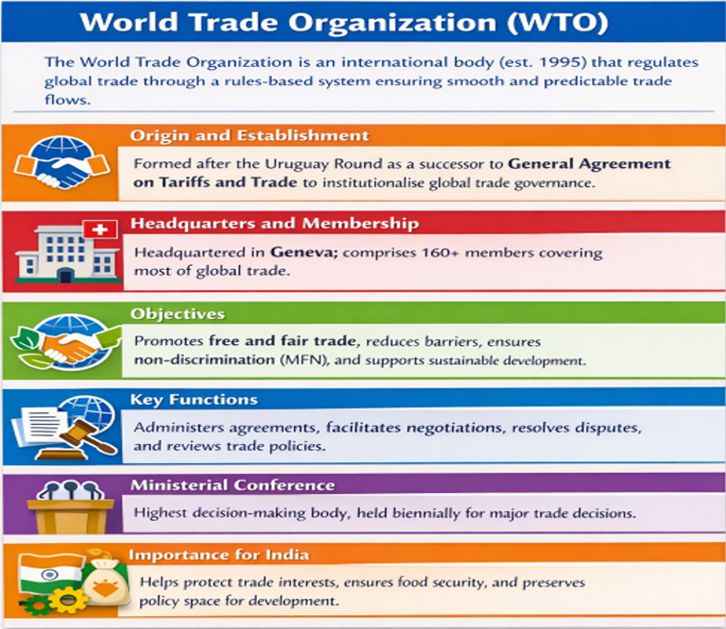
Context: Recently, the World Trade Organisation’s 14th Ministerial Conference (MC14) began in Yaoundé, Cameroon, as the organisation grappled with a growing crisis of relevance.
Key Focus Areas of the Meeting
- Crisis in Multilateral Trading System: The conference highlights the weakening of global trade rules amid rising protectionism and a stalled WTO dispute settlement system, undermining rules-based multilateralism.
- Public Stockholding (PSH) for Food Security: India has demanded a permanent solution to public stockholding, arguing that existing WTO subsidy limits of 10% are outdated and restrict its ability to ensure food security through MSP and PDS mechanisms.
- Digital Trade Moratorium:
- One of the key issues is the continuation of the moratorium on customs duties on electronic transmissions.
- India opposes extending it because it causes significant revenue losses and restricts regulatory flexibility in the evolving digital economy.
- Agricultural Subsidies Debate: Developing countries are seeking greater flexibility in providing subsidies to protect farmers’ livelihoods, while developed nations are pushing for stricter disciplines, leading to a North-South divide.
- WTO Institutional Reforms:
- The conference emphasises the urgent need to restore the dispute settlement system and reform WTO functioning, but consensus remains difficult due to geopolitical tensions.
- The United States is calling for major reforms, including a review of the MFN principle and pressing for plurilateral agreements involving only a group of members. This signals a move away from the WTO’s traditional consensus-based system.
- Investment Facilitation for Development (IFD) Agreement
- It is backed by China and more than 120 countries, which is another major issue aimed at promoting foreign direct investment.
- India opposes it because it is being pursued through a plurilateral route, weakens the WTO’s consensus-based multilateral structure, and may carry strategic implications through global investment networks.
- India’s Strategic Position
- India has adopted a development-oriented stance by defending policy sovereignty, opposing certain trade rules, and aligning with developing nations to safeguard domestic interests.
- India’s approach to the World Trade Organisation is cautious, aiming to preserve policy space while balancing its low global trade share with high growth potential, shaped by past experiences like the Information Technology Agreement (ITA-1).
Central Armed Police Forces (General Administration) Bill, 2026,
Context: Recently, the government introduced the Central Armed Police Forces (General Administration) Bill, 2026, in the Rajya Sabha.
Key Highlights of the Bill
- Objective: To establish a unified, transparent, and legally backed administrative framework for managing personnel across all Central Armed Police Forces (CAPFs).
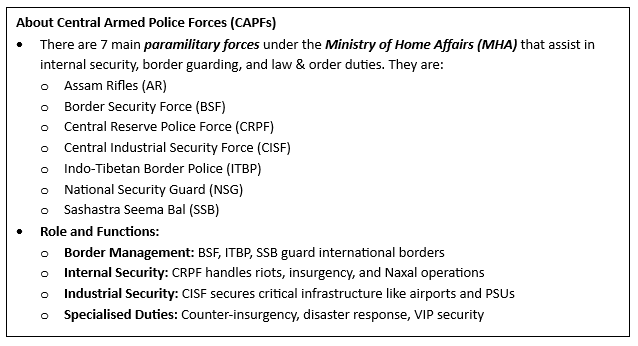
- Institutionalisation of IPS Deputation in CAPFs: The bill aims to continue the predominance of Indian Police Service (IPS) officers on deputation in top leadership roles across all five CAPFs—BSF, CRPF, CISF, ITBP, and SSB.
- Reservation in Posts: The bill proposes to reserve 50% of total Inspector General (IG) posts, a minimum of 67% of Additional Director General (ADG) posts, and all posts in the rank of Special Director General and Director General to be filled by Indian Police Service (IPS) officers on deputation.
- Powers to Make Rules: The bill empowers the Central Government to frame rules concerning service-related matters of officers in the specified CAPFs. These include recruitment, deputation, promotion, and conditions of service.
Concerns Related to the Bill
- Violation of Equality Principles: Preferential treatment for IPS officers raises concerns regarding fairness and potential conflict with principles of equal opportunity in public employment.
- Erosion of CAPF Autonomy: Excessive reliance on deputed officers may undermine the professional independence and specialised expertise of CAPFs.
- Declining Morale within Forces: Perceived discrimination against cadre officers could adversely affect motivation and organisational cohesion.
- Centralisation of Authority: Enhanced rule-making powers of the Central Government may reduce institutional flexibility and decentralised decision-making.
- Against SC Judgement: The Bill directly contravenes the 2025 Supreme Court ruling in Sanjay Prakash & Others v. Union of India (May, 2025), where the SC declared CAPF Group A officers as Organised Group A Services (OGAS) for all purposes and further directed progressive reduction of IPS deputation up to IG rank within two years.
Extension of the Immigration, Visa, Foreigners Registration & Tracking (IVFRT) Scheme
Context: Recently, the Union Cabinet has approved the continuation of the Immigration, Visa, Foreigners Registration & Tracking (IVFRT) Scheme for five years from April 2026 to March 2031 with an outlay of ₹1,800 crore.
About IVFRT Scheme
- Launched in 2010, the IVFRT Scheme aims to interlink and optimise functions related to immigration, visa issuance and registration of foreigners in India.
- Nodal Ministry: Ministry of Home Affairs
- The latest extension aligns with the new Immigration and Foreigners Act, 2025 and Rules to address illegal migration.
- Important Aspects of the Scheme:
- Integrated Digital Platform: It provides a centralised online system connecting Indian Missions abroad, Immigration Check Posts (ICPs), Foreigners Regional Registration Offices (FRROs) and State Police and security agencies.
- Security and Monitoring: The IVFRT System enhances the real-time tracking of foreign nationals, data sharing among security agencies and strengthening of internal security.
- Technology-Driven Governance: The scheme integrates advanced technologies like biometrics, self-service kiosks, and mobile-based platforms to enable a faceless and contactless visa processing system.
- Operational Efficiency: The system has already enabled 100% contactless and faceless visa process, with 91.24% of e-visas cleared within 72 hours, and has reduced the average manual clearance time at immigration posts to 2.5–3 minutes.
- Fast Track Immigration-Trusted Traveller Programme (FTI-TTP): Implemented at 13 Major airports through automated e-gates, reducing the time taken for immigration clearance from 2.5-3 minutes to 30 seconds. It is currently only available for Indian nationals & OCI cardholders.
- Ease of Doing Business: Convenience and security assurance have been made possible by the IVFRT System, leading to huge benefits to tourism, business, trade & commerce, service industry, especially the aviation and hospitality industry.
National Dental Commission (NDC)
Context: Recently, the Government of India has constituted the National Dental Commission (NDC), aimed at improving the quality of dental education and aligning it with global standards.
About the National Dental Commission
- It has been constituted under the National Dental Commission (NDC) Act, 2023, and replaces the Dental Council of India (DCI).
- With the coming into force of the NDC Act from 19th March, 2026, the Dentists Act, 1948, stands repealed.
- It is the apex statutory body, responsible for regulating dental education, ensuring professional conduct, and maintaining institutional standards across the country.
- It will introduce essential and long-overdue regulatory reforms in dental education and enhance access to affordable oral healthcare across the country.
- Three autonomous bodies have been constituted to support the functioning of the Commission:
- Undergraduate and Postgraduate Dental Education Board – to oversee dental education
- Dental Assessment and Rating Board – to regulate accreditation and institutional assessment
- Ethics and Dental Registration Board – to govern professional conduct and registration of dentists
Key Functions of the Commission
- Framing regulations to implement the provisions of the Act
- Conducting rating and assessment of dental institutions
- Evaluating human resources and promoting dental research
- Framing guidelines for fee regulation in private dental colleges
- Establishing standards for community dental care, education, research, and professional ethics
12th Steering Committee Meeting of the GlobE Network
Context: Recently, India hosted the 12th Steering Committee Meeting of the Global Operational Network of Anti-Corruption Law Enforcement Authorities (GlobE Network).
About the GlobE Network
- Origin: It was created under the Riyadh Initiative during Saudi Arabia’s G20 Presidency and operates within the framework of the United Nations Convention against Corruption (UNCAC).
- Membership: The network includes 135 member countries and 250 member authorities, along with 18 observer organisations such as EUROPOL, the World Bank, and the International Association of Anti-Corruption Authorities.
- Governance Structure: It is guided by a steering committee comprising a chair, vice-chair, and 13 members, which provides leadership and strategic direction.
- India’s Participation: In India, the Ministry of Home Affairs acts as the central authority, while the CBI and Enforcement Directorate are its member agencies.
- Functions: The network facilitates direct and faster cooperation among agencies for investigation, prosecution, and recovery of proceeds of corruption, complementing formal mutual legal assistance mechanisms.
- Support Mechanism: The network is supported by the UNODC, which serves as its secretariat and provides administrative assistance.
Significance for India
- Strengthening Anti-Corruption Framework: It enhances India’s ability to tackle corruption cases with cross-border dimensions by improving international cooperation in investigations and enforcement.
- Faster Recovery of Proceeds of Crime: The network enables quicker tracing and recovery of illicit assets located abroad through direct agency-to-agency coordination.
- Improved Intelligence Sharing: It facilitates real-time exchange of information between agencies like the CBI and Enforcement Directorate and their global counterparts, improving case efficiency.
- Complement to Formal Legal Channels: It supplements slow Mutual Legal Assistance Treaties (MLATs) by enabling direct and informal cooperation, making enforcement more agile.
Khelo India Tribal Games 2026
Context: India’s first national multi-sport event for tribal athletes, the ‘Khelo India Tribal Games’, is being held from March 25 to April 3, 2026.
About Khelo India Tribal Games 2026
- This is a national-level multi-sport event dedicated exclusively to tribal athletes from across India.
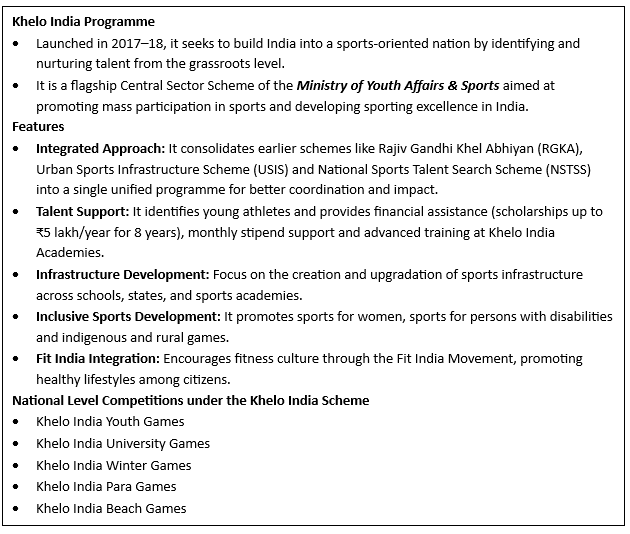
- It is organised under the ‘Khelo India Scheme’, a flagship initiative of the Ministry of Youth Affairs and Sports, aiming to promote a sports culture and nurture excellence in the field of sports.
- Jointly organised by the Ministry of Youth Affairs & Sports, Sports Authority of India (SAI), Indian Olympic Association, National Sports Federations and the Chhattisgarh state organising committee.
- Venues: In Chhattisgarh across 3 cities- Raipur, Jagdalpur, and Sarguja
- Mascot: ‘Morveer’ derived from the Chhattisgarhi words ‘Mor’ (our own) and ‘Veer’ (bravery), it symbolises pride, spirit and the identity of India’s tribal communities.
- Sports: 7 medal sports- archery, athletics, football, hockey, swimming, weightlifting, and wrestling, along with 2 demonstration sports- Mallakhamb and Kabaddi.
Significance of the Khelo India Tribal Games
- Promotion of Tribal Talent: The games provide a dedicated national platform for tribal athletes, helping identify and nurture sporting talent from tribal regions.
- Inclusion in Mainstream Sports: They integrate tribal communities into the national sports ecosystem, ensuring greater social inclusion and representation.
- Preservation of Indigenous Sports: The initiative promotes traditional and indigenous tribal games, helping preserve India’s rich cultural and sporting heritage.
- Grassroots Sports Development: It strengthens the grassroots sports structure in tribal and remote areas through better exposure and competition opportunities.
- Pathway to Elite Sports: The event serves as a talent pipeline for schemes like Khelo India and TOPS, enabling tribal athletes to progress to national and international levels.