

Government to Procure Indigenous Mountain Radars for Air Force
Context: Recently, the Ministry of Defence signed a ₹1,950-crore contract with Bharat Electronics Limited (BEL) for the procurement of two mountain radars for the Air Force.
More on the News
• The Mountain Radar systems have been indigenously designed and developed by the Electronics & Radar Development Establishment under the Defence Research and Development Organisation (DRDO), and will be manufactured by BEL.
• The manufacturing of the radars is being facilitated under the Buy (Indian–Indigenously Designed, Developed and Manufactured) category.
• These radars are specifically suited for deployment in high-altitude and mountainous terrain, significantly enhancing surveillance and detection capabilities along sensitive borders.
• Objective: The radars are meant to strengthen India’s layered air-defence network in difficult border terrain, where conventional radar coverage is weak.
• Significance: The procurement aligns with the Aatmanirbhar Bharat and Make in India initiatives, and is expected to reduce dependence on foreign-origin defence equipment while boosting domestic defence manufacturing capabilities.
About Mountain Radars
• Mountain Radars are specialised surveillance systems designed for high-altitude, rugged terrain, where conventional radars often fail due to physical obstructions such as peaks and valleys.
• They are engineered to bridge “shadow zones”—blind spots created by uneven landscape—to detect low-flying drones, cruise missiles, and enemy aircraft.
Indigenous Stealth Frigate ‘Dunagiri’ Delivered to the Indian Navy
Context: Recently, the Indian Navy received ‘Dunagiri’ at GRSE, Kolkata, marking a major milestone in achieving self-reliance in warship design and construction.
About Dunagiri
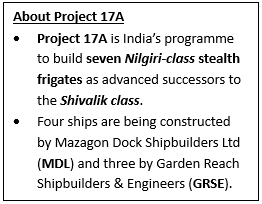
• It is the fifth ship of Nilgiri Class under the Project 17A and the second of the class built at Garden Reach Shipbuilding and Engineers Ltd (GRSE), Kolkata.
- The 4 already commissioned frigates are – Nilgiri, Himgiri, Taragiri, and Udaygiri.
• Legacy and Continuity: The ship is a successor to the earlier INS Dunagiri, a Leander-class frigate that served the Indian Navy for over three decades from 1977 to 2010.
• Indigenous and Advanced Design: Designed entirely by the Warship Design Bureau (WDB), the vessel has about 75% indigenous content, significantly strengthening the domestic defence ecosystem by engaging over 200 MSMEs and generating substantial employment.
• Propulsion System: The frigate employs a Combined Diesel or Gas (CODOG) propulsion system, operating Controllable Pitch Propellers (CPP) on each shaft, supported by an advanced Integrated Platform Management System (IPMS).
• Integrated Combat Suite: It is equipped with a sophisticated array of weapons and sensors, including BrahMos surface-to-surface missiles, MF-STAR radar, the MRSAM system, along with specialised rockets and torpedoes for anti-submarine warfare (ASW).
India’s First Dedicated Venture Capital Fund for Space Startups
Context: Recently, the Government revealed that the “Antariksh Venture Capital Fund”, set up to boost India’s emerging spacetech ecosystem, has been operationalised with key institutional mechanisms now in place.
About the Antariksh Venture Capital Fund
• It is India’s first dedicated venture capital fund for the space sector, which will begin investing in startups from the first quarter of 2027.
- Venture capital (VC) is a form of private equity financing where investors provide capital to startups and early-stage companies with high growth potential in exchange for equity.
• It is a SEBI-registered Category II Alternative Investment Fund (AIF) with Indian National Space Promotion and Authorisation Centre (IN-SPACe) as the key investor, and SIDBI Venture Capital Limited (SVCL) as the Fund Manager.
- AIFs are privately pooled investment vehicles established in India that collect funds from sophisticated investors for investing in non-traditional asset classes.
• Objective: To provide capital to innovative Indian companies developing technologies with TRL 4 and above, enabling them to scale operations, commercialize cutting-edge solutions, and strengthen India’s contribution to the global space economy.
QS Subject Rankings 2026
Context: Recently, India strengthened its presence in the 16th edition of QS Subject Rankings 2026, released by the London-based QS Quacquarelli Symonds.
Key Highlights of the Ranking regarding India
• India added 20 new institutions this year, taking its total to 99. It also holds the fourth-highest number of institutions overall in the rankings.
• India also recorded 120 new subject entries, placing India fourth globally in fresh inclusions after the US, China, and the UK.
• According to the rankings, India records 27 top 50 positions across subjects and broad faculty areas – more than double the 12 recorded in 2024 – earned by 12 institutions.
• The Indian Institute of Management Kozhikode (IIM-K) (ranked 78th worldwide) has attained a significant global achievement by entering the Top 100 of the ranking by Subject 2026 for the first time.
• India’s four Indian Institutes of Technology (IITs), Jawaharlal Nehru University (JNU), and Birla Institute of Technology and Science (BITS), Pilani, ranked among the world’s top 50 universities in various subjects.
• The Indian School of Mines University, Dhanbad, led the individual charge, ranking 21st globally in Mineral and Mining Engineering.
• IIM Ahmedabad earned 21st place in both Business and Management Studies and Marketing, marking India’s first appearance in the global Marketing rankings.
• Indian Institute of Management (IIM) Ahmedabad has made a notable debut in marketing at 21st rank, marking India’s first-ever entry in this subject.
• IIT Delhi recorded six top-50 entries, leading India in Chemical Engineering (48th), Electrical & Electronic Engineering (36th), Mechanical Engineering (44th), and Engineering & Technology (36th).
About QS World University Rankings 2026
• It assesses universities through a robust methodology focusing on academic reputation, employability, research impact, global engagement, and sustainability, serving as a widely respected benchmark of institutional excellence.
• The 16th edition evaluates over 21,000 academic programs across 1,900 universities in more than 100 countries, covering 55 disciplines and five broad faculty areas.
• Top 5 Ranks:
1. Massachusetts Institute of Technology (MIT), USA
2. Imperial College London, UK
3. Stanford University, USA
4. University of Oxford, UK
5. Harvard University, USA
Government extends the RoSCTL Scheme for Apparel and Made-ups Exports
Context: Recently, the government has extended the Rebate of State and Central Taxes and Levies (RoSCTL) Scheme for exports of apparel, garments and made-ups till September 30 or until approval under the 16th Finance Commission cycle, whichever is earlier.
More on the News
• In parallel, the Government has also continued the Remission of Duties and Taxes on Exported Products (RoDTEP) Scheme from 1st April 2026 to 30th September 2026, which benefits textile products not covered under RoSCTL.
About RoSCTL Scheme
• It is a central government scheme that aims to rebate all embedded State and Central taxes and levies not covered under any other scheme, thereby enhancing the global competitiveness of India’s apparel and made-ups exports.
• It is based on the principle of zero-rating of exports, ensuring remission of unrefunded taxes embedded in exported products.
• It serves as a key support mechanism for the textile export sector, particularly benefiting MSME exporters, who constitute a major share of its beneficiaries.
• It was launched by the Ministry of Textiles in 2019.
• Implementing Agency: Department of Revenue, Ministry of Finance
• Under the scheme, exporters are issued a Duty Credit Scrip reflecting the value of embedded taxes and levies in exported products, which can be used to pay basic Customs duty on the import of equipment, machinery, or other inputs.
• For the purpose of calculating the duty credit under the scheme, the value of goods shall be taken as the declared export Free on Board (FOB) value or up to 1.5 times the market price of the goods, whichever is lower.
Andhra Pradesh Reorganisation (Amendment) Bill
Context: Recently, both houses of the Parliament passed the Andhra Pradesh Reorganisation (Amendment) Bill, 2026, making Amaravati the state’s sole and permanent capital.
Key Provisions of the Bill
• It aims to resolve long-standing uncertainty over the state’s capital, as the Andhra Pradesh Reorganisation Act, 2014, had designated Hyderabad as the common capital of Telangana and Andhra Pradesh for a transitional period of up to ten years.
• Amaravati will replace Hyderabad as Andhra Pradesh’s capital with retrospective effect from June 2, 2024, covering all areas notified under the Andhra Pradesh Capital Region Development Authority Act, 2014.
• The earlier 2019–2025 policy of having three capitals: administrative at Visakhapatnam, legislative at Amaravati, and judicial at Kurnool has been reversed, restoring Amaravati as the sole capital.
About Andhra Pradesh Reorganisation Act, 2014
• It is an Act of the Indian Parliament that bifurcated the state of Andhra Pradesh into Telangana and the residuary Andhra Pradesh state.
• Key Provisions:
- Hyderabad would be designated as the common capital of Telangana and Andhra Pradesh for up to ten years, after which it would remain the capital of Telangana, with Andhra Pradesh establishing a new capital.
- The Central Government was mandated to constitute an expert committee to examine options for the new capital of Andhra Pradesh and submit recommendations within six months of the enactment of the Andhra Pradesh Reorganisation Act, 2014.
- From the appointed day, the High Court of Judicature at Hyderabad would serve as the common High Court for Telangana and Andhra Pradesh until a separate High Court for Andhra Pradesh is established under Article 214 of the Constitution.
- A separate High Court for the state of Andhra Pradesh was established on January 1, 2019, at the Interim Judicial Complex at Nelapadu, Amaravati, Guntur district.
Constitutional Provisions for the Formation of States
• Article 1: Declares India as a Union of States, encompassing all States, Union Territories, and any future acquired territories, reflecting a strong Centre with flexible constituent units.
• Article 2: Empowers Parliament to admit new States into the Union or establish new States on terms it considers appropriate.
• Article 3: Authorises Parliament to create new States by separation, merger, or reorganisation, and to alter the area, boundaries, or names of existing States.
- Such a Bill requires prior recommendation of the President, who refers it to the concerned State Legislature for its views.
- This provision has facilitated reorganisations like the formation of Chhattisgarh, Jharkhand, Uttarakhand (2000), and Telangana (2014).
• Article 4: Provides that laws made under Articles 2 and 3 may amend the First Schedule (States and UTs) and the Fourth Schedule (Rajya Sabha seats), and such laws are not considered Constitutional Amendments under Article 368.