

Tamil Nadu’s First Dark Sky Park
Context: Recently, the Tamil Nadu government announced the launch of the State’s first Dark Sky Park at the Ariyur Shola Reserve Forest in Kolli Hills, Namakkal district.
Kolli Hills Dark Sky Park
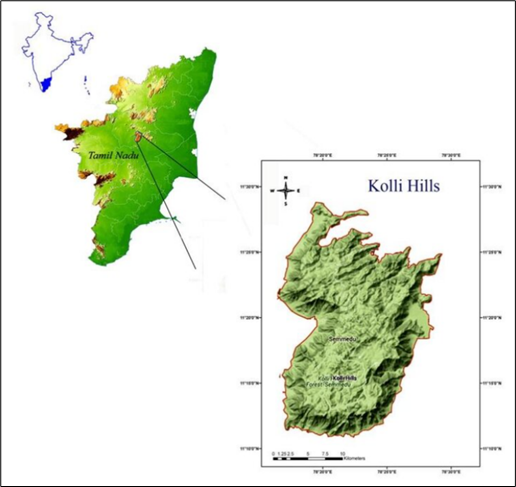
- Kolli Hills has been selected for the establishment of a Dark Sky Park to promote astronomical observation and protect natural night skies from light pollution.
- The region provides favourable conditions for night-sky preservation due to its elevated terrain, dense forest cover and minimal urban light disturbance.
- The location was finalised after evaluating ecological suitability and sky visibility in Ariyur Shola Reserve Forest.
- According to the Forest Department, the park is equipped with three advanced telescopes for structured sky-watching sessions and solar panels to power onsite operations sustainably.
- The facility will function during both night and daytime to promote scientific literacy and awareness of astronomy among students, researchers and the general public.
Dark Sky Park
- A Dark Sky Park is a protected natural landscape with minimal artificial light pollution, enabling clear observation of celestial bodies such as the moon, stars and planets.
- These sites support astronomical research, education, eco-tourism and conservation of natural night environments.
Dark Sky Sites in India
- Pench Tiger Reserve in Maharashtra became India’s first International Dark Sky Park in January 2024. It is also the first tiger reserve in India and the fifth park in Asia to receive certification from DarkSky International.
- Hanle Dark Sky Reserve, established in 2022, was India’s first Dark Sky Reserve. Located at an altitude of over 4,500 metres, it offers some of the best conditions in the world for deep-space astronomical observation due to its clear atmosphere and very low light pollution.
World Wildlife Day (WWD) 2026
Context: The world observes World Wildlife Day on 3rd March every year to mark the adoption of the Convention on International Trade in Endangered Species of Wild Fauna and Flora (CITES).
About World Wildlife Day (WWD)
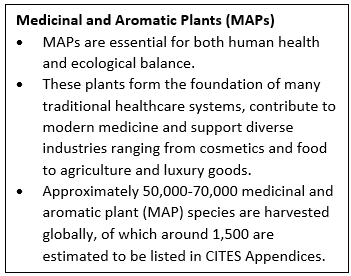
- The WWD2026 theme is “Medicinal and Aromatic Plants: Conserving Health, Heritage and Livelihoods”.
- On 20 December 2013, at the 68th Session of the United Nations General Assembly (UNGA), March 3 was declared United Nations World Wildlife Day (WWD).
- The date commemorates 3 March 1973, when the CITES convention was signed.
CITES (Convention on International Trade in Endangered Species of Wild Fauna and Flora)
- The Convention on International Trade in Endangered Species of Wild Fauna and Flora (CITES) is a multilateral treaty drafted in 1963 and entered into force on 1 July 1975.
- It aims to ensure that international trade in specimens of wild animals and plants does not threaten the survival of the species.
- CITES currently has 184 Parties (183 countries + EU). India became a CITES Party in 1976.
- The headquarters (Secretariat) of CITES is located in Geneva, Switzerland.
Kingfisher Jingle Registered as Sound Mark in India
Context: India’s Trade Marks Registry recently granted sound mark registration to the iconic Kingfisher jingle.
More on the News
- The Trade Marks Registry in Mumbai granted sound mark registration to the Kingfisher advertising jingle “Oo la la la le o” used by United Breweries Limited.
- The protection remains valid for ten years until January 31, 2035 and can be renewed periodically under trademark law.
- The registration covers Class 32, which includes beers and non-alcoholic beverages and Class 33, which includes alcoholic beverages except beer and alcoholic preparations.
- The Kingfisher jingle was first introduced in 1996, and it was commercially used for the first time on February 21, 1996, in advertising campaigns.
- The registration makes United Breweries Limited the first company in India’s alcoholic beverages sector to obtain a registered sound trademark.
- The development reflects the expanding acceptance of non-traditional trademarks under the Trade Marks Act, 1999.
About Sound Mark
- A sound mark is a non-conventional trademark where a specific sound functions as a source identifier for goods or services.
- The sound allows consumers to recognise a particular brand even without visual elements such as logos or brand names.
- A sound mark must satisfy the test of distinctiveness, which means consumers must associate the sound with a specific commercial source.
- In India the application must be filed under Rule 26(5) of the Trade Marks Rules, 2017.
- The applicant must submit the sound in MP3 format, not exceeding thirty seconds, along with a graphical representation such as musical notation.
- The application is examined by the registrar to determine whether the sound is distinctive and not similar to an existing trademark.
- After examination, the mark is published in the Trademark Journal to allow opposition from third parties before final registration.
- India’s first registered sound mark was the Yahoo “yodel” in 2008, which set a precedent for protecting audio trademarks.
Significance of Sound Marks
- The registration allows the company to enforce exclusive legal rights against unauthorised or similar uses of the jingle.
- Sound marks strengthen brand recognition and consumer recall through a distinctive audio identity.
- The protection encourages companies to develop innovative branding strategies beyond visual symbols.
- The recognition of sound marks reflects the evolution of trademark law to accommodate modern marketing practices.
Lok Sabha Committee of Privileges
Context: Recently, the Lok Sabha Speaker constituted the Committee of Privileges to examine matters related to breach of parliamentary privileges and safeguard the functioning of Parliament.
More on the News
- The Lok Sabha Speaker nominated 15 members to the Committee of Privileges and appointed BJP MP Ravi Shankar Prasad as its chairperson.
- The constitution of the committee took place nearly two years after the formation of the 18th Lok Sabha.
- The committee is responsible for examining cases related to breach of privilege of the House and its members.
About Parliamentary Privileges
- Parliamentary Privilege refers to the rights and immunities enjoyed by Parliament as an institution and by Members of Parliament in their individual capacity. These privileges allow them to perform their legislative duties without external interference.
- The Constitution of India provides the legal basis for these privileges. Article 105 grants freedom of speech in Parliament and protects Members of Parliament from legal proceedings for statements made or votes given inside the House or its committees.
- Article 122 states that the validity of parliamentary proceedings cannot be challenged in any court on the ground of procedural irregularity.
- Similar provisions exist for state legislatures under Article 194 and Article 212, which extend comparable privileges to Members of State Legislatures.
- A breach of privilege occurs when any action violates the rights or immunities of Parliament or its members. Actions that cast reflections on the House, its members, or its committees may be treated as a breach of privilege. Such actions may include statements made in newspapers, television interviews, public speeches, or other publications.
About the Committee of Privileges
- The Committee of Privileges is a Standing Committee of Parliament which examines complaints related to breach of privileges.
- The Lok Sabha committee consists of 15 members, while the Rajya Sabha committee has 10 members.
- The committee has the authority to call witnesses, examine documents and investigate the matter. After completing its examination, it prepares a report recommending appropriate action.
- The committee generally submits its report within one month from the date of reference, unless the House specifies a different time frame.
- The House then considers the report through a motion. Members may agree, disagree, or suggest amendments to the recommendations of the committee.
- In practice, many notices of breach of privilege are rejected, and only a few cases result in penal action.
MoD Signs Contracts for ALH Mk-III (MR) Helicopters and VL-Shtil Missiles
Context: Recently, the Ministry of Defence (MoD) signed contracts worth ₹5,083 crore for acquiring six ALH Mk-III (Maritime Role) helicopters for the Indian Coast Guard and Vertical Launch Shtil surface-to-air missiles for the Indian Navy.
More on the News
- The contract for six Advanced Light Helicopters Mk-III (Maritime Role) is valued at ₹2,901 crore and has been signed with Hindustan Aeronautics Limited (HAL), Bengaluru.
- The helicopters are procured under the Buy (Indian–Indigenously Designed, Developed and Manufactured) category to promote domestic defence manufacturing.
- The contract for Surface-to-Air Vertical Launch (VL) Shtil missiles and associated missile holding frames is valued at ₹2,182 crore.
- The agreement has been signed with JSC Rosoboronexport of the Russian Federation, highlighting continued defence cooperation between India and Russia.
- The procurement aims to enhance maritime security, strengthen coastal surveillance, and improve naval air defence capability against aerial threats.
About ALH Mk-III (MR) Choppers
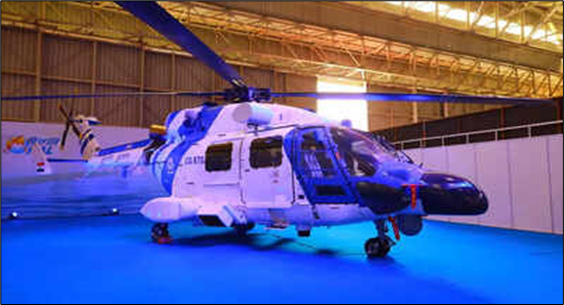
- The ALH Mk-III (MR) (Advanced Light Helicopter – Maritime Role) is a twin-engine helicopter incorporating advanced avionics and modern surveillance systems, which provide improved operational capability compared to existing airborne platforms.
- These helicopters can operate from shore-based airfields and from ships at sea, which allows flexible deployment during maritime missions.
- The ALH Mk-III Maritime Role version is powered by two Shakti-1H1 engines. These engines help the helicopter fly smoothly even in difficult sea weather.
- The aircraft has a 270-degree surveillance radar, which allows it to scan a wide area around it. It also carries a multispectral electro-optical pod that helps in tracking targets during day and night.
- The helicopter is fitted with a 12.7 mm machine gun for security missions. It also has a high-intensity searchlight and even a small Medical ICU setup for rescue missions.
- The helicopters will assist the Indian Coast Guard in maritime surveillance, search and rescue operations, coastal security, and protection of fishermen and offshore installations.
About VL-Shtil Missiles
- The VL-Shtil missile is a naval surface-to-air missile system developed in Russia. It is based on the Buk missile family, widely used in Russian air defence systems.
- The new system uses a vertical launch design, which means the missile is fired straight up from the ship before turning toward its target.
- In the Indian Navy, this missile system is already used on Talwar-class and Shivalik-class frigates.
- The typical combat range of the VL-Shtil missile is about 50 kilometres. This gives naval ships a strong protective area around them.
- The missile is also extremely fast and can reach speeds between Mach 3.5 and Mach 4.5. At this speed, it becomes very difficult for enemy weapons to avoid interception.
- The missile can hit targets flying very low near the sea surface, such as sea-skimming missiles. It can also engage aircraft flying up to 15,000 meters in the sky.
Exercise Vayushakti 2026
Context: Recently, the Indian Air Force (IAF) conducted Exercise Vayushakti-26 at the Pokhran Field Firing Range in Jaisalmer, Rajasthan.
More on the News
- The exercise was conducted along a defined operational storyline that simulated a live combat theatre and tested the integration of different operational components in a realistic battlefield environment.
- The exercise, guided by the core values “Achook, Abhedya aur Sateek,” aims to strengthen public confidence by reaffirming the role of the Indian Air Force as a crucial pillar of India’s national security framework.
- The drill seamlessly integrated offensive air strikes, air defence operations, special forces missions and humanitarian assistance, highlighting IAF’s role as a multi-domain, integrated force and the nation’s first responder.
About Exercise Vayushakti
- The first firepower demonstration of the Indian Air Force was conducted in 1954 at the Tilpat Range and was attended by Jawaharlal Nehru.
- The demonstrations continued for decades and gained national significance. In 1989, the event was shifted to the Pokhran Field Firing Range due to its larger airspace and modern training facilities.
- The exercise was officially named Vayu Shakti in 1999. The drill was later conducted as Exercise Iron Fist in 2013 and 2016 before the Indian Air Force restored the title Vayu Shakti in 2019.
- The aim of the exercise is to validate operational doctrines, test new technologies and strengthen joint operations between the Air Force and other armed forces.
- The exercise also serves as a platform to demonstrate indigenous defence technologies and modern combat platforms used by the Indian Air Force.