

Satellite Tagging of Olive Ridley Sea Turtles
Context: Tamil Nadu has launched a satellite telemetry study to track Olive Ridley turtles and strengthen coastal conservation through scientific monitoring of nesting and movement patterns.
More on the News
- The satellite tagging of Olive Ridley Sea turtles began on Chennai beaches in January 2026 as part of a two-year scientific study.
- Two female Olive Ridley turtles that came ashore to nest near Besant Nagar were satellite tagged and released back into the sea.
- The initiative is a first-of-its-kind radio telemetry study along the Tamil Nadu coast.
- The study will run from 2025 to 2027 to strengthen marine turtle conservation efforts.
- The project follows a Government Order issued in August 2025 by the Department of Environment, Climate Change and Forests of Tamil Nadu.
- The study is jointly implemented by the State Forest Department, the Wildlife Institute of India and the Advanced Institute for Wildlife Conservation, Vandalur.
- Satellite tags will help track turtle movement in near-shore waters during the nesting season from November to April.
- Flipper tags will also be used for long-term monitoring of migration patterns, nest site fidelity and survivorship.
- The total sanctioned cost of the project is about eighty-four crore rupees.
- Data generated will help regulate fishing activities and reduce accidental turtle deaths during the nesting period.
About Olive Ridley Sea Turtles

- Olive Ridley turtles are one of the smallest and most abundant sea turtle species in the world.
- They are best known for mass nesting events called Arribadas along the Indian coastline.
- In India, major nesting sites are found along the coasts of Odisha, Andhra Pradesh, Tamil Nadu and parts of Karnataka.
- The species is classified as Vulnerable on the IUCN Red List.
- Olive Ridleys face threats from fishing nets, coastal development, plastic pollution and artificial lighting.
- Satellite and flipper tagging help identify migratory routes, foraging areas and high-risk fishing zones.
- Scientific tracking supports evidence-based conservation policies and improved protection measures along nesting beaches
National Youth Day 2026
Context: India celebrated National Youth Day 2026 on the birth anniversary of Swami Vivekananda.
National Youth Day

- Since January 12, 1985, the day has been celebrated in India every year as National Youth Day after its declaration in 1984.
- “Ignite the Self, Impact the World” is the theme for 2026, and offers a straightforward, two-step framework approach.
- More than a commemorative occasion, National Youth Day is a moment to reflect on the aspirations, energies, and responsibilities of India’s youth—who form the backbone of the country’s journey towards Viksit Bharat @2047.
Objectives of National Youth Day
- To generate awareness about the life and message of Swami Vivekananda to inspire and motivate youth to participate in nation-building.
- To involve youth in various activities and to promote the spirit of service and volunteerism.
Who is Youth?
- There is no universally agreed international definition of the youth age group. For statistical purposes, the United Nations defines ‘youth’ as those persons between the ages of 15 and 24 years
- As per National Youth Policy 2014, the youth, are defined as those within the age group of 15-29 years, which is nearly 40% of India’s total population.
Key Government Schemes for Youth and their Development
- Mera Yuva Bharat (MY Bharat): A national digital platform that connects youth with volunteering, leadership, skilling, and nation-building opportunities to promote active civic participation.
- Skill India Mission (including PMKVY): A flagship initiative to equip youth with industry-relevant skills through training, re-skilling, and certification to enhance employability.
- Agnipath Scheme: A short-term military recruitment programme that provides youth with disciplined training, technical skills, and post-service employment support.
- Startup India: A comprehensive initiative to promote youth entrepreneurship by providing ease of doing business, funding support, incubation, and market access for startups.
PARAM SHAKTI
Context: The Ministry of Electronics and Information Technology (MeitY) has launched ‘PARAM SHAKTI’, a supercomputing facility hosting the indigenous PARAM RUDRA system, at the IIT Madras.
More on the News
- The system was designed and deployed by the Centre for Development of Advanced Computing (C-DAC) as part of the National Supercomputing Mission (NSM).
- C-DAC (under MeitY) is India’s premier R&D organisation in advanced computing and information technologies, playing a key role in India’s strategic, scientific, and digital missions.
- It is a joint initiative of MeitY and the Department of Science and Technology (DST).
- The facility features integrated power, cooling, and data centre infrastructure to ensure uninterrupted high-performance computing operations.
- The new facility will significantly boost computing capabilities in areas including aerospace, materials science, nuclear research, and drug discovery.
- Under the NSM, Param Shakti hosts the Param Rudra supercomputing cluster with facilities for continuous power, efficient cooling, and data centre operations.
About PARAM SHAKTI
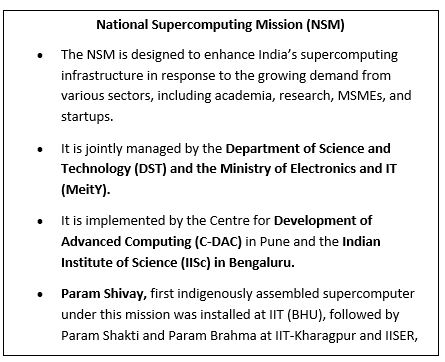
- It is powered by the PARAM RUDRA supercomputing cluster, built using C-DAC’s indigenous RUDRA series of servers.
- PARAM Rudra is a state-of-the-art supercomputing facility developed under Phase-3 of the National Supercomputing Mission and designed and deployed by C-DAC to support the advanced computational needs of IIT Bombay and other regional research and engineering institutions.
- The system delivers a peak computing capacity of 3.1 petaflops, meaning it can perform over 3.1 quadrillion calculations per second.
- A Petaflop is a unit of measurement for computer processing speed, representing one quadrillion floating-point operations per second.
- The facility has been fully developed and manufactured in India, and it runs on open-source software, including AlmaLinux and an indigenously developed system software stack by C-DAC.
National IED Data Management System
Context: Recently,the Union Home Minister inaugurated the operationalisation of the National IED Data Management System (NIDMS), a centralised and secure national platform for managing data related to Improvised Explosive Device (IED) incidents.
More on the News
- NIDMS is a comprehensive digital platform for standardised recording and real-time analysis of IED incidents, including explosives, initiation methods, locations, forensic findings, and operational patterns.
- Developed by the National Security Guards with the help of Rashtriya Raksha University (RRU) in Gandhinagar, IIT-Delhi, National Investigation Agency (NIA) and the Indian Cyber Crime Coordination Centre (I4C).
- It will act as the “next-generation security shield against terrorism” and help in investigating terrorist activities, understanding trends in explosions and formulating effective strategies against them.
- The new system aims to integrate these datasets and use advanced Artificial Intelligence-based tools for analysis and accelerate efforts to connect multiple data sources and strengthen internal security.
- Key Features:
- It will operate as a two-way online platform for central and state security agencies, enabling nationwide upload and analysis of IED and explosion data to support investigations.
- It will support evidence-based prosecution and enhance coordination among agencies.
- It will be integrated with ICJS-2 and will use Artificial Intelligence to connect with other databases.
- ICJS-2 (Inter-Operable Criminal Justice System) is the second phase of India’s Inter-Operable Criminal Justice System, aimed at creating seamless digital integration among all criminal justice institutions to ensure speedy, transparent, and efficient justice delivery.
- The initiative aligns with the vision of “One Nation, One Data Repository”, under which data across departments will be available as a national asset.
India joins the Weimar Triangle format
Context: Recently, the Foreign Minister of India participated in India’s inaugural engagement in the Weimar Triangle format, holding candid discussions with European Ministers.
More on the News:
- The Foreign Minister of India held discussions with the French Foreign Minister, German Minister of State for Europe and Climate Action, and Polish Foreign Minister.
- He described the talks as short but in-depth and open, covering India–European Union relations, the Indo-Pacific region, and the ongoing conflict in Ukraine.
- The Foreign Minister of India also held bilateral talks with French Foreign Minister Barrot, reviewing the India-France special strategic partnership, the first of its kind in Europe.
- Key Highlights:
- India’s engagement with Europe, both via the European Union and bilaterally, has significant untapped potential, with many new areas to explore.
- The emerging multipolar global landscape, marked by volatility and uncertainty, underscores the need for deeper collaboration among like-minded countries with shared interests and a common vision.
About the Weimar Triangle
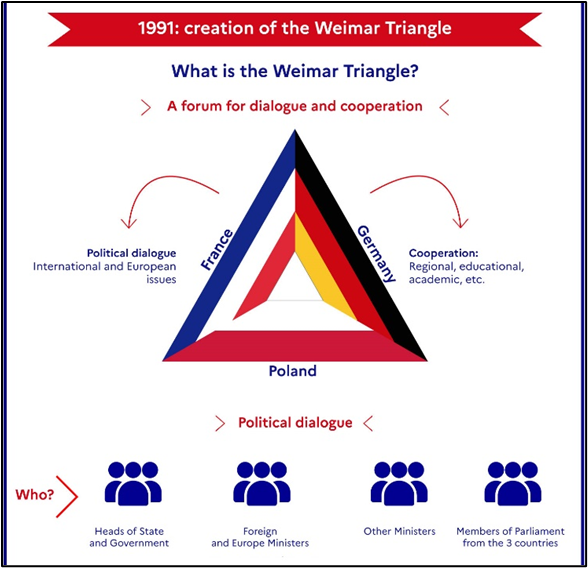
- The Weimar Triangle is a regional alliance of France, Germany, and Poland created in 1991 in the German city of Weimar.
- Their aim was to identify shared fundamental interests regarding Europe’s future and to extend cross-border cooperation.
- In a 10-point declaration, the ministers underscored the major responsibility the three countries shoulder for the European integration process.
- The Ministers for Foreign and European Affairs of the three countries meet regularly for trilateral talks to discuss current political issues and develop joint initiatives.