

North Korea Test-Fired Hypersonic Missile
Context: Recently, North Korea oversaw its first ballistic missile test of the year, a hypersonic missile launch, citing the need to maintain a strong nuclear deterrent.
More on the news
- The missiles were launched from the Ryokpo district of Pyongyang and successfully struck targets approximately 1,000 kilometres (621 miles) away in waters off the country’s east coast.
- A ballistic missile is a rocket-propelled weapon that follows a predetermined, arching path (ballistic trajectory) to deliver one or more warheads to a specific target.
- North Korea tested missiles because of “the recent geopolitical crisis and various international circumstances.
- Analysts suggest the missiles may be the Hwasong-11 (KN-23/24 variants), which were showcased during a military parade in October 2025.
- The possession of a functioning hypersonic weapon would give North Korea the ability to penetrate the enemy’s missile defence shields.
About Hypersonic
- Hypersonic Speed: Refers to speeds at least five times the speed of sound (called Mach-5), about a mile per second.
- Manoeuvrability: Hypersonic missiles can change course during flight, unlike ballistic missiles.
- These missiles can carry both conventional and nuclear warheads
- Types of Hypersonic Weapons:
- Hypersonic Glide Vehicles (HGV): Launched by a rocket, then glide to the target.
- Hypersonic Cruise Missiles (HCM): Powered by air-breathing engines (scramjets) after target acquisition.
World Braille Day
Context: World Braille Day is observed on 4 January annually to mark the birth anniversary of Louis Braille and to highlight the importance of Braille in empowering blind and partially sighted persons through accessible communication.
More on the News
- World Braille Day has been celebrated globally since 2019, the day underscores the critical role of Braille in enabling access to education and information, empowering visually impaired persons to participate fully in society.
- It reaffirms accessible communication as a fundamental human right, essential for dignity, independence, and equality.
About Braille
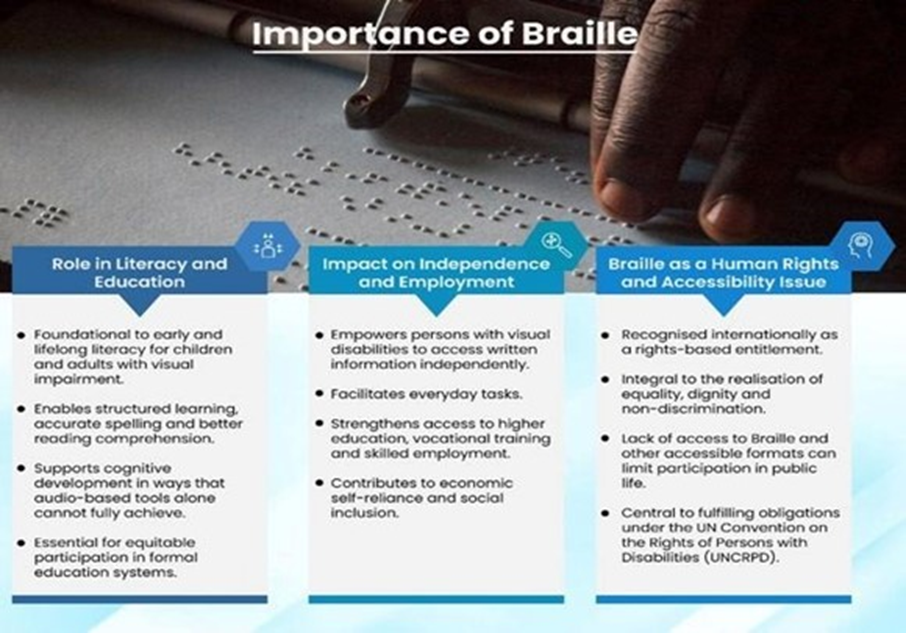
- Braille is a tactile representation of alphabetic and numerical symbols using six dots to represent each letter and number, and even musical, mathematical and scientific symbols.
- It is named after its inventor in 19th century France, Louis Braille.
- It is used by blind and partially sighted people to read the same books and periodicals as those printed in a visual font.
- Braille is essential in the context of education, freedom of expression and opinion, as well as social inclusion, as reflected in article 2 of the Convention on the Rights of Persons with Disabilities.
Braille in India
- The Braille script was introduced in India in 1887.
- Braille was standardised nationally in 1951 as Bharati Braille, with common codes for Indian languages.
- To address this, Braille is embedded in a rights-based framework through measures such as the Rights of Persons with Disabilities Act, 2016 and NEP 2020, positioning it as both a literacy tool and a public accessibility norm.
- The Government of India has developed a comprehensive, rights-based ecosystem to promote Braille for the inclusion and empowerment of persons with visual impairment.
- This framework is grounded in constitutional values of equality, dignity, and social justice, covering education, welfare, skill development, and digital accessibility.
- Legal foundation: Rights of Persons with Disabilities Act, 2016 (RPwD Act)
- Bharati Braille: India’s Standardised Braille Script
Ayush Export Promotion Council
Context: The Ayush Export Promotion Council (AYUSHEXCIL) marked its 4th Establishment Anniversary on 4th January 2026, in New Delhi, highlighting India’s efforts to boost exports of traditional medicine and wellness products.
More on the News
- At the event council highlighted India’s efforts to boost exports of traditional medicine and wellness products.
- The Ayush Export Promotion Council (AYUSHEXCIL) has driven export growth through capacity building, regulatory facilitation, and global outreach via B2B (Business to Business) meetings, exhibitions, and seminars.
- AYUSH exports rose 6.11%, from USD 649.2 million (2023–24) to USD 688.89 million (2024–25), with faster growth after AYUSHEXCIL’s establishment, reflecting rising global demand.
- AYUSHEXCIL has entered its fifth year, aims to strengthen international cooperation, leverage FTAs, promote quality and certification, and enhance global acceptance of India’s traditional medicine systems.
- It highlights India’s growing leadership in the global AYUSH and wellness economy, aligned with Atmanirbhar Bharat and Make in India.
ABOUT AYUSHEXCIL
- AYUSHEXCIL is India’s apex nodal body dedicated to promoting the export of traditional medicine systems
- It was registered as a Section 8 (non-profit) company on January 4, 2022, and formally launched by the Prime Minister of India in April 2022 at the Global AYUSH Investment and Innovation Summit, Gandhinagar.
- It was notified by the Directorate General of Foreign Trade (DGFT) on 31 July 2023 as the nodal Export Promotion Council for the AYUSH sector.
- The Council works in consultation with the Ministry of Ayush and with support from the Ministry of Commerce & Industry.
- It oversees exports of products and services related to Ayurveda, Yoga & Naturopathy, Unani, Siddha, Sowa-Rigpa, Homoeopathy, and other Indian traditional healthcare systems.
Samudra Pratap
Context: Recently, the Union Defence Minister commissioned Indian Coast Guard Ship (ICGS) ‘Samudra Pratap’, the first of two Pollution Control Vessels built by Goa Shipyard Limited (GSL), in Goa.
More on the News
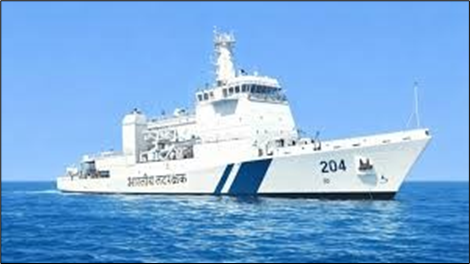
- The vessel has been designed and constructed by Goa Shipyard Limited as part of a national effort to enhance marine pollution response.
- The commissioning of Samudra Pratap significantly enhances the ICG’s ability to respond to oil spills, chemical leaks, and other environmental hazards across India’s Exclusive Economic Zone (EEZ).
- The ship contains more than 60 percent indigenous content, reinforcing Make in India and self-reliance in defence manufacturing.
- The induction marks a milestone as it is the largest vessel currently in the Indian Coast Guard fleet.
- The ship will be based at Kochi under the operational control of the Commander, Coast Guard Region (West).
Features of Samudra Pratap
- Design and Dimensions: Samudra Pratap is 114.5 metres long and 16.5 metres wide with a displacement of 4,170 tonnes.
- Armament and Security Systems: The vessel is armed with a 30 mm (Close Range Naval-91) CRN 91 gun. It is fitted with two 12.7 mm stabilised remote-controlled guns integrated with advanced fire control systems.
- Navigation and Control Systems: The ship features an indigenously developed Integrated Bridge Management System and Integrated Platform Management System.
- It is the first Indian Coast Guard vessel equipped with Dynamic Positioning capability DP-1.
- Power and Firefighting Capabilities: The vessel is equipped with an Automated Power Management System.
- It has a high-capacity external firefighting system.
- Samudra Pratap holds FiFi-2 (Fire Fighting Class 2) and FFV-2 (Fire Fighting Vessel Class 2) certification for advanced firefighting operations.
- Pollution Response and Environmental Protection: The ship is equipped with oil spill detection and response systems, including an oil fingerprinting machine.
- It carries a gyro-stabilised standoff active chemical detector.
- The vessel also has onboard pollution control laboratory equipment.
New e-Business visa for Chinese nationals
Context: Recently, the Government of India launched the e-B-4 Visa, a new electronic “Production Investment Business Visa” category specifically for Chinese nationals.
More on the News
- This move aims to streamline travel for technical experts and business professionals to support India’s manufacturing and industrial sectors.
- The Indian Embassy in Beijing introduced a new e-Business visa sub-class named the e-B-4 Visa on 1 January 2026.
- The development was confirmed through an official advisory published on the Embassy’s website on 5 January 2026.
- The visa allows Chinese engineers, business executives and technical specialists to travel to India for specific production-linked activities.
- Applications for the e-B-4 Visa can be submitted fully online without visiting the embassy or engaging visa agents.
- The expected processing time for the visa is around 45 to 50 days.
- The visa permits a stay in India for up to six months.
- Indian host companies are required to register on the Department for Promotion of Industry and Internal Trade National Single Window System and upload invitation letters.
- The initiative aims to address delays faced by Chinese suppliers involved in India’s electronics, renewable energy and manufacturing sectors.
About the e-B-4 Visa
- The e-B-4 Visa is a specialised e-Business visa introduced for production and investment-linked activities.
- It is meant for short-term and purpose-specific business travel rather than general commercial engagements.
- The visa can be used for the installation and commissioning of equipment.
- It covers quality checks, essential maintenance and plant design activities.
- It allows travel for production setup, IT and ERP ramp-up and training purposes.
- The visa also supports supply chain development, vendor empanelment and plant bring-up.
- Senior management and executive visits related to these activities are included.
- The e-B-4 Visa is distinct from the regular one-year e-Business visa and must be used strictly for notified purposes to avoid compliance issues.