

OPEC+ Agrees to Maintain Steady Oil Output
Context: OPEC+ is expected to reaffirm its decision to keep oil production steady through the first quarter of 2026, despite rising geopolitical tensions among member countries.
More on the News
- The decision follows earlier production increases and reflects concerns of oversupply and declining global oil prices.
- The agreement comes at a time of widening geopolitical instability across West Asia, Eastern Europe and Latin America.
- Eight OPEC+ countries, Saudi Arabia, Russia, the UAE, Kazakhstan, Kuwait, Iraq, Algeria and Oman are part of this decision.
- In November 2025, they decided to pause further output hikes for January, February and March.
- These countries together produce nearly half of the world’s total crude oil supply.
- Between April and December 2025, they increased output targets by about 2.9 million barrels per day.
About the Organisation of the Petroleum Exporting Countries Plus (OPEC+)
- OPEC+ is a powerful alliance between the 12 member countries of OPEC and 10 non-OPEC oil-producing nations, formed in late 2016.
- OPEC (Organisation of the Petroleum Exporting Countries) is a permanent, intergovernmental organisation founded at the Baghdad Conference in September 1960.
- The group coordinates crude oil production to stabilise global prices and manage market supply.
- As of January 2026, the 12 member countries that form OPEC are Algeria, Congo, Equatorial Guinea, Gabon, Iran, Iraq, Kuwait, Libya, Nigeria, Saudi Arabia, the United Arab Emirates, and Venezuela.
- OPEC+ uses the existing OPEC headquarters in Vienna, Austria, as its operational base, where it has been based since moving from Geneva in 1965.
Birth Anniversary of Rani Velu Nachiyar
Context: Prime Minister pays Tribute to Rani Velu Nachiyar on Her Birth Anniversary.
About Rani Velu Nachiyar
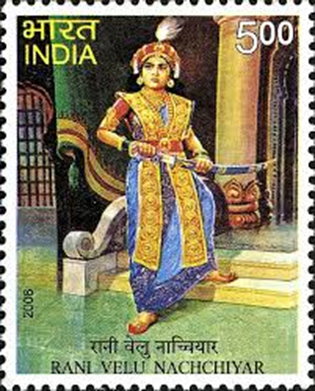
- She was born on January 3, 1730, as the only child of the Raja and Queen of the Ramnad kingdom in present-day Tamil Nadu.
- From a young age, she received training in weaponry, archery and horse riding, and mastered martial arts such as Silambam and Valari.
- She was also highly educated and became proficient in several languages, including Tamil, English, French and Urdu.
- After her marriage, she became the queen of Sivaganga alongside her husband, King Muthu Vaduganatha Periyavudaya Thevar.
- In 1772, Sivaganga was invaded by British East India Company forces with the support of the Nawab of Arcot, leading to the death of her husband in battle.
- Following this defeat, Rani Velu Nachiyar and her daughter went into exile and remained under the protection of Gopala Nayaker near Dindigul for nearly eight years.
- During her period of exile, she carefully rebuilt her strength by forming strategic alliances, including a key alliance with Hyder Ali of Mysore, to raise a trained army.
- In 1780, she led a decisive military campaign against the British East India Company and successfully reclaimed the kingdom of Sivaganga.
- She earned the title Veeramangai, meaning Brave Woman, and became the first Indian queen to successfully challenge British colonial rule, decades before the 1857 revolt.
- As part of her military organisation, she established Udaiyaal, one of the earliest known all-women army units in history.
- Her trusted commander, Kuyili, carried out a historic suicide attack by setting herself on fire to destroy a British ammunition depot during the campaign.
- Rani Velu Nachiyar ruled Sivaganga until 1790, consolidating her authority and restoring stability in the region.
- She passed away on December 25, 1796, leaving behind a legacy as a pioneering figure in India’s early resistance to colonial rule.
- India Post released a commemorative postage stamp in honour of Rani Velu Nachiyar in 2008.
Centre Relaxes DSIR Norms for Deep-Tech Start-ups
Context: Recently, the Union Government has relaxed eligibility norms under DSIR to enable early-stage deep-tech start-ups to access public funding and accelerate India’s innovation ecosystem.
More on the News
- The Union Science and Technology Minister announced the removal of the mandatory three-year viability requirement for deep-tech start-ups.
- The decision was announced during the 42nd Foundation Day of the Department of Scientific and Industrial Research in New Delhi.
- The relaxation applies to financial assistance of up to ₹1 crore under the Industrial Research and Development Promotion Programme.
- Earlier, start-ups were required to demonstrate sustainability and viability for a minimum of three years to qualify for DSIR support.
- With the change, early-stage deep-tech start-ups can now access funding without completing three years of existence.
- The reform is intended to provide early momentum to promising innovators and accelerate technology-led entrepreneurship.
- The government clarified that evaluation standards linked to technological maturity will continue to be maintained.
- The move complements the ₹1 lakh crore Research, Development and Innovation Fund, which supports more mature technologies.
- The relaxation lowers entry barriers for deep-tech start-ups that require early capital support due to long gestation periods.
The Department of Scientific and Industrial Research (DSIR)
- DSIR, established in 1985, is a government department under the Ministry of Science and Technology.
- It is responsible for promoting indigenous technology development, utilisation and technology transfer in India.
- The headquarters of the Department of Scientific and Industrial Research (DSIR) are located in New Delhi, India.
Strengthening the National Pension System (NPS)
Context: The Pension Fund Regulatory and Development Authority (PFRDA) has approved major policy reforms to promote competition and sustainable growth of the National Pension System, to deepen pension coverage and strengthen governance.
More on the News
- The Pension Fund Regulatory and Development Authority approved policy reforms in principle during its Board meeting to strengthen and scale the National Pension System.
- The Ministry of Finance announced that these reforms aim to enhance competition, safeguard subscriber interests and expand NPS outreach.
- A key reform allows Scheduled Commercial Banks to independently sponsor Pension Funds to manage NPS assets.
- This change removes earlier regulatory constraints that had limited bank participation in the pension ecosystem.
- Eligibility for bank-sponsored Pension Funds will be based on net worth, market capitalisation, and prudential soundness aligned with RBI norms.
- Detailed eligibility criteria will be notified separately and will apply to both new and existing Pension Funds.
National Pension System (NPS)
- The National Pension System (NPS) is a government-backed, market-linked defined contribution retirement scheme regulated by the Pension Fund Regulatory and Development Authority (PFRDA).
- NPS was introduced by the Government of India in 2004 to enable systematic and regular savings during the working life of individuals to ensure a stable and adequate income post-retirement.
About The Pension Fund Regulatory and Development Authority (PFRDA)
- It is a statutory regulatory body established under the Pension Fund Regulatory and Development Authority Act, 2013, and is responsible for the overall supervision, regulation, and development of the pension sector in India.
- It is operating under the Ministry of Finance, and it aims to ensure old-age income security by protecting the interests of pension fund subscribers.
- The headquarters of the Pension Fund Regulatory and Development Authority (PFRDA) is located in New Delhi, India.
Suryastra Long-Range Rocket Launcher System
Context: The Indian Army has signed a ₹293 crore contract with Pune-based NIBE Limited to induct an indigenous long-range rocket launcher system, Suryastra, to enhance deep-strike artillery capabilities.
More on the News
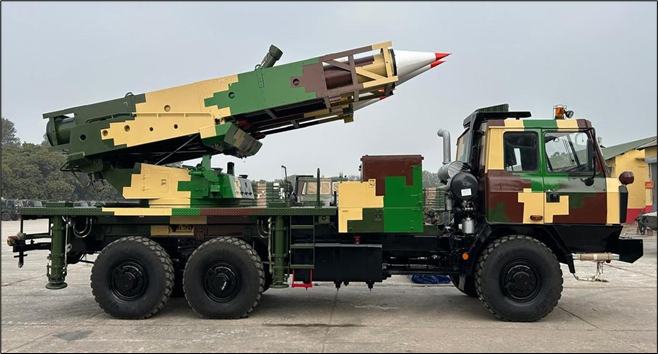
- The contract is for the manufacturing and supply of a universal long-range rocket launcher system named Suryastra, developed in collaboration with Israeli defence major Elbit Systems.
- The system will significantly enhance the Army’s deep-strike firepower and operational reach across multiple fronts.
- The development was officially disclosed by NIBE Limited through filings to the Bombay Stock Exchange and National Stock Exchange.
- The contract includes launchers, ground support equipment, accessories, electronic sequence programming units and customised ammunition.
- The acquisition follows the Defence Acquisition Council’s decision on December 26, 2025 to extend emergency procurement powers till January 15, 2026.
- Under these provisions, armed forces can procure systems worth up to ₹300 crore with deliveries starting within six months and completed within one year.
- The deal builds on a Technology Collaboration Agreement signed in July 2025 between NIBE Limited and Elbit Systems for licensed manufacturing in India.
Suryastra System: Key Features and Capabilities
- Suryastra is India’s first indigenously manufactured universal multi-calibre rocket launcher system.
- The system can conduct precision surface-to-surface strikes at ranges of 150 km and 300 km.
- It is designed to engage multiple targets simultaneously at varying ranges.
- The launcher demonstrated a circular error probable of less than five metres during trials, indicating high precision.
- It is capable of firing multiple rocket types from a single platform, enhancing battlefield flexibility.
- The system can also launch loitering munitions up to a range of about 100 km.
- Suryastra is based on Elbit Systems’ proven PULS launcher technology adapted for Indian requirements.
- It supports both area saturation fire and long-range precision strikes.
Grand International Exposition of Sacred Piprahwa Relics
Context: Recently, the Prime Minister inaugurated an international exposition to display the Piprahwa relics of Bhagwan Buddha, repatriated to India after 127 years.
More on the News
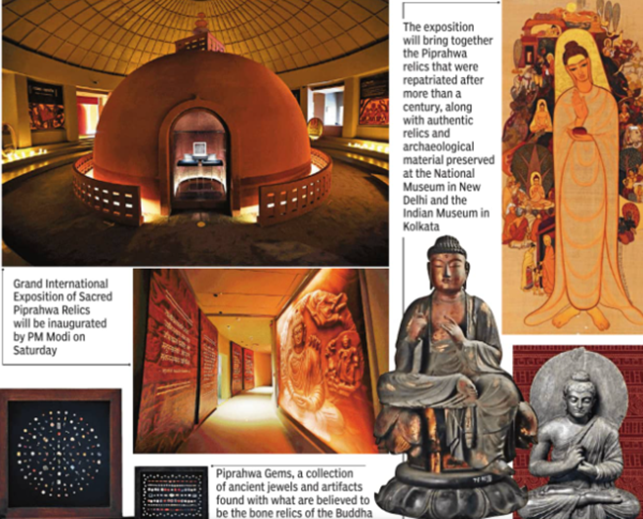
- The Ministry of Culture hosted the exposition at the Rai Pithora Cultural Complex in New Delhi.
- The exposition was titled “The Light and the Lotus: Relics of the Awakened One.”
- It marked the reunification of the Piprahwa gem relics repatriated in 2025 with relics and reliquaries excavated earlier in 1898 and during 1971–1975.
- The repatriation of the relics was achieved in July 2025 through a public private partnership that halted an international auction.
- The exhibition brought together sacred objects preserved across national institutions for the first time since their discovery.
- It showcased over eighty objects ranging from the sixth century BCE to the present period.
- The displayed items included sculptures, manuscripts, thangkas, ritual objects and archaeological materials.
- The exposition reinforced India’s role as the birthplace of Buddhism and as a global spiritual and cultural leader.
Key Highlights of the Piprahwa Relics Exposition
- The sacred relics were originally discovered in 1898 by William Claxton Peppé at the ancient stupa site of Kapilavastu.
- The Piprahwa relics are sacred Buddhist artefacts discovered at the Piprahwa stupa in Uttar Pradesh, India, which is widely identified by archaeologists as the ancient city of Kapilavastu, the homeland of Gautama Buddha.
- These relics are considered some of the most significant tangible evidence of the historical Buddha’s existence.
- Portions of the relics were distributed internationally during the colonial period.
- One portion was preserved at the Indian Museum in Kolkata while others were taken abroad.
- It included reliquaries and jewelled treasures from the Indian Museum Kolkata.
- It also displayed the original monolithic stone coffer in which the relics were found.