

India’s Population Expected to Stabilise by 2080
Context: India is experiencing a rapid demographic shift driven by a sustained decline in fertility rates and rising life expectancy.
More on the News
• The Indian Association for the Study of Population stated that India’s population is expected to stabilise by 2080 at about 1.8 to 1.9 billion.
• The Total Fertility Rate has declined from 3.5 in 2000 to 1.9 in 2023, which is below the replacement level (2.1).
• The decline in fertility is attributed to development, female literacy, late marriages and wider access to contraception.
• States such as Kerala and West Bengal have reached very low fertility levels, well below the replacement rate.
• Rising life expectancy and ageing populations are creating new demands for elderly care systems.
Total Fertility Rate (TFR)
• TFR is the average number of children a woman would have during her lifetime if she experienced the exact current age-specific fertility rates throughout her reproductive years (typically ages 15-49).
• India’s Total Fertility Rate (TFR) has fallen to 2.0 as per the National Family Health Survey-5 (NFHS-5, 2019-21).
• As per the latest Sample Registration System (SRS) Statistical Report 2023, India’s Total Fertility Rate in 2023 stands at 1.9, with Bihar recording the highest rate at 2.8 and Delhi recording the lowest at 1.2.
Hansa-3(NG) trainer aircraft
Context: Recently, the CSIR-National Aerospace Laboratories (NAL) launched a “production version” of the indigenous Hansa-3(NG) trainer aircraft in Bengaluru.
More on the News
• The Hansa-3(NG) has been introduced to meet the growing demand for aviation training as India is expected to require nearly 30,000 pilots in the next two decades.
• The Union Minister of State for Science and Technology reviewed ongoing work on the SARAS Mk-2 light transport aircraft and inaugurated multiple aerospace testing and manufacturing facilities.
• The industry partner Pioneer Clean Amps is establishing a manufacturing unit in Andhra Pradesh with the capacity to produce up to one hundred Hansa-3(NG) aircraft every year.
Hansa-3(NG) Trainer Aircraft
• This aircraft is India’s first all-composite two-seat trainer designed to meet the increasing demand for Private Pilot Licence and Commercial Pilot Licence training.
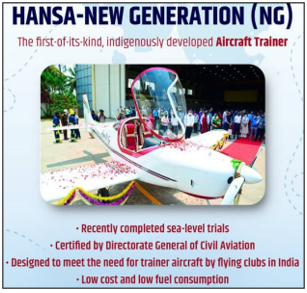
• This aircraft uses an advanced composite airframe that improves structural strength while reducing overall weight.
• This aircraft offers lower operating costs and improved fuel efficiency, making it suitable for flying clubs and training academies.
• This aircraft supports modern pilot training needs through upgraded avionics and enhanced cockpit ergonomics.
• This aircraft has been developed as a fully indigenous platform, reducing India’s dependence on imported basic trainer aircraft.
Disabled People are Facing Major Barriers in Accessing Health Insurance
Context: Recently, a nationwide National Centre for Promotion of Employment for Disabled People (NCPEDP) survey highlighted widespread exclusion of persons with disabilities from health insurance.
More on the News
• NCPEDP released a nationwide survey and white paper showing that most persons with disabilities remain without health insurance.
• The survey was conducted across 34 States and Union Territories and covered over 5,000 respondents.
Key Findings of the Survey
• High rejection rates: The survey shows that eighty per cent of persons with disabilities do not have any form of health insurance, indicating that more than half of the applicants face rejection when they apply for insurance and many receive no explanation for the denial.
• Discriminatory exclusion: The finding points to persistent discriminatory underwriting practices that exclude applicants solely on the basis of disability or pre-existing conditions.
• Systemic inequity: The evidence highlights deep systemic inequities that deny nearly sixteen crore Indians with disabilities access to equitable health protection.
• Legal mandate non-compliance: The assessment finds that mandates of the Rights of Persons with Disabilities Act 2016 are not effectively enforced in the insurance sector.
Key Recommendations of the White Paper
• Disability-inclusive health coverage: White paper recommends the immediate inclusion of all persons with disabilities under Ayushman Bharat without any age or income criteria.
• Holistic health coverage: It calls for enhanced coverage for mental health care, rehabilitation services and assistive technologies within insurance packages.
India Re-elected to the International Maritime Organisation Council
Context: Recently, India has strengthened its global maritime position by being re-elected to the International Maritime Organisation Council with the highest votes in Category B.
More on the News
• India has been re-elected to the International Maritime Organisation Council in Category B with 154 out of 169 valid votes cast at the 34th IMO Assembly in London.
• India’s re-election follows the successful hosting of India Maritime Week 2025 which drew participants from more than 100 countries and showcased India’s maritime capabilities.
• India’s active role in sustainability, maritime safety and decarbonisation initiatives has strengthened its credibility in global maritime governance.
• India has secured the highest number of votes in Category B for the second consecutive term which aligns with the goals of the Amrit Kaal Maritime Vision 2047.
• The other countries elected to Category B include Australia, Brazil, Canada, France, Germany, the Netherlands, Spain, Sweden and the United Arab Emirates.
International Maritime Organisation (IMO)
• IMO is a specialised United Nations agency that sets standards for the safety, security, and environmental performance of international shipping.
• The IMO was established in 1948 after an agreement at the Geneva Conference.
• IMO headquarters are located in London, UK.
• The IMO Council is the executive organ of IMO and is responsible, under the Assembly, for supervising the work of the Organization.
• The Council is made up of 40 Member States, elected by the Assembly for two-year terms.
• The IMO Assembly elects Member States to serve on three categories of the IMO Council.
- Category (a): 10 States with the largest interest in providing international shipping services
- Category (b): 10 States with the largest interest in international seaborne trade
- Category (c): 20 States not elected under (a) or (b) above, which have special interests in maritime transport or navigation and whose election to the Council will ensure the representation of all major geographic areas of the world
India Internet Governance Forum (IIGF) 2025
Context: Recently, the fifth edition of the India Internet Governance Forum was held in New Delhi.
More on the News
• The forum was held at the India Habitat Centre and the India International Centre.
• IIGF-2025 was inaugurated by the Ministry of Electronics and Information Technology (MeitY) and the National Internet Exchange of India (NIXI).
- NIXI is a non-profit organisation under the Ministry of Electronics & Information Technology (MeitY), Government of India, established on June 19, 2003, to improve internet services and infrastructure in the country.
• The event aims to provide a collaborative platform for identifying priorities for India’s internet landscape and examining areas that require policy attention.
• The theme for this year is “Advancing Internet Governance for an Inclusive and Sustainable Viksit Bharat,” reflecting the forum’s focus on inclusive development and responsible digital growth.
• The discussions will be structured around three sub-themes, which include an inclusive digital future, digital infrastructure for resilient and sustainable growth, and the responsible use of artificial intelligence for societal and environmental progress.
About the India Internet Governance Forum
• The India Internet Governance Forum serves as the national chapter of the United Nations Internet Governance Forum and follows a multistakeholder structure to ensure balanced representation.
• The forum provides equal space to government agencies, civil society organisations, industry representatives, technical bodies and academic institutions to deliberate on internet policy matters.
• The forum was established in 2021 to create a platform for open and inclusive dialogue on digital governance and public policy issues.
• A 14-member committee drawn from diverse sectors oversees the activities and functioning of the forum to ensure continuity and institutional support.
World AIDS Day 2025
Context: World AIDS Day is a global observance held on December 1 every year to raise awareness about the HIV/AIDS epidemic.
More on the News
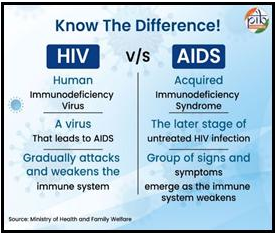
• The theme for World AIDS Day 2025 is “Overcoming disruption, transforming the AIDS response.”
• It was first marked in 1988 by the World Health Organisation (WHO) and has since become a platform for governments, communities, and individuals to unite in the fight against the disease.
Acquired Immunodeficiency Syndrome
• AIDS is caused by the human immunodeficiency virus (HIV), a retrovirus that originated in nonhuman primates and crossed over to humans.
• HIV is primarily spread through certain bodily fluids, including blood, semen, vaginal fluids, rectal fluids, and breast milk. Common transmission routes include unprotected sex and sharing needles.
• HIV remains a major global public health issue, having claimed an estimated 44.1 million lives to date.
• There were an estimated 40.8 million people living with HIV at the end of 2024, 65% of whom are in the WHO African Region.
World Telecommunication Development Conference 2025 (WTDC-25)
Context: Recently, the Government of Azerbaijan hosted the World Telecommunication Development Conference 2025 (WTDC-25) in Baku.
World Telecommunication Development Conference 2025
• The conference, organised by the International Telecommunication Union (ITU), from November 17 to 28, 2025.
• The theme of WTDC-25 is “Universal, meaningful, and affordable connectivity for an inclusive and sustainable digital future”.
• WTDC-25 witnessed the participation of around 2,300 delegates, including more than 65 ministers and heads of agencies from across the world.
• The conference is held every four years and sets the strategic direction and programme of work for global telecommunications development.
• The World Telecommunication Development Conference (WTDC) is a global platform dedicated to advancing digital connectivity, fostering innovation, and shaping policies for a more inclusive digital future
The International Telecommunication Union (ITU)
• ITU is the United Nations specialised agency for information and communication technologies (ICTs).
• ITU was established in 1865, and it is one of the oldest international organisations still in operation.
• ITU is headquartered in Geneva, Switzerland.