
SYLLABUS
GS-3: Awareness in the fields of IT, Space, Computers, robotics, nano-technology, bio-technology and issues relating to intellectual property rights
Context: Recently, the International Astronomical Union (IAU) has approved several names for Martian landforms proposed by two Kerala-based researchers.
News Names and their relevance
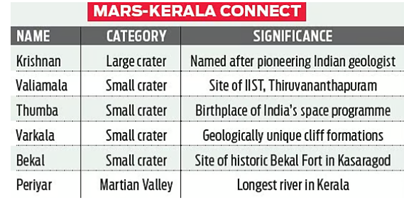
- Krishnan Crater and Palus:
- Martian Site: Krishnan Crater spans 77 km in diameter within Xanthe Terra, featuring a 50 km-wide plain named Krishnan Palus that shows signs of ancient water flows and glaciation. A channel across the palus is designated as Periyar Vallis.
- Significance: M.S. Krishnan, the first Indian Director of the Geological Survey of India in 1951, advanced geological mapping and resource surveys foundational to India’s earth sciences. The naming honors his legacy in planetary geology research.
- Valiamala Crater:
- Martian Site: This crater lies west of Krishnan Crater, named for a smaller feature in the same ancient terrain linked to IIST’s geological studies.
- Significance: Valiamala in Thiruvananthapuram hosts IIST, a key institution for space science education and research driving India’s Mars exploration efforts. It symbolizes Kerala’s role in nurturing space talent.
- Varkala Crater:
- Martian Site: A 9-km crater inside Krishnan Crater, selected for parallels with jarosite deposits indicating past water activity on Mars.
- Significance: Varkala’s coastal cliffs in Thiruvananthapuram feature unique geological formations rich in jarosite, a mineral formed in watery conditions, serving as an Earth analog for Martian studies. These cliffs aid comparative planetology for habitability research.
- Thumba Crater:
- Martian Site: Located 19 km southeast of Krishnan Crater, this feature contributes to mapping ancient fluvial networks in the region.
- Significance: Thumba in Thiruvananthapuram birthed ISRO in 1962, pioneering India’s space program with early rocket launches. It represents the cradle of India’s rocketry and satellite technology advancements.
- Bekal Crater:
- Martian Site: A smaller crater near the Krishnan complex, drawn from global town names for minor features per IAU rules.
- Significance: Bekal in Kasaragod hosts India’s largest fort, a historic coastal stronghold reflecting maritime heritage and strategic defense. It underscores Kerala’s cultural and architectural legacy.
- Periyar Vallis:
- Martian Site: This valley channels through Krishnan Palus, evidencing fluvial erosion in a region with confirmed ancient glaciation.
- Significance: Periyar, Kerala’s longest river, sustains biodiversity in Periyar Tiger Reserve and supports irrigation, hydropower, and ecosystems. It highlights riverine geology relevant to Martian water history studies.
International Astronomical Union (IAU)
- The IAU is the sole organization professionally recognized for naming astronomical objects and features on their surfaces.
- Its mission is to promote and safeguard the science of astronomy through international cooperation in research, communication, education, and development.
- It was founded in 1919 and headquartered in Paris, France, the IAU is a non-governmental organization with over 12,000 individual members from around the world and 85 national members.
- The IAU follows several strict guidelines to ensure names are clear, internationally recognized, and respectful:
- Names must be 16 characters or less, preferably one word, and easily pronounceable in many languages.
- Names should be non-offensive and not too similar to existing names of other objects.
- Political, military, or religious names are generally prohibited, with an exception for political figures who lived prior to the 19th century.
- Names of living individuals are never permitted for surface features.
Sources:
The Hindu
New Indian Express