
SYLLABUS
GS-3: Indian Economy and issues relating to Planning, Mobilization of Resources, Growth, Development and Employment.
Context: Recently, the Union Finance Minister launched the second phase of the asset monetisation pipeline, ‘National Monetisation Pipeline 2.0 (NMP 2.0)’.
More on the News
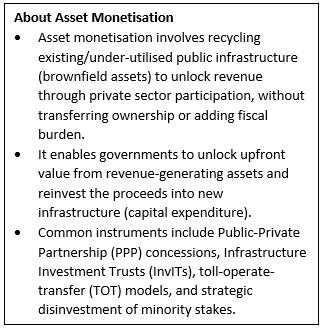
- The second phase of the pipeline has been developed by NITI Aayog, in consultation with infrastructure line ministries, based on the mandate for ‘Asset Monetisation Plan 2025-30’ as announced in the Union Budget 2025-26.
- It targets aggregate monetisation potential of ₹16.72 lakh crore (including ₹5.8 lakh crore private investment) from 12 infrastructure sectors over FY 2026–2030.
- The target under NMP 2.0 is 2.6 times larger than the 6 lakh crore target of NMP 1.0.
- NMP 2.0 aligns with the broader Viksit Bharat vision of accelerating infrastructure-led economic growth.
Key Highlights of National Monetisation Pipeline 2.0
- Objective & Timeframe (FY26–FY30): Provides a structured five-year roadmap for monetising operational public infrastructure assets, offering predictability to investors while enabling systematic capital recycling by the government.
- Aggregate Monetisation Target: Envisages a total monetisation potential of ₹16.72 lakh crore, including approximately ₹5.8 lakh crore of private sector investment across key infrastructure sectors.
- Sectoral Coverage & Asset Focus: Covers 12 major sectors—such as highways (largest share), railways, power, ports, petroleum & natural gas, telecom, aviation, coal, mines, warehousing, urban infrastructure and tourism—primarily focusing on core brownfield assets.
- Highways/MMLPs/Ropeways (4.42 lakh crore; 26% of total), Power (2.77; 17%), Ports (2.64; 16%), Railways (2.62; 16%).
- Framework: NMP 2.0 shall broadly follow the concept of asset monetisation as laid out in NMP 1.0. Asset monetisation shall comprise elements such as transfer of assets for a limited period, divestment of portions of listed entities to unlock additional capital, securitisation of cash flows or strategic commercial auctions.
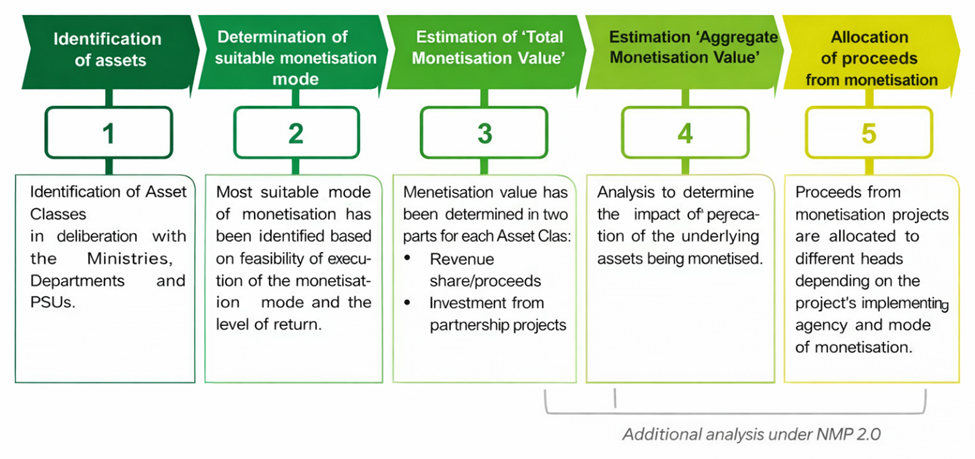
- Proceeds Distribution: The proceeds from asset monetisation projects are allocated to four different heads depending on the implementing agency of the project, as well as the project’s mode of monetisation.
- Consolidated Fund of India: Any type of Government revenue from a monetisation project that is implemented by a Central Ministry (for example, revenue share, premium, lease rental, royalty) shall flow to the Consolidated Fund of India.
- PSU/Port Authorities allocation: Proceeds from monetisation activities undertaken by PSUs shall accrue to the concerned PSU (similar norm shall be followed for Major Port Authorities).
- State Consolidated Fund: Certain projects under NMP 2.0 are expected to generate revenues to the State Governments, especially those belonging to the mines and coal sectors (royalty payments). These proceeds shall accrue to the State Consolidated Fund.
- Direct investment (private): This head shall record the investment by the private sector in monetisation projects that involve construction and/or major maintenance components.
- Stages of Asset Monetisation: The approach to estimation of monetisation potential under NMP 2.0 is divided into five stages:
Significance of NMP 2.0
- Catalysing Infrastructure Financing: Enables recycling of capital from mature brownfield assets into new greenfield infrastructure projects, reducing fiscal pressure while sustaining high public capital expenditure.
- Crowding-in Private Investment: Attracts long-term institutional investors (InvITs, pension funds, sovereign wealth funds) and deepens PPP ecosystems, strengthening India’s infrastructure financing architecture.
- Enhancing Operational Efficiency: Promotes improved asset utilisation, better maintenance standards, and performance-based management through structured private participation without transferring ownership.
- Supporting Viksit Bharat & Growth Momentum: Strengthens logistics, connectivity and industrial competitiveness, thereby boosting GDP growth, job creation, and overall economic resilience.
About National Monetisation Pipeline 1.0
- NITI Aayog launched NMP 1.0 in August 2021, targeting ₹6 lakh crore in asset monetisation over FY22–FY25 across 13 infrastructure sectors, with highways, railways, power, petroleum & natural gas, and telecom accounting for ~72% of the total.
- The programme achieved ~90% of its target (₹5.3–5.4 lakh crore) through successful transactions such as Infrastructure Investment Trusts (InvITs) for highways and power transmission, public-private partnership (PPP) toll roads, airport privatisations (e.g., Adani group), and railway station redevelopment.
- NMP 1.0 demonstrated the viability of large-scale brownfield monetisation, established best practices (including digital bidding processes and investor confidence), and provided valuable lessons that now inform the design and execution of NMP 2.0.