SYLLABUS
GS-3: Infrastructure: Energy, Ports, Roads, Airports, Railways etc.
Context: The Atomic Energy Regulatory Board has approved excavation activities for Units 1 and 2 of the Mahi Banswara Rajasthan Atomic Power Project, marking progress in India’s nuclear expansion.
About the Mahi Banswara Rajasthan Atomic Power Project
- It was launched in Banswara, Rajasthan, on September 25, 2025.
- The project was being implemented by Anushakti Vidhyut Nigam Limited (ASHVINI), a subsidiary of Nuclear Power Corporation of India Limited, as a joint venture with NTPC Limited.
- It was the first nuclear power project in the country to be set up by a joint venture of two Central Public Sector Enterprises (CPSEs).
- The project comprised four units of 700 MW Pressurised Heavy Water Reactors (PHWR) indigenously developed by NPCIL.
- It was to be set up on a twin-unit basis in two phases: Mahi Banswara 1 & 2 (2 × 700 MW) and Mahi Banswara 3 & 4 (2 × 700 MW), at a total cost of ₹42,000 crore.
- Technology:
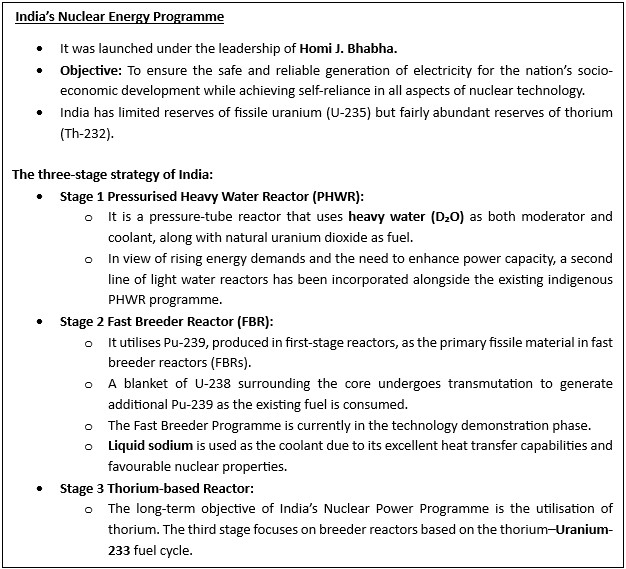
- Pressurised Heavy Water Reactors (PHWRs) indigenously designed by NPCIL.
- Use natural uranium as fuel and heavy water (deuterium oxide) as coolant and moderator.
- It is part of India’s “fleet mode” nuclear programme, which aims to build ten standardised 700 MWe reactors across multiple sites to ensure cost efficiency, faster deployment, and operational standardisation.
- Other reactors under this programme are planned or operational at Kaiga (Karnataka), Gorakhpur (Haryana), Chutka (Madhya Pradesh), Kakrapar (Gujarat), and Rajasthan.
India’s Nuclear Power Status
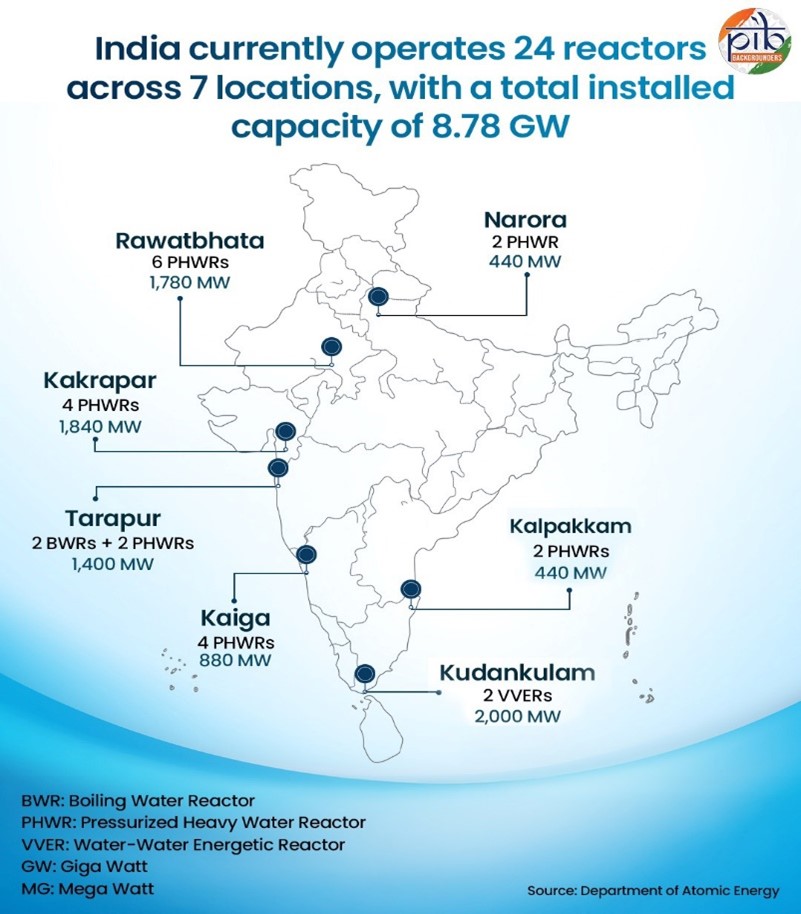
- India currently has 24 operable nuclear reactors with a total installed capacity of 8,780 MWe.
- Additionally, 8 reactors are under construction with a combined capacity of 6,028 MWe.
- There is also 1 reactor that has been shut down, with a capacity of 135 MWe.
- Nuclear energy accounts for 1.7% of the total installed power generation capacity in India.
- Under the Viksit Bharat 2047 vision, India aims to achieve at least 100 GWe nuclear capacity by 2047 to support the clean energy transition and energy security.
Government Initiatives to Achieve the 2047 Nuclear Target
- Long-Term Vision (2025): In 2025, Nirmala Sitharaman announced that at least 100 GWe nuclear capacity by 2047 is essential for India’s energy transition, aligning with Viksit Bharat 2047 and the net-zero 2070 goal.
- India is also shifting toward Light Water Reactors (LWRs) alongside Pressurised Heavy Water Reactors (PHWRs) to meet this target and enhance export competitiveness.
- Bharat Small Reactors (BSRs): In the Union Budget 2024–25, the government proposed Bharat Small Reactors based on indigenous 220 MWe PHWR technology, ensuring technological continuity and strengthening domestic capabilities.
- Nuclear Energy Mission (2025): In February 2025, the Nuclear Energy Mission for Viksit Bharat was announced to develop at least five indigenous Small Modular Reactors (SMRs) by 2033 with federal funding and legislative support.
- Development of Indigenous SMR Technologies: In August 2025, Bhabha Atomic Research Centre announced the development of a 200 MWe Bharat SMR, a 50 MWe SMR, and a 5 MWt high-temperature gas-cooled reactor for hydrogen and industrial use.
- International Cooperation (2025): In February 2025, India and France signed a Letter of Intent on advanced and SMR technologies, while India and the United States agreed to advance the civil nuclear agreement, including plans for US-designed reactors in India.
- Legislative Transformation – SHANTI Bill (2025): In December 2025, Parliament passed the SHANTI Bill, replacing the Atomic Energy Act, 1962, and Civil Liability for Nuclear Damage Act, 2010, with a single comprehensive framework to facilitate nuclear expansion.