SYLLABUS
GS-3: Awareness in the field of Space.
Context: On December 24, 2025, the Indian Space Research Organisation (ISRO) achieved a significant milestone by successfully launching the BlueBird Block-2 communication satellite using its heaviest rocket, the LVM3-M6.
More on the News
- ISRO’s LVM3-M6 launched BlueBird Block-2 (6,100 kg) satellite into low Earth orbit, making it the heaviest commercial satellite and payload ever launched from Indian soil
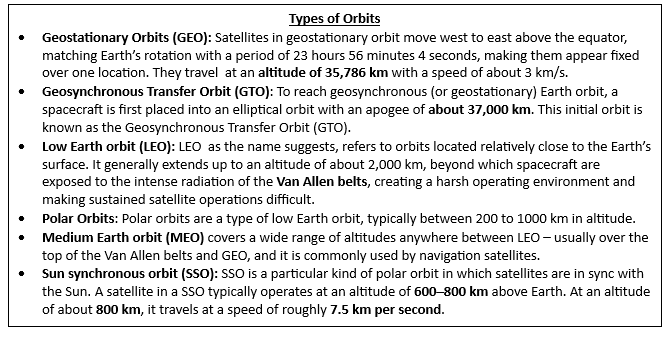
- The LVM3-M6 mission has placed the BlueBird Block-2 satellite into its Low Earth Orbit (LEO).
- The mission marked the sixth operational flight of the LVM3 launch vehicle and represents a significant leap in telecommunications technology.
- The mission was undertaken as part of the commercial agreement sealed between NewSpace India Ltd (NSIL) — the commercial arm of ISRO — and US-based AST SpaceMobile (AST and Science, LLC).
- BlueBird Block-2 is a communication satellite developed by AST SpaceMobile, USA and is part of the next generation of BlueBird Block-2 communication satellites.
- It is designed to provide space-based cellular broadband connectivity directly to standard mobile smartphones.
About LVM3 Launch Vehicle
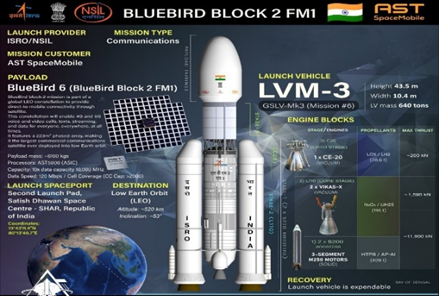
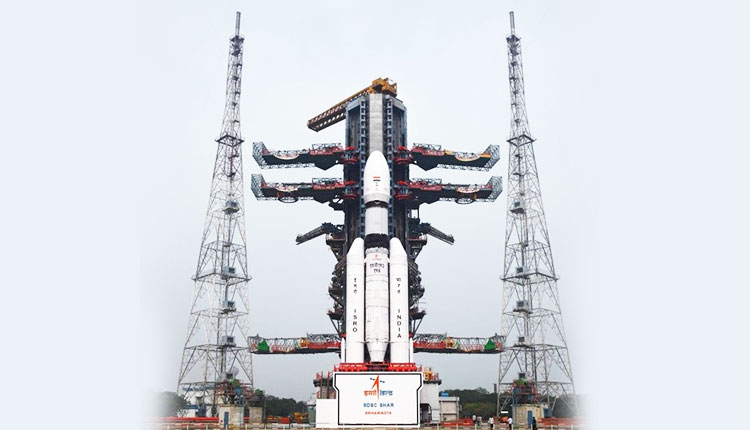
- LVM-3 is a powerful cryogenic engine-based launch vehicle originally designed to place satellites into geosynchronous orbits about 36,000 km above Earth.
- It serves as ISRO’s heavy-lift launch vehicle, capable of cost-effectively deploying payloads of up to 4,000 kg to Geosynchronous Transfer Orbit (GTO) and 8,000 kg to Low Earth Orbit (LEO).
- It is a three-stage launch vehicle comprising two solid strap-on motors (S200), a liquid core stage (L110), and a cryogenic upper stage (C25).
- In its earlier missions, LVM3 successfully launched Chandrayaan-2, Chandrayaan-3, and two OneWeb missions carrying 72 satellites.
- After OneWeb launch, the rocket was renamed as the Geosynchronous Launch Vehicle Mark 3 or GSLV-Mk3.