
SYLLABUS
GS-2: Functions and Responsibilities of the Union and the States, Issues and Challenges Pertaining to the Federal Structure.
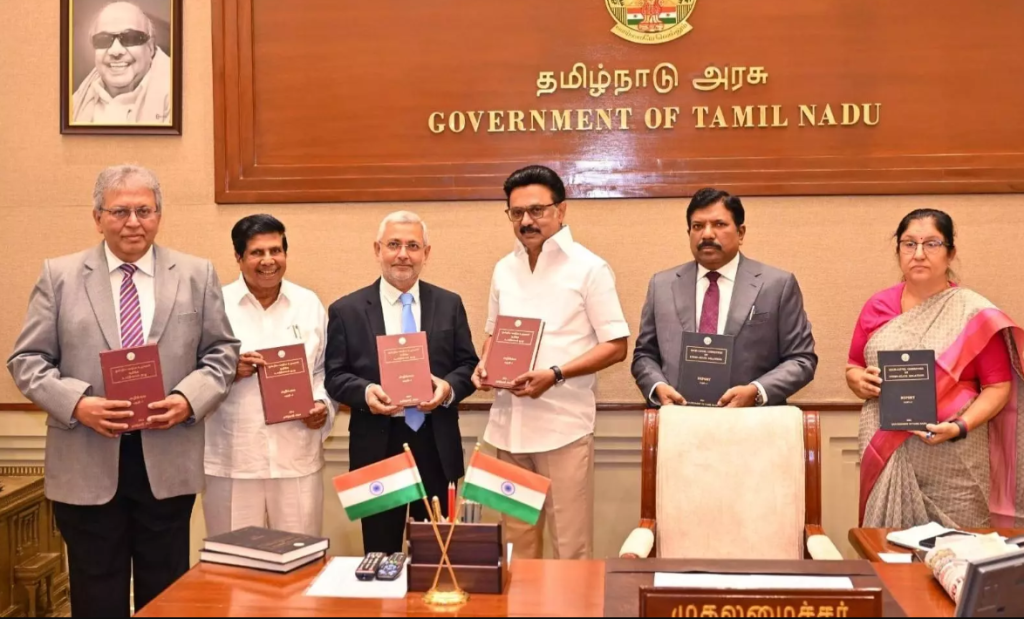
Context: A High-Level Committee on Union–State Relations, appointed by the Tamil Nadu government in April 2025, has submitted Part I of its report recommending a “structural reset” of Indian federalism.
More on the News
• The Committee is headed by Justice Kurian Joseph (retired Supreme Court judge), and draws on Constituent Assembly debates, academic scholarship, and prior committees (Sarkaria, Punchhi, NCRWC) to map patterns of centralisation and propose concrete constitutional and institutional reforms.
• The report argues that India’s federal design, framed under the shadow of Partition and princely state integration, has evolved into excessive centralisation that no longer matches the country’s political maturity and diversity.
• It presents eleven foundational arguments for decentralisation, including the Liberty Argument, Democracy Argument, and Innovation Argument, while critiquing what it terms the Uniformity Fallacy and Control Fallacy.
Key Recommendations of the Committee
A. Constitutional Amendments & Basic Structure:
- Amend Article 368 to require ratification of most constitutional amendments by two-thirds of States representing two-thirds of the population, thereby strengthening federal consent.
- Insert an explicit “Basic Features” clause in Article 368, listing unamendable features such as federalism, democracy, secularism, judicial review and free elections, thereby codifying the basic structure doctrine.
B. Territorial Integrity of States and UTs:
- Curtail Parliament’s unilateral power under Article 3, requiring affected State consent by a special majority and, in some cases, referendums before altering State boundaries or status.
- Insert a new Article 3A to bar the creation of new Union Territories and require periodic referendums for existing UTs on their future status.
C. Language Policy:
- Reject the “One Nation, One Language” approach, advocating plural linguistic federalism.
- Amend Article 343 to make English a permanent official language of the Union, and delete references to Hindi in Article 345.
- Replace the Special Officer for Linguistic Minorities with a National Language Commission, and replace the Three Language Formula with high proficiency bilingualism (English + mother tongue/state language).
D. Role of Governors:
- Amend Article 155 so that the President must appoint one of the three names approved by the State Legislative Assembly.
- Amend Article 156 to abolish the “pleasure doctrine” and fix a single, non-renewable five-year term, with removal only via a State Assembly resolution.
- Introduce a binding “Instrument of Instructions” in a new Thirteenth Schedule, clearly limiting gubernatorial discretion.
E. Fiscal Federalism and GST:
- Revisit GST Council voting weights to enhance State voice and clarify that its decisions are recommendatory, in line with the Mohit Minerals (2022) judgment.
- Strengthen revenue autonomy and ensure predictable, rule‑based transfers to States.
F. Representation & Delimitation:
- Extend the freeze on inter-state Lok Sabha seat allocation until 2126 or until interstate fertility rates converge, to protect States that have stabilised their populations.
G. Legislative & Administrative Powers:
- Separate Union and State election administration, strengthening State Election Commissions and reducing central over‑reach in electoral processes.
- Move education back to the State List, restore State control over medical education, rework centrally sponsored schemes (with higher Union funding shares) in health.
Impact on Centre–State Relations
• Rebalancing Legislative and Constitutional Power: If implemented, the recommendations would significantly constrain unilateral central action on constitutional amendments, giving States a veto‑like role in key structural changes.
• Balancing Demographic Equity: By proposing the extension of the Lok Sabha seat freeze, the report seeks to protect States that successfully controlled population growth from losing political representation and influence in national decision-making.
• Reinforcing Pluralism: The recommendations on language policy aim to constitutionally safeguard multilingualism, preventing cultural homogenisation and ensuring that India’s linguistic diversity remains central to its democratic and federal identity.
• Institutional Recalibration: Through constitutional, fiscal, and administrative reforms, the committee envisions reducing central dominance and establishing a more balanced, trust-based federal structure with meaningful autonomy for States.
Other Committees/Commissions on Centre–State Relations
• Sarkaria Commission (1983–88): Set up to review Centre–State relations under the existing Constitution; recommended restraint in using Article 356, a permanent Inter‑State Council, clearer norms for the Governor’s role, and stronger fiscal federalism.
• Punchhi Commission (2007–10): Re‑examined Centre–State relations; suggested fixed guidelines on Governor’s appointment and tenure, limitations on dismissal of State governments, and clearer principles for Union intervention.
• National Commission to Review the Working of the Constitution (NCRWC, 2000–02): Addressed issues of decentralisation, local bodies, and inter‑governmental coordination, while largely preserving the basic balance of powers.
• Rajamannar Committee (1969–70, Tamil Nadu): First State‑level inquiry; criticised centralisation, recommended repeal of Article 356, stronger Inter‑State Council (Article 263), transfer of subjects (trade unions, electricity) to State List, and limiting Planning Commission.
• Anandpur Sahib Resolution (1973, Shiromani Akali Dal): Demanded redefining Centre–State ties, greater State autonomy (devolving power except defence/foreign affairs/currency), Punjab water rights, and Sikh political rights.