
The Finance Minister of India, Smt Nirmala Sitharaman, presented the Union Budget 2026-27 on 1st February 2026 (9th Consecutive Budget). Here are the Key Highlights of the Budget:
ABOUT UNION BUDGET
- Article 112 of the Constitution provides that the “annual financial statement” for every financial year, popularly known as the Budget, shall be laid before both the Houses of Parliament.
- The term ‘budget’ has not been used in the Constitution.
- The Budget Division of the Department of Economic Affairs (DEA) in the Ministry of Finance is responsible for preparing the Union Budget.
- The Budget is a statement of the estimated receipts and expenditures of the Government in a financial year.
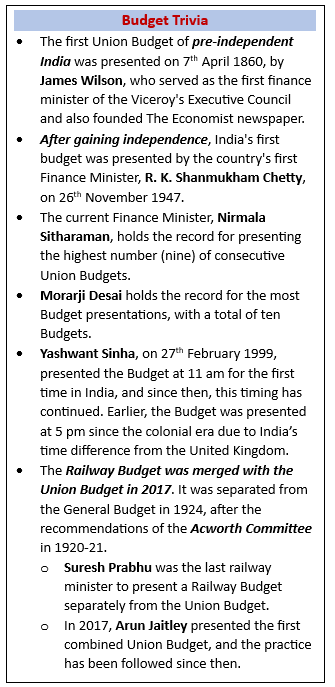
- Besides the Finance Minister’s Budget speech, the following Budget documents are presented to the Parliament:
- Annual Financial Statement (AFS) as provided under Article 112
- Demands for Grants of Central Government (under Article 113)
- Finance Bill (as required under Article 110 (1)(a))
- Memorandum Explaining the Provisions in the Finance Bill
- Statements of Fiscal Policy under Fiscal Responsibility and Budget Management (FRBM) Act, 2003.
- Expenditure Budget
- Receipt Budget
- Expenditure Profile
- Budget at a Glance
- Budget Highlights (Key Features)
- Output Outcome Framework for Schemes 2026-27
- Explanatory Memorandum as to the Action Taken on the Recommendations Made by the Sixteenth Finance Commission.
- The Budget speech of the Finance Minister has two sections – Part A and Part B
- Part A: The first part of the budget speech provides an overview of the economy of the previous and current years, and also gives Budget estimates for the next financial year. Thus, it is concerned with the ‘macro’ aspect of the economy.
- Part B: The second part of the Budget speech highlights the government’s tax proposals for the next financial year, and it has a direct bearing on the personal finances of citizens.
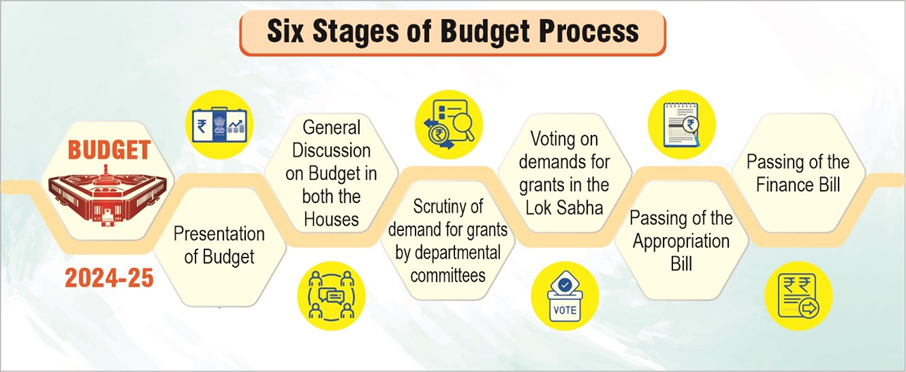
BUDGET AT A GLANCE
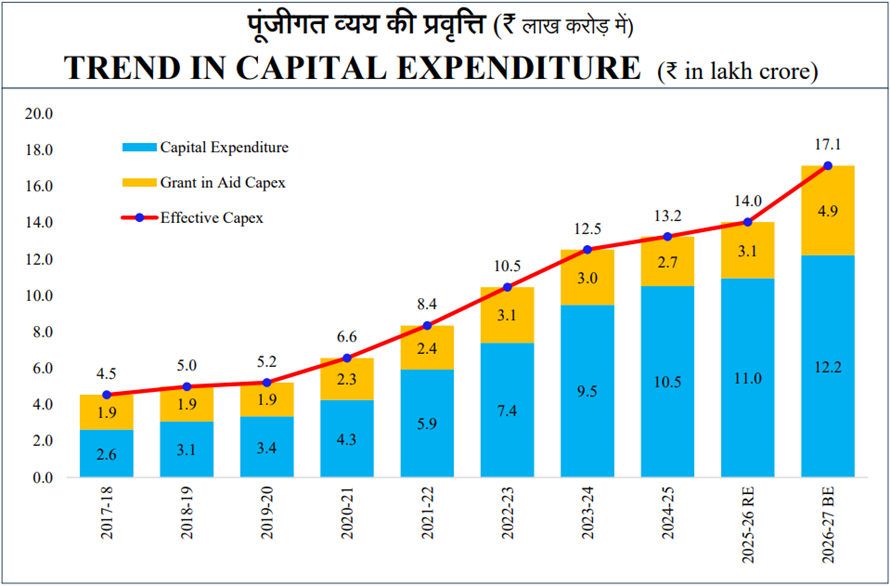
- Expenditure: The total expenditure in Budget Estimates (BE) 2026-27 is estimated at ₹53,47,315 crore of which total capital expenditure is ₹12,21,821 crore and effective capital expenditure is ₹17,14,523 crore.
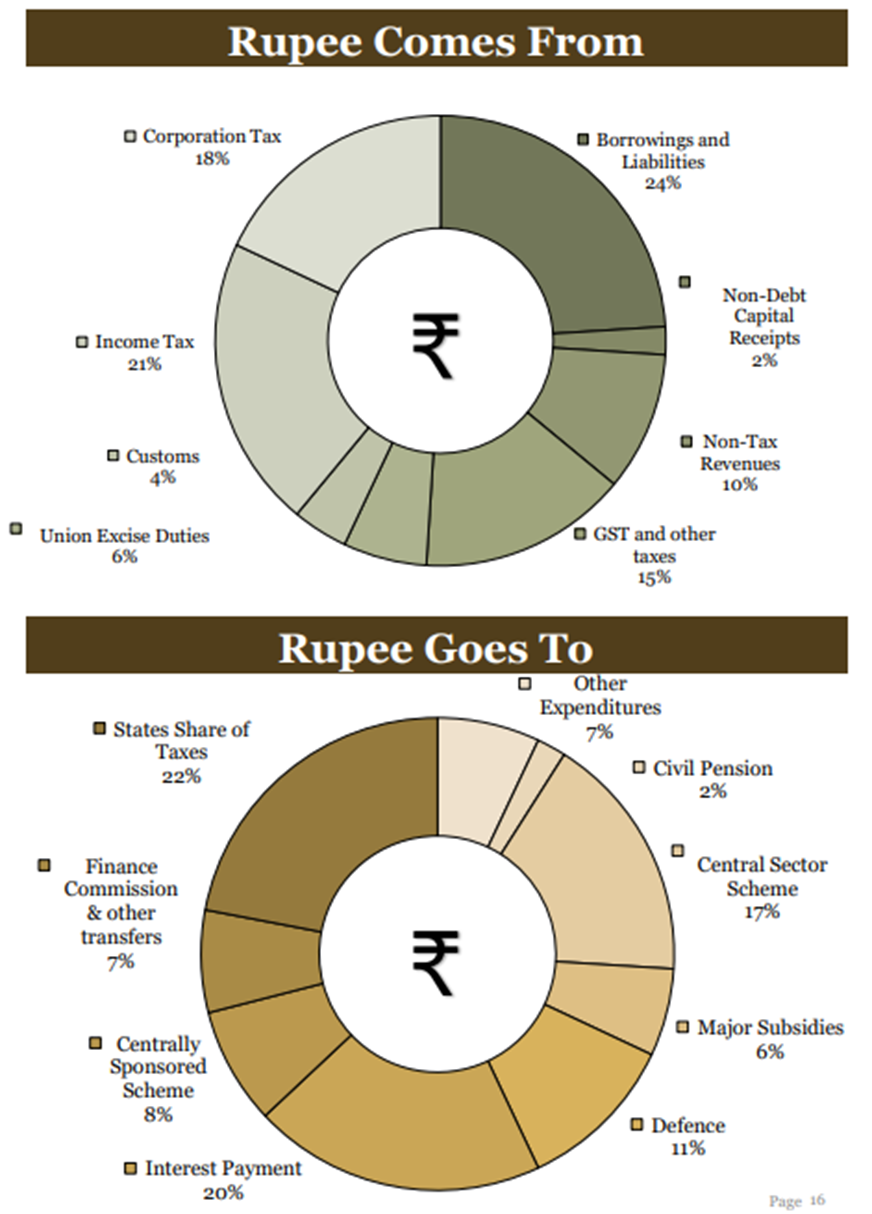
- Interest payments are estimated at ₹14,03,972, which accounts for above 26% of the total expenditure.
- Receipts: The total receipts other than borrowings are estimated at ₹36,51,547 crore, of which revenue receipts are ₹35,33,150 and capital receipts (excluding borrowings) are ₹1,18,397 crore.
- The market borrowings are estimated at ₹16,95,768.
- Deficits:
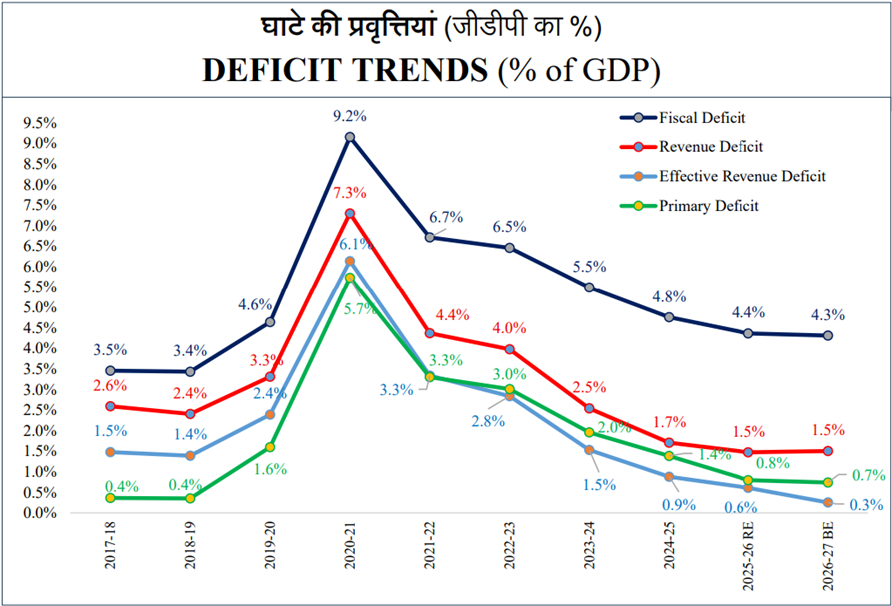
- Fiscal deficit in 2026-27 is targeted at 4.3% of GDP, which is lower than the revised estimate of 4.4% of GDP in 2025-26.
- Revenue deficit in 2026-27 is targeted at 1.5% of GDP, which is the same as the revised estimate of 1.5% in 2025- 26.
- GDP: The nominal GDP is projected to grow by 10.1% in FY2026-27 over the first Advance Estimates of FY 2025-26. (Nominal GDP growth rate is real growth plus inflation)
- As per the first advance estimates published by the National Statistics Office, India’s real GDP is estimated to grow by 7.4% in FY 2025–26.
- Debt: The central government aims to reach a debt to GDP ratio of 50±1 per cent by FY 2030-31. In BE 2026- 27, outstanding liabilities are estimated to be 55.6% of the GDP.
PART A
- The Union Budget 2026-27 is guided by 3 Kartavya:
- Sustainable Economic Growth: To accelerate and sustain economic growth, by enhancing productivity and competitiveness, and building resilience to volatile global dynamics.
- Capacity Building: To fulfil the aspirations of people and build their capacity, making them strong partners in India’s path to prosperity.
- Sabka Sath, Sabka Vikas: To ensure that every family, community, region and sector has access to resources, amenities and opportunities for meaningful participation.
A. First Kartavya — Accelerate and Sustain Economic Growth (it proposes 6 interventions)
- Scaling up Manufacturing in Strategic and Frontier Sectors
Biopharma SHAKTI
- ₹10,000 crore outlay over 5 years to develop India as a global biopharma manufacturing hub.
- Establishment of a biopharma network with 3 new NIPERs and upgradation of 7 existing NIPERs.
- Creation of 1,000+ accredited clinical trial sites across India.
India Semiconductor Mission (ISM) 2.0
- Focus on production of equipment and materials, full-stack Indian IP design, and resilient supply chains.
- Industry-led research and training centres to develop advanced technology and skilled manpower.
Electronics & Critical Minerals
- Electronics Components Manufacturing Scheme outlay enhanced to ₹40,000 crore.
- Dedicated Rare Earth Corridors in Odisha, Kerala, Andhra Pradesh, and Tamil Nadu for mining, processing, and manufacturing.
Chemicals & Capital Goods
- Support to States for 3 Chemical Parks via challenge-based, cluster-oriented plug-and-play model.
- Strengthening capital goods sector through:
- Hi-Tech Tool Rooms by CPSEs at two locations.
- Scheme for Enhancement of Construction and Infrastructure Equipment (CIE).
- Container Manufacturing Scheme with ₹10,000 crore outlay over 5 years.
Textile Sector
- Integrated Programme for Textiles including:
- National Fibre Scheme for natural, man-made, and new-age fibres.
- Textile Expansion and Employment Scheme for traditional clusters.
- Mega Textile Parks focused on technical textiles.
- Mahatma Gandhi Gram Swaraj Initiative for khadi, handloom, handicrafts with global branding and skilling support.
- Rejuvenating Legacy Industrial Sectors
- Scheme to revive 200 legacy industrial clusters through infrastructure and technology upgradation to enhance cost competitiveness and efficiency.
- Creating Champion SMEs and Supporting Micro Enterprises
- ₹10,000 crore SME Growth Fund to nurture globally competitive “Champion SMEs”.
- Additional ₹2,000 crore to the Self-Reliant India Fund for micro-enterprise risk capital.
- Professional institutions (ICAI, ICSI, ICMAI) to design modular courses to create ‘Corporate Mitras’, especially in Tier-II and Tier-III towns.
- Delivering a Powerful Push to Infrastructure
- Public capital expenditure increased to ₹12.2 lakh crore in FY 2026-27.
- Infrastructure Risk Guarantee Fund to de-risk private investment during the construction phase.
- Monetisation of CPSE real estate through dedicated REITs.
Green Logistics & Transport
- New Dedicated Freight Corridor connecting Dankuni–Surat.
- Operationalisation of 20 National Waterways over 5 years.
- Inland ship repair ecosystems at Varanasi and Patna.
- Coastal Cargo Promotion Scheme to raise modal share of waterways and coastal shipping to 12% by 2047.
- Seaplane VGF Scheme and incentives for indigenous seaplane manufacturing.
- Ensuring Long-Term Energy Security
- ₹20,000 crore over 5 years allocated for Carbon Capture, Utilisation and Storage (CCUS) technologies.
- Developing City Economic Regions (CERs)
- ₹5,000 crore per CER over 5 years through challenge-based, reform-linked financing.
- Development of 7 High-Speed Rail Corridors as growth connectors:
- Mumbai–Pune, Pune–Hyderabad, Hyderabad–Bengaluru, Hyderabad–Chennai, Chennai–Bengaluru, Delhi–Varanasi, Varanasi–Siliguri.
- High-Level Committee on Banking for Viksit Bharat.
- Restructuring of PFC and REC to enhance scale and efficiency.
- Review of FEMA (Non-Debt Instruments) Rules for an investor-friendly framework.
- Incentive of ₹100 crore for municipal bond issuances exceeding ₹1,000 crore.
B. First Kartavya — Capacity Building (it proposes 5 interventions)
1. Education to Employment Linkages
- High-Powered ‘Education to Employment and Enterprise’ Standing Committee, with a focus on the services sector.
2. Creation of Professionals for Viksit Bharat
Health & Medical Services
- Upgradation and expansion of institutions for Allied Health Professionals (AHPs).
- Addition of 1 lakh AHPs over 5 years.
- Establishment of 5 Regional Medical Hubs for medical tourism.
AYUSH
- Establishment of 3 new All India Institutes of Ayurveda.
Animal Husbandry
- Addition of 20,000+ veterinary professionals.
- Loan-linked capital subsidy for veterinary colleges, hospitals, labs, and breeding centres.
3. Orange Economy (Creative Economy)
- Support to the Indian Institute of Creative Technologies, Mumbai.
- AVGC Content Creator Labs in 15,000 schools and 500 colleges.
4. Education Infrastructure
- Creation of 5 University Townships near industrial and logistics corridors.
- One girls’ hostel in every district through VGF/capital support.
5. Tourism, Heritage & Sports
- National Council for Hotel Management upgraded to National Institute of Hospitality.
- Pilot programme to upskill 10,000 tourist guides in 20 destinations.
- National Destination Digital Knowledge Grid for heritage documentation.
- Development of 15 archaeological sites as experiential cultural destinations.
- Launch of Khelo India Mission for long-term sports ecosystem development.
C. Third Kartavya — Sabka Sath, Sabka Vikas
1. Increasing Farmer Incomes
- Integrated development of 500 reservoirs and Amrit Sarovars.
- Promotion of high-value crops (coconut, sandalwood, cocoa, cashew).
- Coconut Promotion Scheme to enhance productivity.
- Launch of Bharat-VISTAAR, a multilingual AI platform integrating AgriStack and ICAR knowledge systems.
2. Empowering Divyangjan
- Divyangjan Kaushal Yojana to enable task-oriented employment in IT, AVGC, hospitality, and F&B sectors.
3. Commitment to Mental Health and Trauma Care
- Establishment of NIMHANS-2 in North India.
- Upgradation of National Mental Health Institutes at Ranchi and Tezpur as regional apex centres.
4. Focus on Purvodaya States and the North-Eastern Region
- Integrated East Coast Industrial Corridor with Durgapur node.
- Development of 5 tourism destinations in Purvodaya States.
- Deployment of 4,000 e-buses.
- Development of Buddhist Circuits across Arunachal Pradesh, Sikkim, Assam, Manipur, Mizoram, and Tripura.
PART B
A. Direct Taxes
1. New Income Tax Act, 2025
- New Income Tax Act, 2025, to replace the Income-tax Act, 1961, to come into effect from April 2026.
2. TDS / TCS Rationalisation
- TCS on overseas tour program packages reduced to 2% (earlier 2–20%).
- TCS on LRS remittances for education and medical purposes reduced to 2% (from 5%).
- Simplified TDS provisions for manpower supply benefiting labour-intensive sectors.
- Automated rule-based scheme for small taxpayers to obtain lower / nil TDS certificates.
3. Measures for Cooperatives
- Extension of deduction to cooperative societies supplying:
- Cattle feed and cotton seed, in addition to milk, oilseeds, fruits, and vegetables.
- Inter-cooperative dividend income deductible if further distributed to members.
- 3-year dividend exemption for notified national cooperative federations on investments made up to 31.01.2026.
4. Attracting Global Business & Investment
- Tax holiday till 2047 for foreign companies providing global cloud services from India.
- 15% safe harbour on cost for related-party data centre service providers.
- Safe harbour for bonded warehouse component warehousing at 2% of invoice value.
- 5-year income tax exemption for non-residents supplying capital goods/equipment to toll manufacturers in bonded zones.
- Exemption of global income for non-resident experts for 5 years under notified schemes.
- MAT exemption for non-residents taxed on presumptive basis.
B. Indirect Taxes
1. Tariff Simplification
- Marine, leather & textiles:
- Duty-free import limit for seafood processing inputs increased from 1% to 3% of FOB value.
- Duty-free imports extended to leather/synthetic footwear exports.
- Energy transition:
- BCD exemption extended for Li-ion battery manufacturing capital goods.
- Sodium antimonate for solar glass exempted.
- Nuclear power:
- BCD exemption extended till 2035.
- Critical minerals:
- BCD exemption on capital goods for processing.
- Biogas blended CNG:
- Biogas value excluded for excise duty calculation.
- Civil & defence aviation:
- BCD exemption on aircraft parts and MRO inputs.
- Electronics:
- BCD exemption on specified microwave oven components.
- SEZs:
- One-time concessional DTA sales up to prescribed export proportion.
2. Ease of Living (Customs)
- Tariff rate on dutiable personal imports reduced from 20% to 10%.
- 17 drugs/medicines exempted from BCD.
- Duty-free personal import of drugs/food for 7 additional rare diseases.
- Revised baggage rules to enhance duty-free allowances.
- Honest taxpayers allowed to settle disputes by paying additional amount in lieu of penalty.
3. Customs Process & Trust-Based Systems
- Duty deferral for AEO Tier-2 & Tier-3 increased from 15 to 30 days.
- Validity of advance rulings extended from 3 to 5 years.
- Auto-clearance for trusted importers where no compliance required.
- Customs warehousing shifted to operator-centric, self-declaration model.
- Expansion of AI-based non-intrusive scanning at ports.
4. Ease of Doing Business
- Single digital window for cargo clearances by end of FY.
- Food, drugs, plant, animal, wildlife clearances (≈70% interdictions) operational by April 2026.
- Customs Integrated System (CIS) rollout in 2 years.
5. New Export Opportunities
- Fish catch in EEZ or High Seas made duty-free; landing abroad treated as export.
- Removal of ₹10 lakh per consignment cap on courier exports to boost MSMEs and e-commerce.