
SYLLABUS
GS-3: Conservation, environmental pollution and degradation, environmental impact assessment
Context: A state-wide survey by the Wildlife Trust of India (WTI) reports that the Kashmir Markhor, a Himalayan wild goat, is on the brink of local extinction.
More on the News
- The survey was conducted by WTI in collaboration with the Jammu and Kashmir Department of Wildlife Protection and the Nature Conservation Foundation.
- WTI survey highlights that only 300–350 individuals are remaining across its historical range from Banihal Pass in Pir Panjal to the Shamshabari range north of the Jhelum River.
Key highlights of the Survey

- Remaining Habitats of Kashmir Markhor: TheKazinag range is the species’ last stronghold in India, with fragmented populations persisting in the Hirporawildlife sanctuary in Shopian and in the Tattakuti wildlife sanctuary and Khara Gali Conservation Reserve in Poonch.
- Threat to Survival: Unplanned development, intense livestock grazing and poaching have emerged as growing threats.
- The Hirpora population faces severe pressure from overgrazing and the construction of a highway around 15 years ago.
- Populations in Poonch have been heavily impacted by past poaching, worsened by inadequate wildlife staffing and infrastructure.
- The Journal for Nature Conservation (August 2025) noted that the breeding season of domestic goats overlaps with that of the Markhor in May and June, placing significant pressure on the Markhor’s habitat and food resources.
- Urgency of Conservation: The survey stresses that conservation efforts must be significantly strengthened to establish at least one additional viable population range in the Pir Panjal, alongside Kazinag, to ensure the species’ long-term survival.
Conservation Measures adopted by the State:
- Strengthening Protected Areas: A national park in the Kazinag range has been dedicated to the Markhor, Hirpora Wildlife Sanctuary has been extended, and Tattakuti Wildlife Sanctuary has been formally notified to protect the species.
- Monitoring and Surveillance: WTI continues to monitor key sites and work with local communities and herders to reduce threats.
About Kashmir Markhor

- “Markhor” is a Persian term meaning “snake-eater.” The name refers to its spiral horns or the belief that it kills snakes with its hooves.
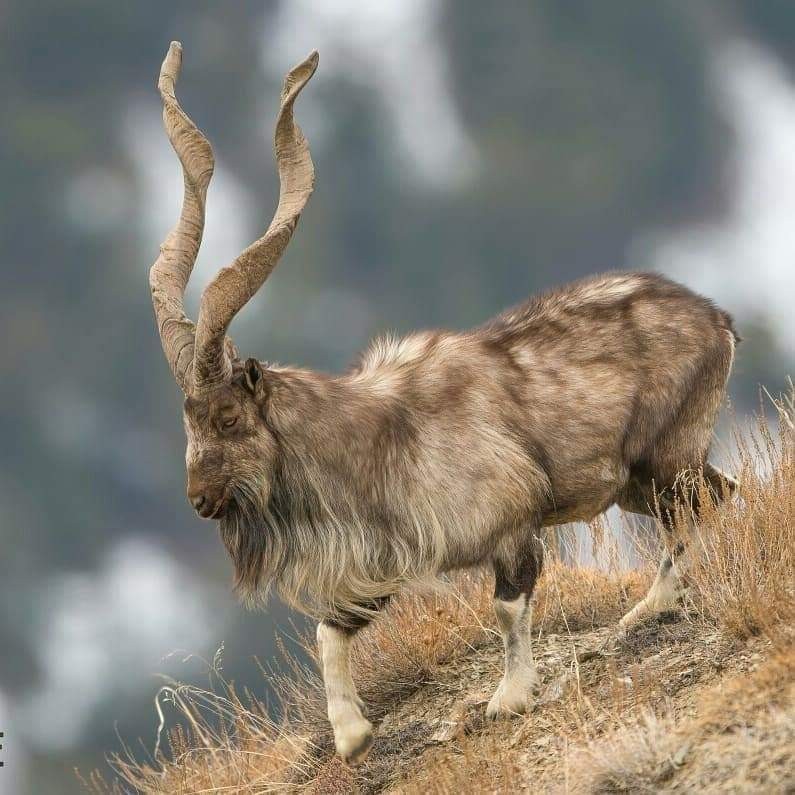
- Distinctive Features: This range-restricted mountain ungulate is among the largest wild goats in the world, weighing around 100 kg, with features such as long, spiralling corkscrew horns and a flowing ruff along the chin, neck, and shoulders.
- Survival Skills: With brown coats, a stocky build, and extraordinary agility, they appear almost part of the mountains themselves.
- To escape predators and any other danger or disturbance, females with young navigate slopes of almost 90-degree terrain.
- Protection Status: The species is listed under Schedule I of the Wildlife (Protection) Act, 1972 and the Jammu and Kashmir Wildlife (Protection) Act, 1978.
- IUCN Status: Near Threatened
- The UN General Assembly proclaimed 24 May the International Day of the Markhor, starting in 2024.
- Ecological significance: Markhors are mixed feeders- grasses, herbs, shrubs, leaves and twigs all feature in their diet, thus helps in preventing overgrowth and maintains healthy soils.
- Healthy populations of Markhor signal a well-balanced mountain ecosystem, providing essential prey for predators like snow leopards, common leopards, and wolves.