
SYLLABUS
GS-3: Awareness in the fields of IT, Space.
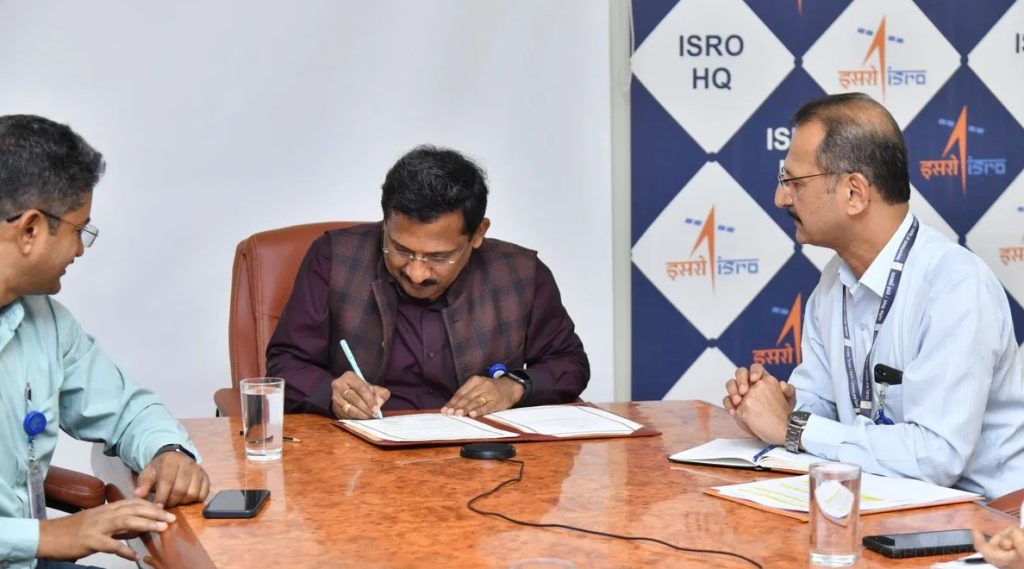
Context: Recently, the Indian Space Research Organisation (ISRO) and the European Space Agency (ESA) have signed an agreement titled “ESA-ISRO Arrangement concerning Joint Calibration and Validation Activities and Scientific Studies for Earth Observation Missions”.
More on the News
- The agreement aims to strengthen cooperation in joint calibration, validation activities, and scientific studies for Earth observation missions.
- The collaboration will support future Earth observation missions, including ESA’s Fluorescence Explorer (FLEX) mission, which seeks to improve understanding of vegetation biology and photosynthesis processes.
- Both agencies highlighted cooperation in areas such as Earth observation, satellite navigation, ground station support, and human spaceflight.
- ESA has earlier supported Indian missions such as Chandrayaan and Aditya‑L1, while ISRO has provided deep space antenna support and ground station services.
- The new arrangement will facilitate joint calibration and validation campaigns and scientific research for upcoming satellite missions, strengthening India–Europe space cooperation.
About the Earth Observation Missions
- Earth Observation (EO) missions involve the use of satellites equipped with active or passive sensors to collect data about the Earth’s surface and environment.
- These sensors monitor a wide range of targets, from oceans and mountains to the atmosphere, magnetosphere, and even deeper Earth systems, enabling scientists to study environmental processes and planetary dynamics.
- Many EO satellites, especially CubeSats, use passive sensors that detect natural radiation from the Sun or Earth and analyse spectral changes as the radiation interacts with the atmosphere and surface.
- Due to their small size and limited power generation, CubeSats often rely on such passive sensing technologies, but their low cost and ease of mass production allow them to operate in constellations, significantly improving the spatial and temporal coverage of Earth data.
- EO missions support applications such as climate monitoring, disaster management, environmental protection, and atmospheric research, demonstrating how compact satellite platforms can effectively contribute to global Earth system observation.
ISRO–ESA Cooperation in Earth Observation (EO)
- Cooperation between the ISRO and the ESA in Earth Observation dates back to 1978, making it one of the longest-running international space collaborations focused on environmental monitoring and scientific research.
- The cooperation framework established in 1978 was significantly renewed in 2002, expanding collaboration from basic satellite data exchange to deeper technical, operational, and scientific cooperation in Earth observation missions.
- In 2018, ISRO and ESA signed a Technical Operating Arrangement enabling the full, free, and open exchange of satellite data between Europe’s Sentinel satellites and India’s EO missions such as Oceansat-2, Megha-Tropiques, and Scatsat-1, supporting global environmental monitoring, climate research, and disaster management.
- Data from Indo-French missions such as Megha-Tropiques and SARAL are widely used within the broader European Earth observation ecosystem, contributing to global climate models, ocean monitoring, and atmospheric studies.
- A major focus of the new arrangement is ESA’s Fluorescence Explorer (FLEX) mission, which studies vegetation health and plant photosynthesis, with ISRO contributing expertise in terrestrial and agricultural observationto validate the mission’s findings.
- ESA’s global ESTRACK tracking network provides ground station support for several Indian missions. At the same time, ISRO has supported European missions, including Proba-3 (2024), reflecting a high level of operational trust and technical cooperation between the agencies.
- Key collaborative platforms include Copernicus data exchange for environmental monitoring, FLEX for vegetation studies, Sentinel–Oceansat cross-platform ocean observation, and TRISHNA for high-resolution thermal infrared imaging, strengthening joint capabilities in climate science and Earth system observation.
Sources:
The Hindu
The Hindu
ISRO
Economic Times
Business Standard