
SYLLABUS
GS 3: Science & Technology – achievements of Indians in science & technology; indigenization of technology and development of new technology; awareness in the fields of IT, space
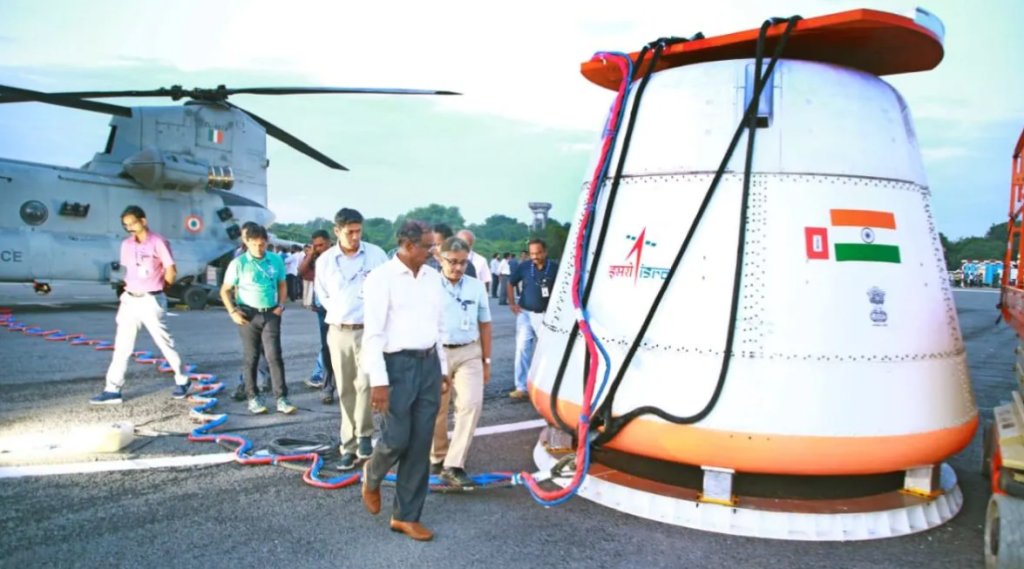
Context: Recently, Indian Space Research Organisation successfully conducted the second Integrated Air Drop Test (IADT-02) at the Satish Dhawan Space Centre as part of the Gaganyaan mission.
About Integrated Air Drop Test (IADT-02)
• Simulated Crew Module (~5.7 tonnes, equivalent to Gaganyaan G1) was lifted by an Indian Air Force Chinook helicopter to ~3 km and released over a sea drop zone near Sriharikota coast .
• 10 parachutes of 4 types deployed in a precise sequence during descent.
• Parachutes ensured gradual velocity reduction for safe touchdown.
• Module successfully recovered with Indian Navy; IADT-02 validated parachute-based deceleration system.
• The test is crucial for ensuring the safe recovery of the crew module, which carries astronauts during human spaceflight.
• The first test was conducted on August 24, 2025 at the Satish Dhawan Space Centre.
• A 4.8-tonne dummy Crew Module was dropped from a height of 3 km using a helicopter.
About Gaganyaan Mission
• The Gaganyaan mission envisages demonstration of human spaceflight capability by launching a crew of 3 members to an orbit of 400 km for a 3 days mission and bringing them back safely to earth by landing in Indian sea waters.
• Pre-requisites of the Gaganyaan mission include development of critical technologies such as:
- Human rated launch vehicle for safe crew transport
- Life Support System for Earth-like environment in space
- Crew emergency escape system
- Crew management including training, recovery and rehabilitation
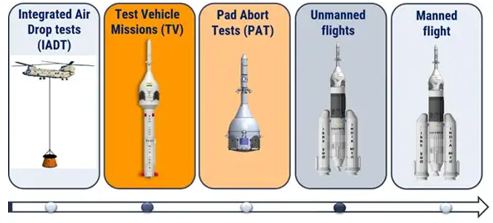
• Various precursor missions are planned to demonstrate Technology Preparedness Levels:
- Integrated Air Drop Test (IADT)
- Pad Abort Test (PAT)
- Test Vehicle (TV) flights
• Safety and reliability of all systems will be proven through unmanned missions before the final manned mission.
Gaganyaan Mission – Key Components and Features
| Component | Details |
| HLVM3 (Human Rated LVM3) | LVM3 rocket of Indian Space Research Organisation identified for Gaganyaan mission; consists of solid, liquid and cryogenic stages; re-configured for human rating; capable of placing Orbital Module in 400 km orbit; includes Crew Escape System (CES) with high burn rate motors for emergency escape |
| Orbital Module (OM) | Comprises Crew Module (CM) and Service Module (SM); equipped with advanced avionics systems with redundancy for human safety |
| Crew Module (CM) | Habitable module with Earth-like environment; double-walled structure with pressurized inner and unpressurized outer structure with Thermal Protection System; includes life support, avionics, crew interfaces and deceleration systems; designed for safe re-entry and landing |
| Service Module (SM) | Provides support to CM in orbit; contains thermal, propulsion, power, avionics systems and deployment mechanisms; unpressurized structure |
| New Technologies | Development of engineering systems and human-centric systems with focus on crew safety |
Significance of IADT-02
• Marks a key milestone in the Gaganyaan mission, advancing readiness for India’s first human spaceflight.
• Successfully validates the Crew Module’s parachute-based deceleration system, crucial for safe re-entry and landing.
• Demonstrates effective coordination between Indian Space Research Organisation, Indian Air Force, Indian Navy, and Defence Research and Development Organisation.
• Strengthens confidence in crew safety systems, including controlled descent and sea recovery operations.
• Builds on earlier tests (IADT-01) and contributes to technology validation before uncrewed (G1) and eventual crewed missions.