
SYLLABUS
GS-3: Indian Economy and issues relating to planning, mobilization of resources, growth, development and employment.
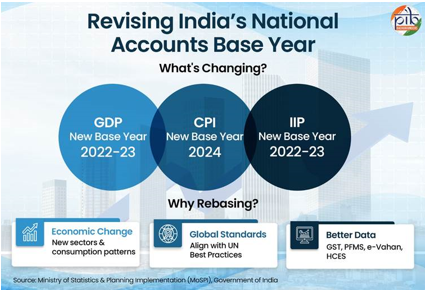
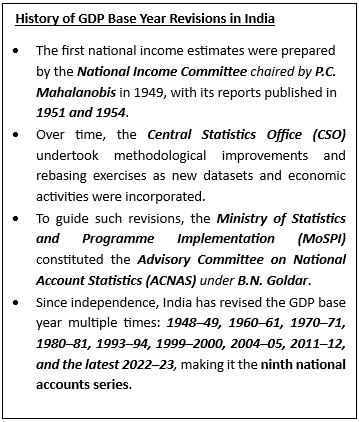
Context: Recently, the Ministry of Statistics and Programme Implementation (MoSPI) has released a new GDP series with a base year of 2022–23, replacing the earlier 2011–12 series, along with methodological and data improvements to better reflect India’s evolving economic structure.
More on the News
• GDP growth outlook: Real GDP growth for 2025–26 is estimated at 7.6%, higher than 7.1% in 2024–25, according to the Second Advance Estimates released by MoSPI.
• Quarterly growth trend: GDP grew 7.8% in Q3 (Oct–Dec 2025), reflecting sustained economic momentum.
• Revision of past growth figures under the new series:
- 2023–24: revised to 7.2% (earlier 9.2%)
- 2024–25: revised to 7.1% (earlier 6.5%)
• Size of the economy: Nominal GDP for 2025–26 is estimated at ₹345.47 lakh crore, while real GDP is projected at ₹322.58 lakh crore.
• Sectoral Growth Trends (FY 2025–26)
- Secondary sector: projected growth 9.5%, driven mainly by manufacturing (≈12.5%).
- Tertiary sector: expected growth 8.9%, led by trade, transport, and financial services.
- Primary sector: growth expected to slow to 2.8%, reflecting moderation in agriculture and mining.
Key Methodological Improvements
• Double deflation method: The earlier single-deflator method has been replaced with double deflation in manufacturing and agriculture. This adjusts both inputs and outputs for inflation separately, providing a more accurate measure of real growth.
• Granular deflation strategy: Deflators such as CPI, WPI and Unit Value Index are now used at item-level granularity instead of aggregate-level adjustments.
• Integration of Supply–Use Tables (SUT): The SUT framework has been aligned with national accounts to reduce discrepancies between production-based and expenditure-based GDP estimates.
• Improved benchmarking technique: The Denton proportional benchmarking method replaces the earlier pro-rata approach for deriving quarterly GDP estimates, ensuring better alignment between quarterly and annual data.
• Better measurement of the informal and household sectors: Regular surveys such as ASUSE and PLFS are used to estimate household sector activity more accurately.
• Improved estimation of Private Final Consumption Expenditure (PFCE): A mixed approach combining household consumption surveys, production data, and commodity flow methods has been adopted along with the COICOP 2018 classification.
New Data Sources Used
• GST data – for corporate sector estimation and quarterly indicators.
• e-Vahan database – for estimating road transport-related consumption.
• Public Finance Management System (PFMS) – for government accounts and expenditure data.
• Annual Survey of Unincorporated Sector Enterprises (ASUSE) – for informal sector activity.
• Periodic Labour Force Survey (PLFS) – for employment and labour market estimates.
• Corporate filings (MCA-21) – for activity-wise value added of companies.
Why the Base Year Was Revised
• Reflect structural changes in the economy: Over time, India’s economic structure has shifted significantly, with the services sector contributing more than half of GDP, while the relative share of agriculture has declined. Updating the base year helps accurately capture these changes.
• Use improved and updated data sources: Digitisation and administrative databases such as GST, PFMS and e-Vahan provide more reliable and high-frequency economic data, allowing more precise national accounts estimates.
• Improve estimation methodology: The new series incorporates methodological upgrades such as double deflation, granular deflators, improved benchmarking techniques and Supply-Use Tables, enhancing the accuracy and consistency of GDP estimates.
• Select a representative benchmark year: FY 2022–23 was chosen as the base year because it represents the most recent “normal” year after the COVID-19 disruptions of 2019–21, ensuring a stable reference point.
• Align with international statistical standards: The revision follows global best practices under the System of National Accounts (SNA 2008) and IMF guidelines for national accounts compilation.
Implications of the New Base Year
• More Accurate Measurement of Economic Activity: Improved methodologies, granular price indices, and new data sources provide more reliable estimates of real GDP growth.
• Better Capture of Emerging Sectors: The revised framework captures the contribution of digital services, platform economy, and gig work more accurately.
• Changes in Fiscal Ratios: Since nominal GDP estimates are slightly lower than earlier calculations, ratios such as Fiscal deficit-to-GDP and Debt-to-GDP may appear higher even if the deficit amount remains unchanged.
• Improved Policy Formulation: More accurate economic data helps policymakers, investors, and businesses make better economic planning and investment decisions.
• Modernisation of India’s Statistical System: The revision forms part of broader statistical reforms, including updates to CPI, IIP, and WPI base years, strengthening India’s national statistical framework.