
SYLLABUS
GS-3: Indian Economy and issues relating to planning, mobilisation of resources, growth, development and employment.
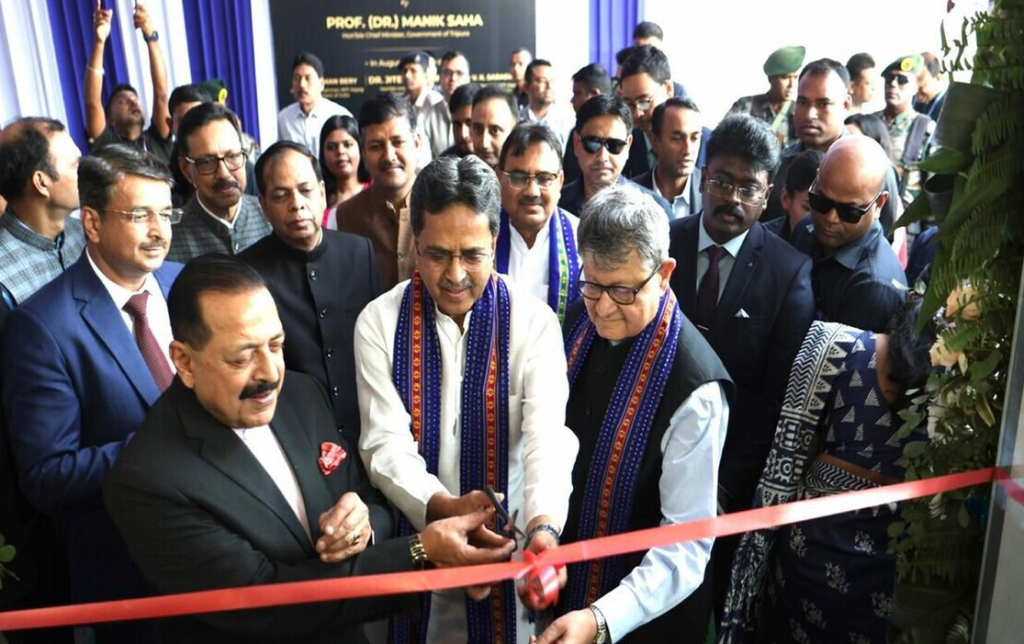
Context: Recently, the Atal Innovation Mission (AIM) under NITI Aayog launched India’s first State Innovation Mission (SIM) in Tripura, marking a significant step towards embedding Innovation and Entrepreneurship into the State’s long-term development framework.
More on the News
- The launch took place on 26 February 2026 at the Hapania International Exhibition Centre in Agartala.
- The initiative is part of the AIM 2.0 under the State Support Mission (SSM) framework.
- It aims to create a long-term institutional innovation ecosystem aligned with national priorities and local strengths.
- The SIM will function under the Tripura Institution for Transformation (TIFT).
- A dedicated incubation hub, T NEST (Tripura – Nurturing Entrepreneurship and Startups), was launched.
- Innovation Centres will be established in all eight districts of Tripura to promote grassroots innovation, especially among women and tribal communities.
- Tripura launched one of India’s first District Innovator Fellowships to identify and support grassroots innovators.
- The State also announced that Tripura will introduce a State AI Policy and develop an AI City in Agartala to promote responsible and inclusive artificial intelligence.
- Tripura has over 150 startups with high growth and a strong share of women-led enterprises.
- The State also has over 3.13 lakh MSMEs registered on the Udyam portal.
Significance of State Innovation Mission
- Institutionalises innovation at the state and district levels.
- Promotes decentralised innovation beyond metropolitan hubs.
- Strengthens school-level innovation through the expansion of Atal Tinkering Labs.
- Provides incubation, mentorship, infrastructure, and funding support to startups.
- Enables commercialisation of local ideas into scalable enterprises.
- Supports inclusive innovation targeting women, tribal, and rural entrepreneurs.
- Strengthens cooperative and competitive federalism in innovation governance.
- Positions the Northeast as a new growth engine of India.
About the Atal Innovation Mission (AIM)
- The Atal Innovation Mission (AIM), launched in 2016 by NITI Aayog, is the Government of India’s flagship initiative to create and promote a culture of innovation and entrepreneurship across the country.
- Its objective is to create a facilitating environment for the transformation of ideas into innovative and impactful solutions at schools, universities, research institutions, MSME and industry levels across the country.
- The Atal Innovation Mission (AIM) 2.0 is the next phase of the initiative under NITI Aayog, approved in November 2024 to extend the mission until March 31, 2028, with an allocated budget of ₹2,750 crore.
- AIM 2.0 is designed to strengthen India’s innovation and entrepreneurship ecosystem in three ways:
- By increasing input (ushering more innovators and entrepreneurs).
- By improving the success rate or ‘throughput’ (helping more startups succeed).
- By improving the quality of ‘output’ (producing better jobs, products and services).
Major Programs under AIM
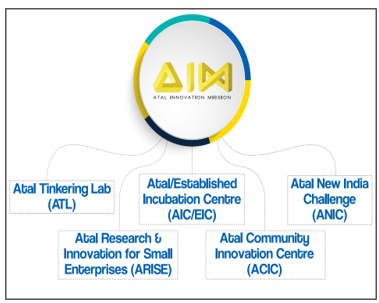
- Atal Tinkering Labs (ATL): Established in schools (grades 6-12) to foster curiosity and creativity through 21st-century tools like 3D printing, robotics, and Internet of Things (IoT).
- Atal Incubation Centres (AIC): Business incubators at universities and corporates that provide startups with infrastructure, mentorship, and seed funding.
- Atal Community Innovation Centres (ACIC): Focused on promoting innovation in underserved regions, including Tier 2/3 cities, tribal, and rural areas.
- Atal New India Challenges (ANIC): A grant-based mechanism providing up to ₹1 crore to help startups commercialise technologies that solve sectoral challenges in areas like health, agriculture, and mobility.
- Applied Research and Innovation for Small and Medium Enterprises (ARISE): It aims to promote research, innovation and job creation in the MSMEs and Startups.
- Mentor India Programme: A volunteer mentorship program involving over 6,200 “Mentors of Change” from industry and academia to guide young innovators.