
SYLLABUS
GS-3: Science and Technology- Developments and their Applications and Effects in Everyday Life.
Awareness in the fields of IT, Space, Computers, Robotics, Nano-technology, Bio-technology and issues relating to Intellectual Property Rights.
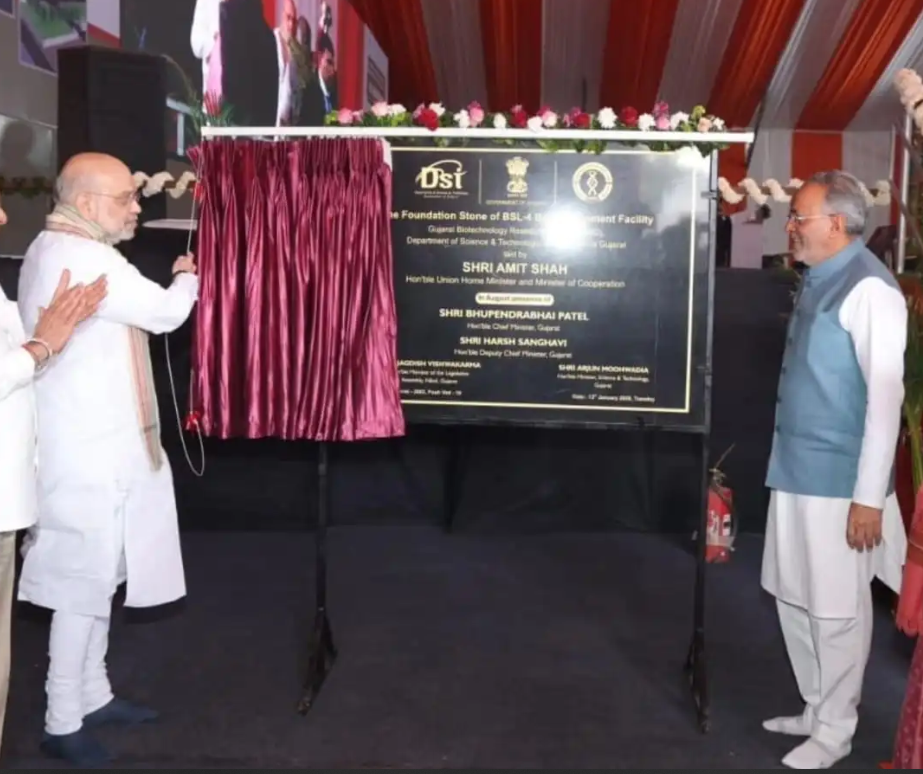
Context: Union Home Minister Amit Shah laid the foundation stone of the Bio-Safety Level 4 (BSL-4) Containment Facility and laboratory in his Lok Sabha constituency of Gandhinagar on January 13.
More on the News:
• It will be the second such civilian research facility in India and the first to be fully funded and controlled by a state government.
• Globally, there are 69 BSL-4 laboratories operational or under development.
Key features of the New BSL-4 Biocontainment Facility in Gandhinagar
• Site and Capital Outlay: The BSL-4 lab is being constructed under the Gujarat State Biotechnology Mission (GSBTM), in Gandhinagar (Gujarat), at a cost of ₹362 crore over 11,000 square meters.
• Timeline: The planning began in mid-2022, and its foundation stone was laid more than three years later, on January 13, 2026.
• Oversight: It will function under the Gujarat Biotechnology Research Centre (GBRC), which currently has a BSL-2+ lab and was one of the first in India to decode the whole genome sequence of the SARS-CoV-2 coronavirus that caused the Covid pandemic.
• Infrastructure & research capability:
- The facility will comprise BSL-4, BSL-3, BSL-2, as well as ABSL-4 and ABSL-3 laboratory modules, along with advanced utilities and supporting infrastructure.
- The ABSL-4 lab will have two components: one will be testing samples, and the second is producing vaccines from antibodies in animals.
• Wider Consultation: Consultants on the project includes:-
- National Dairy Development Board (NDDB) of India, which has experience setting up a BSL-3 lab;
- Doshi Consultants Pvt Ltd, which has worked on setting up pharmaceutical and biotech facilities;
- Basler & Hoffmann AG of Switzerland as biosafety consultants; and
- HT Group GmbH of Germany, among others.
• Stringent international standards adherence: The laboratory is being developed in compliance with guidelines issued by the US CDC (Centers for Disease Control and Prevention), US NIH (National Institutes of Health), DBT India (Department of Biotechnology), and ICMR (Indian Council of Medical Research).
What is a BSL-4 facility?
• Technical term: Bio-Safety Level 4 represents the highest level of biological containment where laboratories are designed to safely research the world’s most dangerous and life-threatening pathogens, which are highly infectious and often lack effective vaccines or treatments.
• In-situ Environment: At these labs, under extremely controlled conditions that are periodically inspected and monitored based on international standards, scientists conduct advanced research on high-risk pathogens, work on the development of diagnostics, vaccines, and therapeutics, and conduct rapid outbreak investigation and response.
Existing BSL-4 and ABSL-4 labs in India
• BSL-4 laboratory
- Civilian: Currently, there is only one civilian BSL-4 laboratory functional in India, located at the National Institute of Virology (NIV) in Pune, Maharashtra.
- Defence: In late 2024, the Defence Research and Development Organisation (DRDO) set up its own BSL-4 lab in Gwalior, Madhya Pradesh.
• BSL-3 laboratory: Currently, there are only two high-security labs in India studying the deadliest zoonotic diseases.
- National Institute of High Security Animal Diseases (ICAR-NIHSAD) in Bhopal, Madhya Pradesh, with a current ABSL-3+ rating, but which is slated to be upgraded to ABSL-4 according to an announcement in June 2025.
- International Centre for Foot and Mouth Disease (ICAR-ICFMD) in Bhubaneswar, Odisha, which has an ABSL-3Ag rating.
• Also, there are 154 BSL-2 and 11 BSL-3 laboratories in India (including both public and private).
Key Initiatives and Policies to promote Biocontainment Facilities:
• Setting up of a Nationwide Network of Laboratories for Managing Epidemics and National Calamities: a central sector scheme under Ministry of Health and Family Welfare to establish a network of Virus Research and Diagnostic Laboratories (VRDL).
- Under this scheme, 165 biosafety laboratories, including 11 BSL-3 level labs and 154 BSL-2 level labs, have been approved.
• Intensification of Research in High Priority Areas (IRHPA) program: Under the scheme, Anusandhan National Research Foundation (ANRF) has funded 5 BSL/ABSL-3 labs.
• National One Health Mission (NOHM): It includes establishing a network of BSL-3 laboratories across ministries and conducting specialized training for lab personnel.
• Department of Biotechnology (DBT): 26 biosafety laboratories have been established in various DBT institutes.
• Indian Council of Agriculture Research (ICAR): 9 biosafety laboratories have been established in various ICAR institutes.
• Council of Scientific and Industrial Research (CSIR): 11 biosafety laboratories have been established in various CSIR institutes.
Significance of the BSL-4 lab Facility:
• Strengthening Pandemic Preparedness: This will help the state not only respond to deadly human disease outbreaks in real time but also to zoonotic diseases transmitted from animals to humans, as well as aid in research and development of vaccines and therapeutics.
• “Health shield” for India: Expanding biosafety infrastructure with a growing network of BSL-2, BSL-3 and BSL-4 labs is the “beginning of a new era of health security and biotechnology in the country”.
• Critical Infrastructure: The BSL-4 laboratory coming up in Sector-28 of Gandhinagar, along with an Animal Bio-Safety Level (ABSL) facility, will be a strategic national asset where research is conducted on the deadliest pathogens known to mankind.
• One Health approach: Research on zoonotic diseases addresses human, animal, and environmental health collectively.