
SYLLABUS
GS-3: Conservation, environmental pollution and degradation, environmental impact assessment.
Context: The Union government will establish the National Coral Reef Research Institute (NCRRI) in the Andaman and Nicobar Islands as India’s first dedicated centre for coral reef research and monitoring.
More on the News
- The institute will be set up at Chidiyatapu in South Andaman at an estimated cost of ₹120 crore under the Ministry of Environment, Forest and Climate Change.
- This centre will function as the nodal agency for scientific research, conservation planning and management of coral reef ecosystems across India’s coastal and island regions.
- Scientists have noted that climate change, warming seas, sea-level rise, and human activities continue to place severe pressure on coral ecosystems, making long-term monitoring essential.
Significance of the National Coral Reef Research Institute (NCRRI)
- The institute will act as India’s central research and monitoring body for all coral reef ecosystems.
- The institute will generate comprehensive scientific data to support policy and conservation decisions at national and regional levels.
- The institute will focus on advanced coral reef conservation techniques, ecological restoration and long-term habitat monitoring.
- The institute will support coastal and island communities by improving understanding of reef-linked fisheries, tourism and livelihood systems.
- The institute will strengthen India’s capacity to respond to climate-driven stresses such as coral bleaching and habitat degradation.
- The institute will promote collaboration among scientists, conservation agencies and local institutions to build a coordinated reef management framework.
About Coral Reefs
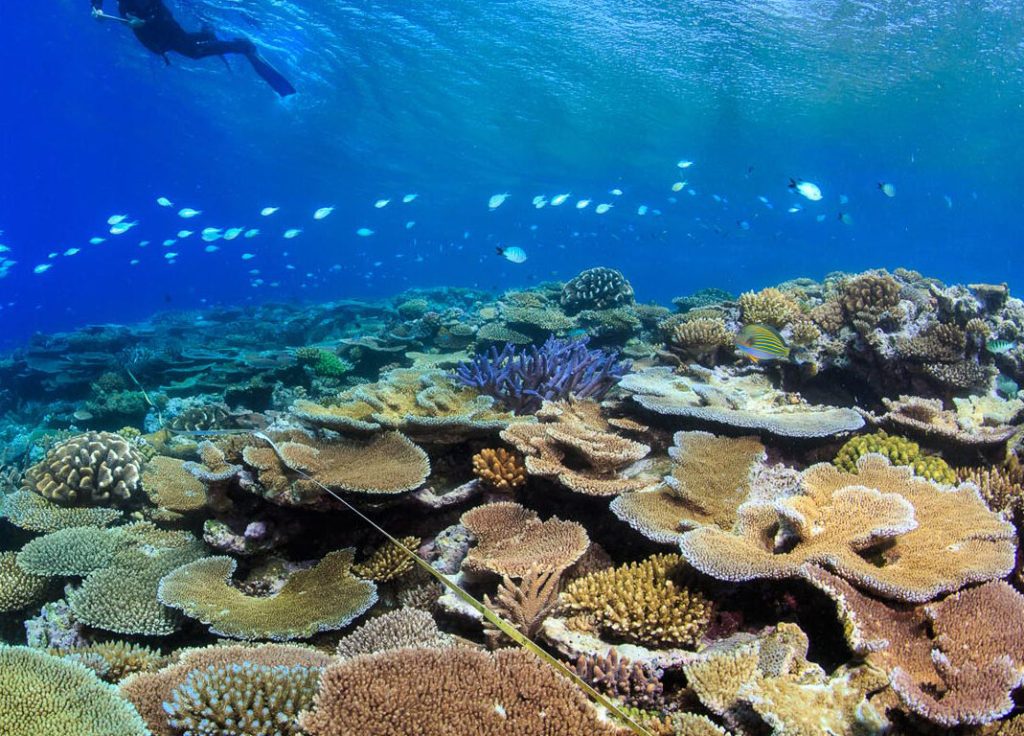
- Coral reefs are the skeletons of stony coral polyps cemented together. Corals grow very slowly – some grow only about 3-20 mm per year.
- Reefs are ridge-like structures, either natural or artificial, and Corals are animals from the phylum Cnidaria, typically found along tropical coastlines.
- They comprise hundreds to thousands of living organisms called polyps, each only a few millimetres in diameter.
- Coral reefs require warm, shallow, clear, and saline saltwater to grow, with optimal temperatures between 23° C and 29° C.
- They also need a hard substrate for attachment, and the clear water is crucial for their symbiotic algae, which require sunlight for photosynthesis.
- Wave action is also beneficial as it supplies nutrients and oxygen while keeping sediment from settling on coral surfaces.
Key Types of Coral Reefs
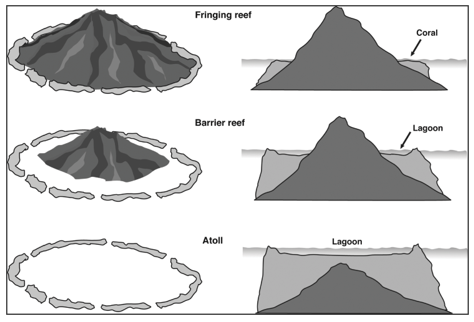
- Fringing reefs: They grow near the coastline around islands and continents. They are separated from the shore by narrow, shallow lagoons. These are the most common types of reefs.
- Barrier reefs: They are also parallel to the coastline but are separated by deeper, wider lagoons. At their shallowest points, they can reach the water’s surface, forming a “barrier” to navigation.
- Atolls: These are rings of coral that create protected lagoons and are usually located in the middle of the sea. Atolls usually form when islands surrounded by fringing reefs sink into the sea or the sea level rises around them.