
SYLLABUS
GS-3: Role of external state and non-state actors in creating challenges to internal security
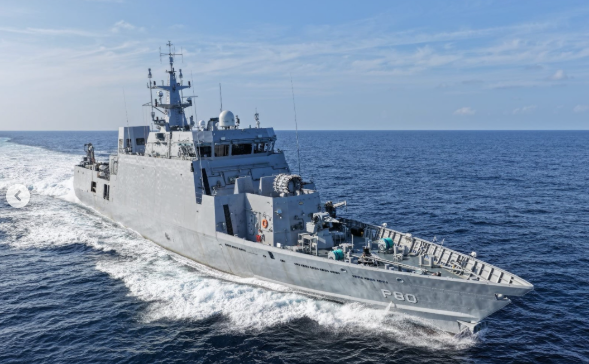
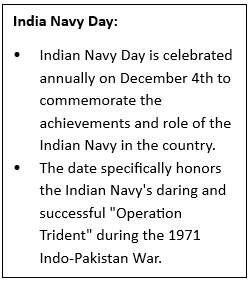
Context: On the Navy Day, the Chief of Naval Staff released the Indian Maritime Doctrine 2025, laying down the principles that govern its strategy, roles and employment across the full spectrum of conflict.
More on the News
- It was first released in 2004, revised in 2009 and amended in 2015; the 2025 edition reflects major shifts in India’s maritime environment and strategic outlook over the past decade.
- The new doctrine aligns closely with India’s vision of Viksit Bharat 2047 and integrates key national initiatives such as Sagarmala, PM Gati Shakti, Maritime India Vision 2030, Maritime Amrit Kaal Vision 2047 and MAHASAGAR.
Key Features of the Indian Maritime Doctrine 2025
- Recognition Grey-Zone warfare:
- IMD-2025 first formally identifies “no-war, no-peace” as a distinct phase between peace and full-scale war in the conflict spectrum.
- It highlights the rising importance of grey-zone tactics, including coercive, hybrid, and sub-threshold maritime actions below war thresholds.
- The doctrine thus responds to modern realities of subtle, ongoing, and ambiguous deterrence rather than overt confrontations.
- Jointness & Tri-Service Integration:
- IMD-2025 emphasizes jointness across India’s armed forces to enable interoperability and unified maritime operations.
- It aligns with recent tri-service doctrines on special forces, airborne/heliborne, and multi-domain operations, preparing for theatre-based commands.
- The shift promotes integrated operations to optimize resources, accelerate decisions, and counter multi-domain threats effectively.
- Focus on Multi-Domain Threats, Emerging Technologies, and Autonomous Systems:
- IMD-2025 broadens the operational theatre to space, cyber, and cognitive domains beyond traditional seas, recognizing multi-domain maritime conflicts.
- It advocates integrating uncrewed systems, autonomous platforms, and advanced tech for asymmetric, technology-led maritime security.
- The doctrine addresses grey-zone, hybrid, and irregular warfare, underscoring the maritime environment’s growing complexity.
Significance of the Doctrine
- Doctrinal Clarity: As the Navy’s principal guidance, it provides clarity on India’s maritime roles and a future-ready framework for capability development and operational readiness.
- Multi-Domain Expansion: The doctrine expands maritime security scope to include cyberspace, space, seabed, cognitive domains, and hybrid warfare, endorsing autonomous and uncrewed technologies to address emerging threats.
- Aligned towards Aatmanirbhar Bharat: It boosts self-reliance through indigenous capability development, technology adoption, and alignment with long-term national security priorities.